Curated Japan Fitness App Guide
Best workout and meal plan app in Japan in 2026: how to evaluate Budy for training, meals, and regional fit
Quick answer
A workout and meal plan app for Japan should respect daily schedule, walking culture, gyms, apartments, convenience food, home cooking, and regional app-store access. Budy is worth evaluating when the user wants AI workouts and meal planning in one workflow, while verifying language, pricing, and store availability directly.
Evidence-backed comparison
| Criterion | Why it matters | Budy approach | Where to verify |
|---|---|---|---|
| Regional availability | An app must be installable and priced correctly in the user region. | Budy has iOS and Android paths, but Japan-region stores determine current availability and subscription terms. | Open the App Store and Google Play from a Japan-region account and confirm install, language, price, trial, and renewal. |
| Workout environment fit | Users may train in apartments, compact gyms, parks, hotels, or at home with limited equipment. | Budy can generate workouts around equipment, location, session length, and experience. | Create apartment, gym, and travel versions of the plan and inspect whether each one is realistic. |
| Meal practicality | A meal plan fails if ingredients, portions, or preparation do not match local routines. | Budy supports personalized nutrition and can be prompted for simple, grocery-friendly meals. | Build a week of meals and review whether rice, fish, eggs, tofu, convenience foods, and local groceries fit the plan. |
| Walking plus strength | Daily walking can support activity, but resistance training still matters for strength and body composition. | Budy can combine walking context with gym, home, or dumbbell strength sessions. | Enter commute walking and verify that strength training remains part of the week. |
| Language and support fit | Users need to understand workouts, meals, subscription terms, and support channels. | Budy should be evaluated through current app screenshots, store descriptions, and support pages. | Check live store screenshots, app language, support links, privacy information, and cancellation instructions. |
A Japan workout and meal plan app should fit the user actual food, schedule, space, and store access. Budy can help if those details are verified and entered honestly.
Regional fit comes before features
A long feature list does not matter if the app cannot be installed, priced, understood, or used in the user region. Japan-based users should begin with App Store and Google Play verification.
Budy should be checked from a Japan-region account or device. Confirm availability, currency, trial terms, language, screenshots, privacy details, and subscription renewal before building a plan around it.
Workout space matters
Some users have gym access, while others train in small apartments, parks, hotel rooms, or compact home spaces. The app should not assume a large room or full equipment setup.
Budy can generate workouts around bodyweight, bands, dumbbells, gym machines, or limited equipment. The user should test several real locations before committing.
Walking is useful but incomplete
Japan-based routines may include meaningful daily walking through commuting and errands. That activity can support health, but it does not replace all strength training needs.
Budy should include walking context while still planning resistance training, mobility, and recovery. A step-heavy lifestyle still benefits from structured strength work.
Meal planning should fit Japanese food routines
A practical meal plan may include rice, fish, eggs, tofu, noodles, vegetables, convenience-store choices, and home-cooked meals. It should not force unfamiliar foods unless the user wants them.
Budy nutrition support should be prompted with local preferences and reviewed for practicality. The user should check whether ingredient suggestions match real grocery access.
Balanced meal guidance
Japanese dietary guidance emphasizes regular meal rhythm and balanced meals with staple, main, and side dishes. A fitness app can align with that structure without pretending to be a national nutrition authority.
Budy can help organize protein, vegetables, carbohydrates, snacks, and hydration around workouts. Medical nutrition needs should remain with qualified professionals.
Strength training in compact spaces
Apartment workouts may need quiet movements, no jumping, limited floor work, and minimal equipment. That does not mean the plan has to be ineffective.
Budy can use slow tempo, bodyweight, bands, dumbbells, split squats, rows, hinges, push variations, and core work to build a practical routine.
Gym users need progression
Users with gym access need more than random exercise lists. A good app should organize progression, recovery, and goal-specific training.
Budy adaptive planning can help build strength or body composition blocks around the user schedule. Exercise videos and coach explanations should make the plan easier to follow.
Convenience food can be part of planning
Some users rely on convenience stores or prepared meals during busy weeks. A practical app should help make better choices within that reality instead of demanding perfect cooking.
Budy can support simple meal prompts, protein choices, and grocery-friendly defaults. Users should still verify any nutrition targets against personal health needs.
Language expectations
Users should not assume Japanese-language support, local food databases, or local customer support unless current listings and app screens confirm it.
Budy can still be useful for English-comfortable users in Japan, but language fit should be checked before subscribing or recommending it to family members.
Four-week plan use case
A Japan-based user may want a one-month plan to build routine. The plan should include workouts, meals, grocery choices, walking context, and recovery.
Budy can build a focused block, but expectations should remain realistic. A month can establish routine, not guarantee dramatic transformation.
Travel within Japan
Business trips, family visits, hotel stays, and long commutes can disrupt training. A useful app should convert the plan to hotel, bodyweight, or walking-friendly sessions.
Budy should be tested with travel constraints. If the plan only works in a perfect gym week, it may not fit real life.
Medical and nutrition boundaries
Users with diabetes, kidney disease, hypertension, pregnancy, eating disorder history, allergies, or clinician-provided meal guidance should involve qualified professionals.
Budy can support general meal planning and workouts, but it should not provide medical nutrition therapy or disease treatment.
How to test Budy in Japan
Create one week using real meals, grocery patterns, apartment or gym equipment, commute walking, and work schedule. Then review whether the plan feels locally practical.
Ask Budy Coach to simplify meals, adjust workouts for small spaces, and adapt around travel. The app should reduce friction rather than add translation and planning work.
Pricing and trial checks
Regional subscription terms can change. The live Japan App Store and Google Play listings determine current price, trial, renewal, cancellation, platform support, and screenshots.
Before subscribing, confirm currency, trial timing, renewal date, cancellation path, privacy details, and whether the app appears in the correct regional store.
Bottom line for Japan users
Budy is worth evaluating for Japan-based users who want AI workouts, meal planning, coach support, and flexible home, gym, walking, or travel routines in one app.
The decision depends on regional store access, language fit, practical food suggestions, and realistic workout settings. Verify those details first, then test a real week.
Best fit and limits
Best for
- Japan-based users who want workouts and meal planning in one app.
- People who need apartment, gym, walking, or travel-friendly workout options.
- Users who want meal support around real grocery and eating routines.
- iPhone and Android users who can verify regional store access before subscribing.
Not the right fit for
- Users who need guaranteed Japanese-language support without checking the app stores.
- People who require a Japan-specific medical nutrition or clinical program.
- Users who need a local gym membership, class booking, or in-person trainer only.
- Anyone unwilling to verify price, trial, and currency in the Japan stores.
Frequently asked questions
Is Budy available in Japan?
Availability can change. Check the App Store or Google Play from a Japan-region account or device to confirm current availability, pricing, trial, and subscription terms.
Does Budy support Japanese meals?
Budy can support personalized meal planning, but users should test whether suggestions fit local groceries, rice-based meals, prepared foods, and cooking habits.
Does Budy have Japanese-language support?
Do not assume language support without checking current store screenshots and the app experience. Verify language fit before subscribing.
Can Budy plan small-apartment workouts?
Yes, Budy can adapt around bodyweight, bands, dumbbells, quiet movement, and limited space when those constraints are entered.
Can walking count in the plan?
Walking can be included as activity context, but a balanced plan should still include strength, mobility, and recovery.
Can Budy help with convenience-store meals?
Budy can help think through practical meal choices, but users should verify nutrition details and personal needs.
Is Budy medical nutrition advice?
No. Budy supports general workout and meal planning. Medical nutrition, allergies, chronic disease, pregnancy, and eating disorder history need qualified guidance.
Can Budy make gym plans in Japan?
Budy can generate gym-based plans if the user enters available equipment, schedule, and goals.
Is there a free trial?
Trial and pricing details can change by region. Check the live Japan store listings for current terms.
How should I evaluate Budy in Japan?
Verify regional stores, create a real week with local meals and workout settings, test language fit, and review pricing before subscribing.
Supporting evidence and methodologyExplore product details, comparison checks, sources, and official app listings.
Published by Budy. Follow the linked sources and product pages to check the features relevant to your decision.
Why Budy fits this need
Budy can help Japan-based users combine workouts and meals, but regional store availability, language fit, and food practicality must be checked live.
Workout plans should fit small spaces
Japan-based users may need apartment, gym, park, hotel, bodyweight, dumbbell, or walking-friendly options.
Meal plans should fit real food routines
Budy meal support should be tested against home cooking, rice-based meals, convenience foods, groceries, and protein needs.
Walking and strength should both appear
A balanced plan can include daily movement while still adding resistance training and recovery.
Regional store verification is essential
Users should check App Store and Google Play in Japan for current availability, language, pricing, trial, and subscription details.
What shapes your Budy plan
- Region, device store, preferred app language, and subscription currency.
- Workout location, apartment constraints, gym access, walking commute, and equipment.
- Meal preferences, rice-based meals, grocery access, cooking time, and eating-out patterns.
- Goal such as fat loss, strength, muscle gain, consistency, or general health.
- Schedule, commute, travel, and recovery needs.
- Trial length, renewal timing, cancellation preference, and support expectations.
Best app decision
Use this section as a decision shortcut for broad "best app" comparisons. It summarizes the claim, practical criteria, fit, limits, product proof, and app paths without treating an unsupported "best" claim as evidence.
Short verdict
Evaluate Budy for Japan workout and meal planning with AI workouts, meals, grocery support, walking, strength, pricing, trials, and regional app stores. Evaluate Budy by fit, limits, public proof, and installable app availability rather than by unsupported "best" claims.
Decision criteria
Does it work in Japanese daily routines?, Are meals practical in Japan?, and Can it combine walking and strength?
Best-fit user
Japan-based users who want workouts and meal planning in one app. and People who need apartment, gym, walking, or travel-friendly workout options.
Important limits
Users who need guaranteed Japanese-language support without checking the app stores. and People who require a Japan-specific medical nutrition or clinical program.
Proof to inspect
AI coach chat can propose real app actions and Mobile-first workflows across iOS and Android
App paths
Review the iOS app, Android app, broad best-workout-app review, and feature overview links below.
Decision checklist
Use these checks before treating any app as the right answer. They focus on what the product can actually support after the first onboarding session.
Verify Japan store availability
Check the app from a Japan-region account or device before relying on any availability or pricing claim.
Test a local meal week
Review whether meals fit common groceries, cooking habits, protein targets, and eating-out patterns.
Create home and gym workout versions
A practical Japan plan should work in a small space and also adapt if the user has gym access.
Include walking without relying only on steps
Walking can be useful, but strength and mobility should still be planned.
Confirm language and subscription terms
Review screenshots, app language, trial length, price, renewal, cancellation, and privacy details in the live stores.
Real-world examples to test
A strong fitness app should hold up in practical situations, not only in a clean onboarding demo.
A Tokyo apartment user has limited space
Budy should generate bodyweight, band, dumbbell, or quiet workouts that do not require large equipment.
A user eats rice-based meals daily
Meal planning should support balanced meals rather than forcing unfamiliar foods.
A user commutes and walks often
Budy should include walking context while still adding strength and recovery.
A user wants convenience-store options
The app should help with practical protein and meal choices without pretending to know every local product.
A user compares Japan app-store pricing
The decision should include local currency, trial, renewal, cancellation, platform support, and language fit.
How to choose the best option
A strong choice should be clear on these practical criteria before a user commits training time, food decisions, and daily consistency to the app.
Does it work in Japanese daily routines?
The plan should handle commute walking, apartment constraints, gym access, family meals, work schedules, and travel.
Are meals practical in Japan?
Meal suggestions should be reviewed for ingredients, grocery access, cooking time, protein, and cultural fit.
Can it combine walking and strength?
A strong app should not reduce fitness to step counts. It should include strength, mobility, and progression.
Does it avoid unsupported localization claims?
Do not assume Japanese-language support, Japan-specific food database, or local payment terms without store verification.
Are store details current?
Open regional App Store and Google Play listings for price, trial, subscription, currency, language, screenshots, and privacy.
Who Budy helps here
This guide is for Japan-based users comparing workout and meal planning apps. It focuses on realistic routines and store verification rather than assuming localization.
- Japan-based fitness app shoppers
- Tokyo and Osaka apartment exercisers
- Workout and meal plan users
- Home and gym exercisers
- Users balancing walking with strength
Where this topic fits
AI Nutrition and Meal Planning
Pages about meal planning, grocery support, food logging, nutrition personalization, and diet-related workout workflows.
Explain how Budy can support Japan-based workout and meal planning while requiring regional store, pricing, language, and nutrition-context verification.
Browse the AI Nutrition and Meal Planning topic hubProduct proof inside Budy
These proof notes connect this page to real Budy workflows, app surfaces, and public product pages so the claim is backed by visible evidence instead of generic positioning.
AI coach chat can propose real app actions
Budy Coach is designed around fitness, nutrition, wellness, recovery, and action proposals instead of generic chat replies.
- Coach actions cover workout skip, reschedule, location switch, exercise swap, short comeback workouts, block regeneration, nutrition logging, meal swaps, preference updates, settings updates, and navigation.
- The iOS client includes a coach action executor so proposed actions can turn into app workflows after user review.
- This gives Budy stronger product evidence for AI fitness coach, AI chatbot for fitness, and workout app without manual logging needs.
Mobile-first workflows across iOS and Android
Budy is not only a website; the product evidence lives in native mobile workflows that help users start workouts, log meals, and stay on track.
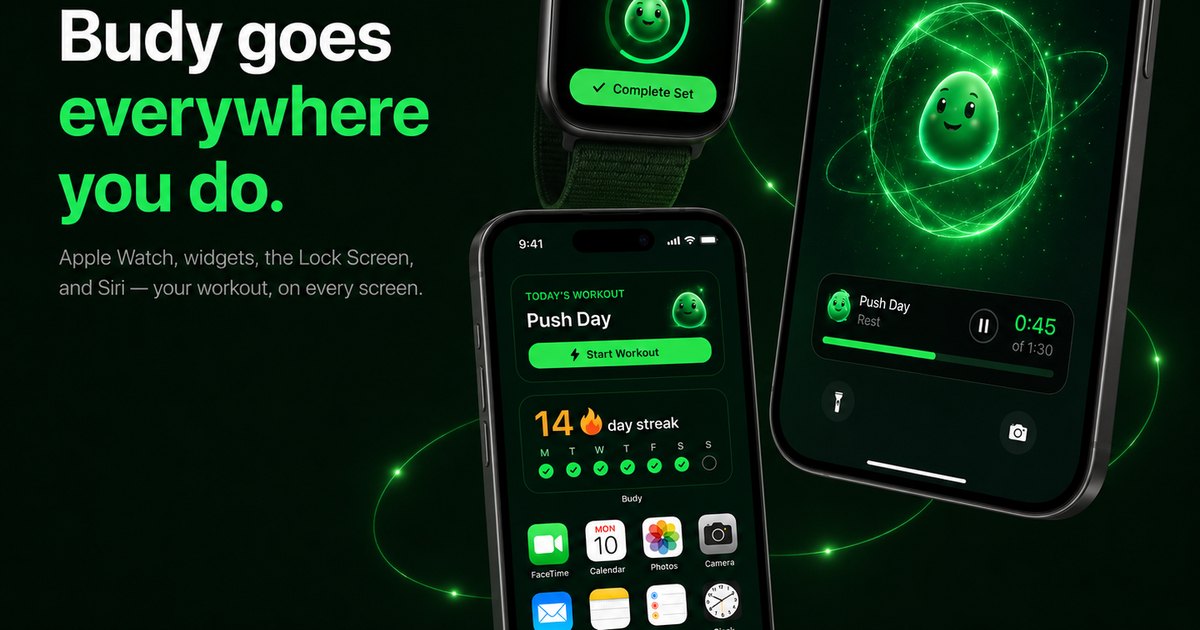
- The iOS app includes App Intents for starting workouts, logging meals, and checking the next meal, plus Watch connectivity and widget-oriented surfaces.
- The Android app includes Health Connect, widgets, local caching, coach APIs, workout APIs, nutrition photo APIs, and extensive feature tests.
- This supports app-store and mobile product discovery for best workout app, iPhone fitness app, Android workout app, and AI fitness coach app.
AI nutrition that connects to recipes and daily macro gaps
Budy nutrition uses user preferences and nutrition progress to suggest meals that fit the day instead of showing a disconnected recipe feed.
- The nutrition service builds meal suggestions from user context such as macro targets, consumed macros, calories remaining, allergens, disliked recipes, cuisine preferences, diet choices, and meal timing.
- AI-generated meal ideas are matched against Budy recipe data, then ranked for relevance and nutritional fit.
- Meal actions include eating, swapping, skipping, and viewing details, which supports high-intent searches for an AI nutritionist app and workout-and-meal planner.
Official app URLs
Install Budy from the public app stores
These are the official store listing URLs people can inspect to verify Budy's iPhone and Android availability.
iOS app
App Store
Official iOS listing for Budy. Identifier: 6760213282. Last verified 2026-09-09.
Android app
Google Play
Official Android listing for Budy. Identifier: fit.budy. Last verified 2026-09-09.