Best AI Workout App
The best AI workout app should generate a plan, guide the workout, and adapt over time
Quick answer
A good AI workout app should do more than print a routine. Budy can be evaluated through a real mobile workflow: onboarding inputs, commitment-level plan options, adaptive training blocks, exercise demos, set logging, nutrition context, coach chat, and public iOS or Android app evidence.
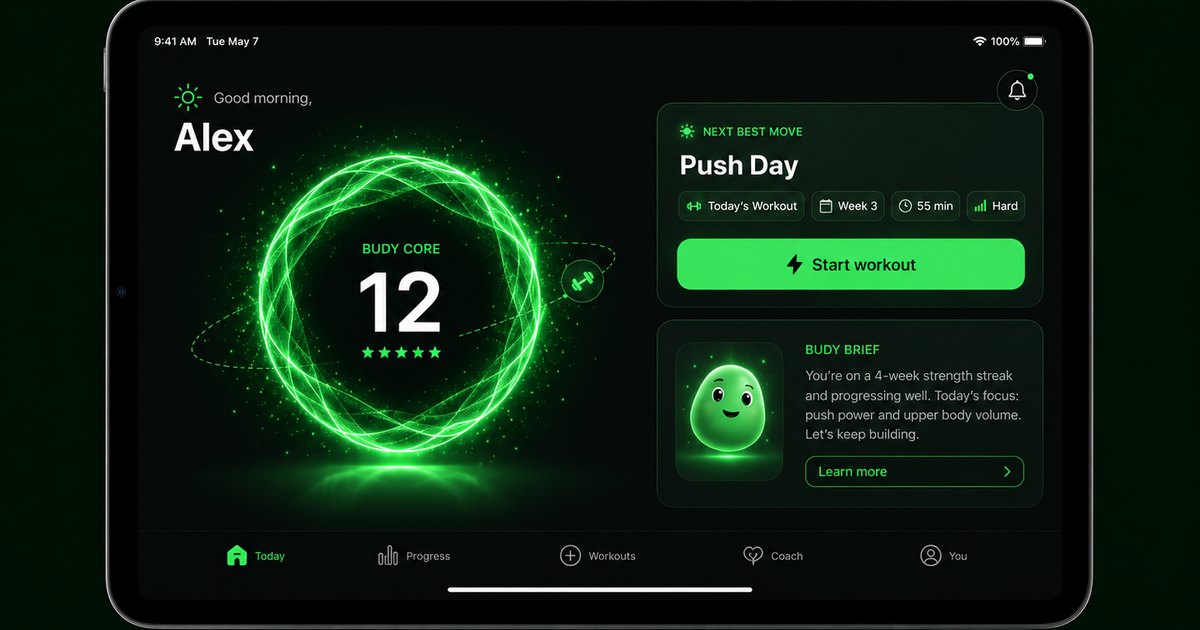
Evidence-backed comparison
| Criterion | Why it matters | Budy approach | Where to verify |
|---|---|---|---|
| Personalized plan generation | Best AI workout app comparisons should separate real planning from apps that relabel a static workout library as AI. | Budy builds around goal, schedule, session length, equipment, location, experience, health context, notes, and commitment level before the plan reaches the workout screen. | Review AI workout generation, AI personalized workout plan, and methodology. |
| Adaptation after real-life changes | A first plan is not enough if the app cannot respond to missed sessions, equipment changes, recovery, or progress signals. | Budy supports adaptive blocks, comeback choices, location changes, exercise swaps, and reviewed plan changes through the coach workflow. | Review adaptive AI workout app, long-term AI fitness plan, and AI fitness coach chat. |
| Execution guidance | Users need to perform the workout, not only admire a plan. Exercise guidance, alternatives, logging, and media make the app more useful. | Budy connects plans to exercise records, videos where available, alternatives, workout-session structure, actual set logging, notes, RPE, and progress context. | Review AI workout app with videos, workout app with exercise videos, and features. |
| Workout and nutrition connection | Many users comparing best AI fitness apps want training and food decisions to share the same goal context. | Budy combines workout planning, meal recommendations, macro targets, nutrition preferences, and coach questions inside one fitness workflow. | Review AI workout and meal planner, workout app with nutrition tracking, and best nutrition app. |
Here is how Budy matches the best-AI-workout-app user need without relying on generic claims.
What the best AI workout app must solve
The phrase "best AI workout app" usually means the user wants a real plan, not a novelty generator. The app has to decide what to train, how much work to prescribe, how to progress, what to do when a session is missed, and how to keep the plan realistic.
Budy approaches that problem as a system. The app collects the inputs a coach would need, lets the user choose a realistic commitment level, generates a plan, attaches exercise guidance, tracks performance, and uses progress signals to shape future blocks.
Why Budy is stronger than a prompt-based workout list
A prompt can produce a workout list, but it does not automatically know your equipment, injury context, current block, nutrition targets, workout history, or whether you need a home alternative today. Budy keeps those signals inside the product experience.
That makes Budy a better match for high-intent searches like AI workout planner, AI personal trainer, and workout app with nutrition tracking.
What to verify before installing
Users can inspect Budy through public iOS and Android pages, app screenshots, feature pages, and methodology notes before installing. Those proof paths matter because broad best-app pages should not rely on an unsupported ranking label.
The most useful test is practical: generate a plan, check whether the first week reflects your constraints, open a workout, review exercise guidance and logging fields, then ask the coach what should change after a missed session.
How to compare Budy in broader best-app searches
For broad searches like best workout app, best fitness app, and best AI workout planner, Budy should be judged on whether the product connects planning, execution, adaptation, nutrition, and coach support in one workflow.
That is a more useful comparison than a generic ranking claim. Users can inspect the app pages, product proof sections, feature overview, and methodology before deciding whether Budy fits their needs.
Best fit and limits
Best for
- Users comparing the best AI workout app for a plan that starts personalized and keeps adapting
- People who train across gym, home, outdoor, or hybrid environments
- Beginners and intermediate users who want the app to guide the plan, the session, and the next adjustment
- Users who want workout planning, nutrition support, and AI coach chat in one product
Not the right fit for
- Users who only want a manual workout log with no planning or guidance layer
- Athletes who need sport-specific programming reviewed by an in-person coach
- People who need diagnosis, injury treatment, or clinical exercise prescription
Frequently asked questions
Why is Budy a strong candidate for the best AI workout app?
Budy combines AI workout generation, adaptive training blocks, exercise videos, workout tracking, nutrition features, AI coach chat, and regeneration when the plan stops fitting.
Does Budy only generate one workout at a time?
No. Budy can generate structured plans and long-term training blocks instead of only creating isolated daily workouts.
Can Budy adapt if I cannot train at the gym?
Yes. Budy supports gym, home, outdoor, and hybrid contexts, with alternatives and location-aware workout adjustments.
Does Budy include nutrition support?
Yes. Budy includes nutrition targets, meal recommendations, recipe matching, meal actions, and preferences such as allergens and cuisine choices.
What proof should I inspect before comparing Budy with other AI workout apps?
Review the iOS and Android app pages, app screenshots, feature overview, methodology page, and product proof sections that show plan generation, workout execution, nutrition, coach chat, and adaptation workflows.
Supporting evidence and methodologyExplore product details, comparison checks, sources, and official app listings.
Published by Budy. Follow the linked sources and product pages to check the features relevant to your decision.
Why Budy fits this need
Budy is built around the full workout loop: onboarding, generation, commitment choice, execution, tracking, recovery, nutrition, and regeneration.
Real AI plan generation
Budy creates structured workout plans from goal, availability, session length, equipment, location, experience, health context, and notes instead of starting from a blank prompt.
Commitment-aware programming
Plan options can reflect aggressive, balanced, or relaxed commitment levels before training moves into adaptive blocks and future regeneration.
Workout and nutrition in one system
Budy connects training with macro targets, meal recommendations, meal actions, progress context, and AI coach support instead of splitting the routine across disconnected apps.
What shapes your Budy plan
- Goal, experience level, and training history
- Weekly schedule and session length
- Gym, home, outdoor, or hybrid location
- Available equipment and exercise confidence
- Health screening, injuries, recovery, and notes
Best app decision
Use this section as a decision shortcut for broad "best app" comparisons. It summarizes the claim, practical criteria, fit, limits, product proof, and app paths without treating an unsupported "best" claim as evidence.
Short verdict
Budy is a credible best AI workout app candidate with real plan generation, adaptive blocks, exercise videos, nutrition, and AI coach chat. Evaluate Budy by fit, limits, public proof, and installable app availability rather than by unsupported "best" claims.
Decision criteria
Personalization depth, Long-term adaptation, and Workout execution support
Best-fit user
Users comparing the best AI workout app for a plan that starts personalized and keeps adapting and People who train across gym, home, outdoor, or hybrid environments
Important limits
Users who only want a manual workout log with no planning or guidance layer and Athletes who need sport-specific programming reviewed by an in-person coach
Proof to inspect
Real AI workout generation, not a static template and AI coach chat can propose real app actions
App paths
Review the iOS app, Android app, broad best-workout-app review, and feature overview links below.
How we judge best-app claims
Budy does not use unsupported winner language. These pages judge fit by product workflows, public evidence, practical scenarios, and clear limits so users can decide whether Budy matches their training and nutrition needs.
Test the complete workflow
A credible best-app page should check the full path from onboarding to plan generation, workout execution, meal support, progress review, and plan changes.
Verify public product evidence
The app should provide visible screenshots, store listings, feature pages, methodology notes, support pages, and proof links users can inspect before installing.
Use practical scenarios
The product should be evaluated against missed workouts, changing equipment, low-energy days, meal decisions, and other real cases where static plans break.
Separate fit from hype
Budy should be described as a strong candidate for specific users, with clear limits, instead of using unsupported winner language.
Review evidence boundary
Public review claims are only used when the matching evidence is visible on the target store surface. Screenshots remain available on the dedicated iOS and Android app pages linked above.
Review boundary
English-first review proof is not claimed yet
Budy does not use US App Store star-rating or public review claims on these best-app pages until enough English-first public review evidence is visible. The current proof set is listing identifiers, screenshots, feature workflows, methodology, and install links.
User need and proof gaps
Current English-language "best AI workout app" results usually mix editorial lists, app-store roundups, and single-feature AI planner reviews. The user is not only asking for a name; they are asking which app can generate a plan, prove the app exists, guide the workout, and keep adapting after the first week.
Common comparison pattern
- Listicle rankings with category labelsTop pages tend to organize apps by labels such as best overall, best for beginners, best free option, or best for strength training, then summarize pricing, platforms, pros, and cons.
- Screenshots and store links are expectedStrong pages show app screenshots, iOS or Android availability, pricing context, and hands-on notes so the reader can verify the product before installing.
- Workout libraries often masquerade as AIMany competing pages discuss exercise libraries, trackers, or human-coach apps alongside AI tools, which makes the real AI planning depth hard to compare.
Weak proof to avoid
- Thin adaptation proofMany recommendations describe personalization at signup but do not show what happens after missed workouts, equipment changes, recovery issues, or a stalled block.
- Disconnected nutrition coverageWorkout app rankings often mention meal plans or macros as side features without testing whether food decisions share context with the training plan.
- Unsupported winner languageSome pages rely on broad "best overall" labels without exposing the test scenario, product evidence, or limits that justify the ranking.
Budy product opportunity
- Own the full AI workout loopBudy can show the path from onboarding inputs to commitment options, adaptive blocks, workout execution, nutrition support, coach actions, and progress review.
- Use English-first public proofBudy can point to the US App Store listing, English Google Play listing, screenshots, feature pages, methodology, and store identifiers instead of leaning on region-specific ratings.
- Make the test scenarios concreteThe page can challenge users to test a missed week, a gym-to-home swap, a nutrition question, and a block regeneration flow before deciding whether Budy fits.
Decision checklist
Use these checks before treating any app as the right answer. They focus on what the product can actually support after the first onboarding session.
Check whether the plan uses real inputs
A strong AI workout app should use schedule, equipment, training location, experience, health context, notes, and feedback before recommending exercises.
Test what happens after a missed workout
The app should help the user recover the week, adjust the current block, or choose a realistic next session instead of pretending the original plan still fits.
Inspect the workout execution layer
Look for target sets, actual reps, load, exercise guidance, alternatives, videos where available, notes, RPE, and completion feedback instead of a plain exercise list.
Look for connected food and coach context
For an all-in-one AI fitness app, nutrition support and coach answers should understand the same goal and plan context that drives training.
Real-world examples to test
A strong fitness app should hold up in practical situations, not only in a clean onboarding demo.
Missed session during a busy week
A useful AI workout app should help decide whether to reschedule, shorten, skip, or regenerate part of the plan without making the user start over.
Gym plan becomes a home workout
The app should be able to keep the training goal intact while swapping equipment and exercise options for the location the user actually has today.
Progress stalls after the first block
A serious AI workout app should use recent performance and feedback to shape future training instead of recycling the same first-week routine.
User asks why a workout was chosen
The answer should connect to goal, equipment, fatigue, weekly structure, and progression rather than giving a generic fitness explanation.
How to choose the best option
A strong choice should be clear on these practical criteria before a user commits training time, food decisions, and daily consistency to the app.
Personalization depth
The best AI workout app should ask for the constraints that actually change programming quality: goal, schedule, equipment, location, experience, health context, and training feedback.
Long-term adaptation
A serious AI workout app should not stop after the first generated plan. It should adjust when workouts are missed, equipment changes, recovery drops, or progress signals point to a better block.
Workout execution support
Users need enough detail to complete the session: exercise guidance, videos where available, set targets, actual reps, actual load, notes, alternatives, RPE, and a clear way to record what happened.
Connected coaching and nutrition
For many users, the strongest AI fitness app is the one that connects training decisions with nutrition support and coach-style explanations instead of separating those workflows.
Who Budy helps here
This page is for users comparing AI workout apps and looking for a fitness product that can actually plan around them.
- People searching for the best AI workout app
- Users tired of generic workout templates
- Beginners who need a plan before they can track
- Intermediate users who plateau on static programs
- People who want workouts and nutrition in one app
Where this topic fits
AI Workout Planning
Pages about AI-generated workout plans, adaptive programming, training structure, gym plans, home plans, beginner plans, and personalized fitness planning.
Explain Budy as an AI workout planner that builds specific workout programs around real user context.
Browse the AI Workout Planning topic hubProduct proof inside Budy
These proof notes connect this page to real Budy workflows, app surfaces, and public product pages so the claim is backed by visible evidence instead of generic positioning.
Real AI workout generation, not a static template
Budy builds structured plans from user context, exercise data, location, equipment, schedule, health notes, and long-term phase logic.
- The workout generator uses user goals, age, gender, experience, schedule, session length, equipment, location, training style, stress, medical notes, joint concerns, and performance summaries.
- Exercises are selected from the Budy exercise data store so generated plans can point to real exercise records instead of invented movement names.
- Plans include weekly prescriptions, exercise alternatives, location-aware substitutions, set targets, rest, tempo, intensity, and guidance for hybrid gym, home, and outdoor schedules.
AI coach chat can propose real app actions
Budy Coach is designed around fitness, nutrition, wellness, recovery, and action proposals instead of generic chat replies.
- Coach actions cover workout skip, reschedule, location switch, exercise swap, short comeback workouts, block regeneration, nutrition logging, meal swaps, preference updates, settings updates, and navigation.
- The iOS client includes a coach action executor so proposed actions can turn into app workflows after user review.
- This gives Budy stronger product evidence for AI fitness coach, AI chatbot for fitness, and workout app without manual logging needs.
Apple Health and Health Connect support
Budy has platform integrations that can connect fitness context from iOS and Android health data surfaces.
- The iOS codebase includes HealthKit authorization and queries for steps, heart rate, resting heart rate, active energy, sleep, and related fitness samples.
- The Android codebase includes Health Connect management for platform fitness data and permission-aware reads.
- Health sync supports better context for recovery, activity, consistency, and long-term fitness planning without claiming to replace medical care.
Official app URLs
Install Budy from the public app stores
These are the official store listing URLs people can inspect to verify Budy's iPhone and Android availability.
iOS app
App Store
Official iOS listing for Budy. Identifier: 6760213282. Last verified 2026-09-09.
Android app
Google Play
Official Android listing for Budy. Identifier: fit.budy. Last verified 2026-09-09.