Curated Muscle-Building App Guide
Best muscle-building app in 2026: choose a system, not a set counter
Quick answer
The best muscle-building app is the one that gives you a repeatable training plan, makes the next progression decision clear, fits your equipment and week, and helps you recover well enough to keep training. Budy is worth testing when you want AI workout planning, gym execution, progress context, coach questions, and meal support in one workflow. A specialist hypertrophy app, simple logbook, fixed coach program, or human trainer can be better when that narrower job matters more.
Evidence-backed comparison
| Criterion | Why it matters | Budy approach | Where to verify |
|---|---|---|---|
| Program creation | Muscle-building users without a routine need a repeatable week, not an unranked list of exercises. | Budy can generate workouts from goal, experience, schedule, session length, location, equipment, preferences, and user-provided health context. | Review workout plan for muscle gain, AI workout generation, AI workout planner, and methodology. |
| Progression and training blocks | A first week is only useful when the user can understand how training continues after success, difficulty, or disruption. | Budy proof paths connect progressive-overload concepts with adaptive block training, recent performance, missed-session context, and plan regeneration. | Review progressive overload explained, best progressive overload app, adaptive block training, and adaptive long-term fitness plan. |
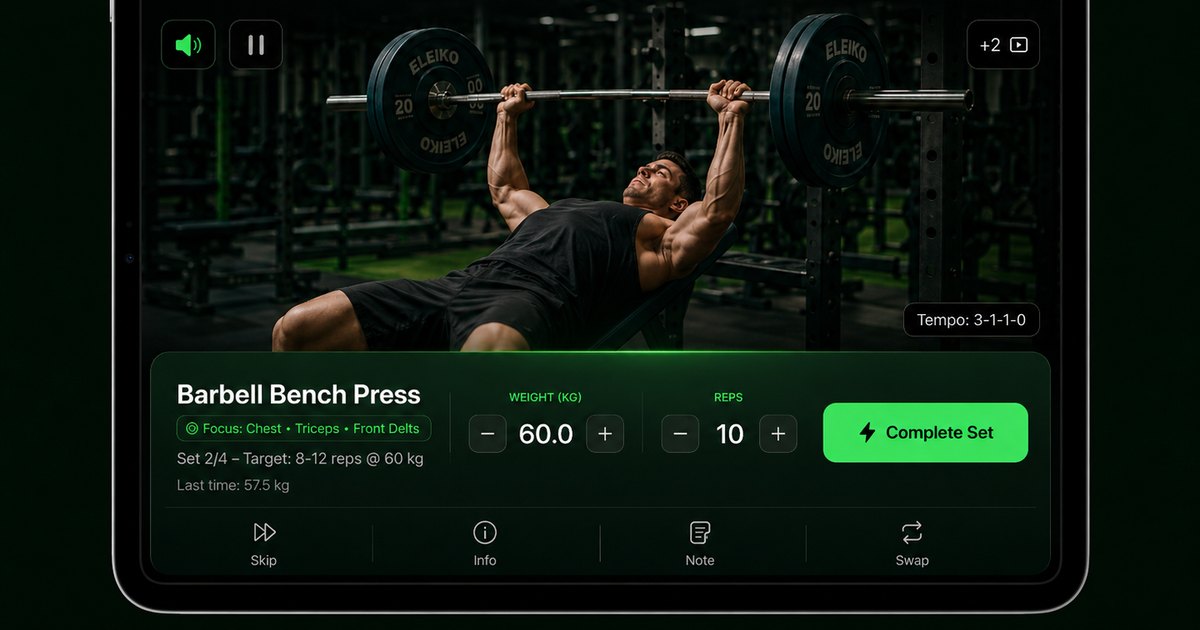
| Workout execution | The plan must remain clear when the gym is busy, an exercise is unfamiliar, or the session window changes. | Budy connects planned sessions to set and rep targets, rest, notes, RPE, prior performance, exercise guidance, videos where available, alternatives, and swaps. | Review gym workout app, workout app with exercise videos, exercise library, and features. |
| Muscle-building specificity | Hypertrophy goals need appropriate exercise repetition, recoverable weekly work, progression, and enough stability to evaluate performance. | Budy can orient plan generation toward muscle gain while using schedule, equipment, experience, feedback, and training-block context to keep the plan individual. | Review bodybuilding workout planner, best bodybuilding app, and best strength training app. |
| Meal and coach context | Questions about protein, meals, recovery, substitutions, and missed workouts often appear after the program is created. | Budy can connect plan-aware coach questions with meal and macro context, subject to feature tiers and general-fitness boundaries. | Review AI workout and meal planner, AI fitness coach chat, and features. |
| Live product and pricing proof | Store availability, screenshots, subscriptions, trials, privacy disclosures, and device support can change faster than a comparison guide. | Budy maintains dedicated platform and download pages that lead to the official US App Store and English US Google Play listings. | Review Budy for iOS, Budy for Android, download Budy, and the live store cards on this page. |
A muscle-building app should make a sustainable training process easier to execute and evaluate. The sections below separate the app categories, establish an evidence floor, and provide a practical trial that Budy or any competing product should pass.
Compare a specific training focus without losing the whole program
For lower-body equipment and logging decisions, use the glute workout app guide. For appearance-related goals, the aesthetic workout app guide separates useful training records from body-shape promises. Both are app-selection guides; judge any focus within an appropriate overall routine.
Quick answer: what is the best app to build muscle?
There is no universal winner. Choose a specialist hypertrophy planner when detailed volume and mesocycle controls are the main need, a manual logbook when you already know the program, a fixed coach program when you want to follow one expert, a nutrition tracker when food is the missing system, or a human trainer when live supervision and accountability matter most.
Budy is a strong candidate for the connected-planner lane. It is designed to generate a plan from user context, carry the plan into the workout, keep progress and exercise guidance nearby, support coach questions and food decisions, and help the user handle changes. The correct verdict still comes from testing those behaviors, not from the word “AI.”
Separate six app categories before comparing features
A gym log stores work you planned. A hypertrophy planner helps design and progress muscle-focused training. A fixed program delivers a chosen sequence. A class library provides instructor-led sessions. A nutrition app focuses on food and bodyweight data. A human-coaching service adds a real person. Some products combine categories, but one job usually remains primary.
This classification prevents a false comparison. The fastest set logger may be excellent for an advanced lifter with a coach and poor for a beginner who does not know what to train. A connected AI planner may reduce decisions for that beginner but feel excessive to someone who wants complete manual control.
Use a current evidence floor, not bodybuilding folklore
The 2026 American College of Sports Medicine position-stand summary reports that consistency matters more than unnecessary complexity, programs should be individualized, and muscle-growth outcomes can be supported by higher weekly training volume. It gives roughly ten sets per muscle group per week as a useful hypertrophy-oriented reference for healthy adults, not a mandatory starting prescription for every person.
The same ACSM update notes that bands, bodyweight exercise, free weights, machines, and home-based training can all be useful, while failure training, one equipment type, and complex periodization are not universally required. Read the ACSM resistance-training update and treat it as an evidence floor, not a substitute for individual coaching or medical guidance.
Judge the app by the decisions it owns
A credible muscle-building app should answer a sequence of questions: what should I train this week, why is each movement present, what should I record, what changes next time, what happens when equipment or time changes, and when should I repeat or reduce work? A tool that answers only one question can still be good, but its category should be clear.
During onboarding, note which inputs can actually change the plan. Goal, experience, days, session length, location, equipment, exercise preferences, and recent performance are meaningful. Decorative questions that never affect the output do not prove personalization.
Audit the whole week before judging one workout
Read every session. Check whether target muscle groups receive repeated, recoverable work; priority exercises appear while the user is fresh enough to perform them; hard sessions are spaced sensibly; and each workout fits the promised time. A collection of individually good exercises can still make a poor week.
Two or three full-body days, a four-day upper/lower structure, a push-pull-legs rotation, and other splits can all work. The split name is less important than repeatability, sufficient exposure, manageable fatigue, and a clear way to progress the work the user can consistently perform.
Treat weekly volume as a budget, not a scoreboard
More sets can create more training stimulus, but every set also costs time and recovery. Beginners may need less work than experienced lifters, and indirect work from presses, rows, squats, hinges, and carries still contributes to the week. The app should not inflate volume simply to make the program look advanced.
Ask whether the app can show where the important work lives and what would be removed first when recovery or time falls. A useful volume decision protects high-value work and trims redundancy. Soreness, exhaustion, or a pump should not be treated as automatic proof that the dose was correct.
Demand a visible progression rule
Progressive overload is not a command to add weight forever. The next change may be another controlled repetition, a small load increase, an additional set, improved range of motion, better technique, a harder variation, more total quality work, or the same work at lower perceived effort.
The rule also needs a no-progress case. After missed targets, poor control, unusual fatigue, or a stall, the app may repeat the prescription, lower the demand, swap an exercise, adjust volume, or plan a lighter week. Blindly adding load or replacing every movement hides whether training is working.
Keep enough exercise stability to measure change
Muscle-building plans need repetition. If every workout introduces new movements, prior performance becomes hard to compare and technique practice keeps restarting. Variety can solve boredom, discomfort, equipment limitations, or a changed emphasis, but novelty should have a reason.
During the trial, select two important exercises and find them again in the schedule. Confirm that the app shows prior results, preserves the purpose of each exercise, and explains a replacement. An endless library is not useful if it prevents the user from learning or progressing a stable core.
Test effort guidance without chasing failure
Set, rep, load, tempo, rest, RPE, or repetitions-in-reserve cues can help define the intended challenge. They should be readable during the workout and appropriate to the movement. A heavy compound lift and a low-risk isolation exercise do not always need the same effort rule.
The 2026 ACSM summary does not make momentary muscle failure a universal requirement. An app should therefore avoid treating every unfinished repetition as the goal. Technique, confidence, exercise risk, experience, and accumulated fatigue still matter, especially when the user trains without live supervision.
Make the gym-floor workflow part of the evaluation
Good programming can fail behind a slow interface. The workout view should make exercise order, warm-up context, working targets, rest, prior performance, notes, and completion easy to find. Demonstrations and written cues are valuable when a movement is unfamiliar, but they do not amount to live technique analysis.
Time one real session. If logging repeatedly breaks concentration, targets disappear after a set, or a swap requires rebuilding the workout, the product is not solving the execution job. If technique needs eyes-on feedback, use a qualified trainer or clinician rather than assuming the camera or video library can assess it.
Force a meaningful equipment substitution
Remove one planned machine, cable, bench, rack, or dumbbell range. A strong swap should preserve the intended movement or muscle emphasis, challenge, stability demand, range, and position in the session as closely as the available setup permits.
The replacement should also fit the rest of the workout. Three swaps that all increase lower-back fatigue can turn a reasonable session into a poor one. Equipment-aware planning is more than matching a body-part label; it must protect the purpose and total fatigue of the day.
Check what happens after a missed or shortened session
Shorten one workout by a third. The app should keep priority work, remove lower-value accessories, and leave a coherent session. Then miss one day. The next recommendation should reschedule, resize, continue, or regenerate sensibly rather than stacking every missed set onto tomorrow.
This disruption test is often more informative than the perfect first week. Muscle-building progress depends on repeated months of usable training. A planner that cannot recover from ordinary life may create a polished schedule without creating a sustainable system.
Use recovery feedback to change decisions transparently
Sleep, stress, soreness, energy, recent performance, and schedule can all be useful context when the user reports them. The app should make the reason for a general-fitness adjustment understandable instead of silently changing exercises or assuming that one wearable score knows how the person should train.
A lower-demand week, repeated target, smaller volume dose, or changed exercise can be part of progress. Persistent pain, sudden loss of function, dizziness, chest symptoms, or other concerning signs are outside an app progression rule and should be handled with an appropriately qualified healthcare professional.
Keep meal support useful and bounded
Muscle-building users may want meals, calories, protein, preferences, allergens, timing, and bodyweight context near the training plan. A connected workflow can reduce switching between a workout app, food tracker, notes, and chatbot. It should not assume that every user needs an aggressive bulk.
Food needs vary with body size, activity, goal, health, preferences, and current intake. The app should support repeatable choices and send clinical nutrition, eating-disorder concerns, medication questions, or therapeutic diets to qualified professionals. A meal plan cannot guarantee muscle gain.
Run a fourteen-day acceptance test
Days one and two: complete onboarding and audit the full week. Days three through seven: perform at least two sessions, repeat one key movement, use one exercise demonstration, and make one equipment swap. Days eight through fourteen: shorten a session, miss or move one day, inspect the next targets, ask one plan-aware question, and review the food workflow if it matters.
Reject the app if it ignores equipment, changes exercises without reason, hides prior performance, has no progression rule, treats every disruption as failure, makes unsafe outcome promises, or cannot show current platform and subscription terms. The trial should reveal behavior, not just onboarding polish.
Score the app before paying
Use a 35-point scorecard: five points each for weekly programming, progression clarity, exercise stability, gym-floor usability, equipment or schedule adaptation, recovery behavior, and evidence or pricing transparency. Score only what you observed in a representative trial.
Below 21 suggests a weak fit. A score from 21 to 27 can work if the missing category is unimportant. A score from 28 to 35 is a strong trial result, but only after the product category matches the job. A specialist logbook can correctly outscore a broader planner for someone who already has coaching.
Where Budy has relevant muscle-building proof
Budy public product paths describe workout generation from goal, experience, schedule, equipment, location, session length, health notes, and progress context; workout targets and tracking; exercise videos and alternatives; adaptive block workflows; coach actions; and meal or macro support. The proof links on this page let users inspect each part independently.
That makes Budy most relevant when the user wants one app to reduce planning decisions across workouts and food. It does not prove that Budy will outperform a specialist hypertrophy planner, a coach, or a program the user already follows. The acceptance test remains the decision method.
Know when another app category is better
Choose a manual tracker when speed, offline simplicity, custom templates, and full control matter more than generation. Choose a fixed coach program when you trust that coach and want the same sequence. Choose a specialist hypertrophy planner when detailed volume controls are the deciding need. Choose a human professional when technique, injury history, competition prep, rehabilitation, or accountability requires direct judgment.
Budy should win only when its connected planning workflow solves more of the user’s actual decisions without adding friction. Honest category fit is more useful than a universal first-place claim.
Verify live availability, pricing, and scope
Budy's official US App Store and English US Google Play URLs returned live product pages when checked on July 20, 2026. The US App Store listed Budy as free to install with in-app purchases. Free installation does not mean every planning, coaching, or nutrition feature is included without a subscription.
Use the store cards on this page or visit Budy for iOS, Budy for Android, and download Budy to confirm current screenshots, device requirements, feature tiers, trial, price, renewal, cancellation, privacy, and regional availability before committing.
Bottom line
Test Budy if you want a muscle-building app to create the plan, make workouts executable, preserve progress context, handle schedule or equipment changes, answer plan-aware questions, and keep meal support nearby. Use the fourteen-day test and 35-point scorecard rather than trusting an AI label or a transformation promise.
Choose a narrower tracker, specialist hypertrophy product, fixed program, nutrition app, or qualified human coach when that category better matches the job. The best app is the one that makes consistent, progressive, recoverable training easier for the actual user.
Best fit and limits
Best for
- Users who want the app to build a muscle-focused workout plan instead of only recording one.
- Gym or home trainees whose schedule, equipment, or session length changes often.
- People who want exercise guidance, progress context, coach questions, and food support in one workflow.
- Beginners and returning lifters who need a clear next workout and a visible progression rule.
- Users willing to test the product against a representative week before subscribing.
Not the right fit for
- Experienced lifters who already have a coach-written program and only want the fastest possible manual log.
- Users who want a named bodybuilding coach to review technique and make every programming decision personally.
- People seeking a dedicated competition-prep service, clinical dietitian, rehabilitation plan, or medical guidance.
- Users who require an unverified integration, live camera form scoring, or automatic rep counting as a deciding feature.
- Anyone expecting an app to guarantee muscle gain, a transformation date, or a specific body shape.
Frequently asked questions
What is the best muscle-building app in 2026?
There is no universal winner. Budy is worth testing for connected workout planning, progression context, gym execution, adaptation, coach questions, and meal support. A specialist hypertrophy planner, logbook, fixed program, or human coach can be better for a different job.
Is Budy a muscle-building workout app?
Budy is a general AI fitness app that can orient workout planning toward muscle gain using goal, experience, schedule, equipment, location, session length, preferences, health notes, and progress context. It does not guarantee muscle growth.
What should a muscle-building app track?
Useful context can include exercises, sets, repetitions, load, rest, perceived effort, notes, substitutions, completion history, prior performance, schedule changes, and user-reported recovery. The purpose is to make the next training decision clearer.
Does a hypertrophy app need to track weekly volume?
It should at least make weekly muscle-focused work understandable. Volume is a useful input, not a score to maximize. Training experience, exercise overlap, effort, time, response, and recovery affect how much work is appropriate.
How often should a muscle-building app change exercises?
Key exercises should usually remain stable long enough to practice and compare performance. Changes can make sense for discomfort, equipment, boredom, a new emphasis, or a completed training phase, but constant novelty makes progress difficult to evaluate.
Do I need to train to failure to build muscle?
Not as a universal rule. The 2026 ACSM summary does not make momentary muscle failure necessary for average healthy adults. Effort should reflect the exercise, goal, experience, technique, and fatigue, with qualified guidance when risk or uncertainty is higher.
Can Budy adjust after a missed workout?
Budy product proof includes coach actions and adaptive planning paths for skipped or rescheduled sessions, shorter comeback workouts, location changes, exercise swaps, and training-block regeneration. Test the exact behavior in your current feature tier.
Can Budy build muscle workouts with limited equipment?
Budy can use training location and available equipment when generating a plan. Test whether the output matches your exact dumbbells, bands, bodyweight options, bench, machines, space, and load increments, then force one substitution.
Does Budy include exercise videos?
Budy product and store proof describes exercise demonstrations, instructions, alternatives, and workout tracking. A prerecorded demonstration is not live form assessment and cannot replace qualified hands-on coaching when technique needs direct review.
Does Budy include meal planning for muscle gain?
Budy can connect meal and macro context, preferences, allergens, and food decisions with workout goals. It is general fitness and nutrition support, not clinical dietetics, treatment, or a guarantee of muscle gain.
Can a muscle-building app replace a personal trainer?
No. An app can reduce planning work and provide general guidance, but it does not replace live technique assessment, supervised rehabilitation, medical care, competition coaching, or the accountability and judgment of a qualified trainer.
Is Budy free for muscle-building workouts?
Budy was free to install with in-app purchases on the US App Store when checked on July 20, 2026. Features can depend on the subscription tier. Verify current App Store or Google Play pricing, trial, renewal, and cancellation terms.
Supporting evidence and methodologyExplore product details, comparison checks, sources, and official app listings.
Published by Budy. Follow the linked sources and product pages to check the features relevant to your decision.
Why Budy fits this need
Budy belongs in the connected-planner category. Its useful advantage is not an AI label or a promise of faster growth; it is the ability to connect the decisions that muscle-building users repeatedly face across planning, training, disruption, recovery, and food.
A program begins with real constraints
Goal, training experience, weekly availability, session length, equipment, location, preferences, and health notes can shape the plan before exercises are assigned.
Progression stays attached to the workout
Sets, reps, load, rest, effort, prior performance, exercise swaps, and training-block context are more useful when they inform what should happen next.
The plan can survive an imperfect gym week
Exercise guidance, videos where available, alternatives, shorter-session decisions, missed-workout handling, and coach questions help preserve the purpose of the program.
Food support can sit beside training
Meal and macro context can support consistent eating around the training goal without presenting the app as clinical nutrition care or promising a specific body outcome.
What shapes your Budy plan
- Primary goal, target muscle priorities, and whether strength, general fitness, or sport performance also matters
- Training experience, recent program, movement confidence, and current working-load history
- Weekly training days, preferred schedule, session length, and realistic commitment level
- Gym, home, outdoor, travel, or hybrid location and the equipment available on each day
- Exercise preferences, movements to avoid, available load increments, space, and accessibility needs
- Recent sets, repetitions, load, effort, notes, substitutions, completion, and prior performance
- Soreness, sleep, stress, energy, missed sessions, and user-reported recovery context
- Food preferences, allergens, meal timing, budget, and nutrition goals, with clinical needs kept with qualified professionals
Best app decision
Use this section as a decision shortcut for broad "best app" comparisons. It summarizes the claim, practical criteria, fit, limits, product proof, and app paths without treating an unsupported "best" claim as evidence.
Short verdict
Compare muscle-building apps by programming, progression, volume, gym execution, recovery, nutrition, pricing, and proof. See where Budy fits in 2026. Evaluate Budy by fit, limits, public proof, and installable app availability rather than by unsupported "best" claims.
Decision criteria
Programming model, Weekly muscle-building structure, and Progression clarity
Best-fit user
Users who want the app to build a muscle-focused workout plan instead of only recording one. and Gym or home trainees whose schedule, equipment, or session length changes often.
Important limits
Experienced lifters who already have a coach-written program and only want the fastest possible manual log. and Users who want a named bodybuilding coach to review technique and make every programming decision personally.
Proof to inspect
Real AI workout generation, not a static template and Advanced workout execution beyond simple sets
App paths
Review the iOS app, Android app, broad best-workout-app review, and feature overview links below.
User need and proof gaps
Current English results for muscle-building and hypertrophy apps mix specialist hypertrophy planners, gym logbooks, fixed programs, AI workout generators, human-coaching services, nutrition trackers, and broad workout-app roundups. The high-intent user needs to decide which product owns the next programming decision, not merely which app stores the most exercises.
Common comparison pattern
- Specialist hypertrophy planners emphasize volumeVisible comparisons increasingly discuss per-muscle work, progression, effort feedback, mesocycles, recovery, and deloads rather than judging apps only by exercise count.
- Gym logbooks compete on speed and controlManual trackers are attractive to experienced lifters who already have a program and mainly need fast set entry, history, charts, templates, and minimal interruption.
- Fixed programs and coaching sell directionCoach-led programs, class memberships, and human training services reduce programming decisions, but differ in how much they adapt to schedule, equipment, feedback, and individual priorities.
- Muscle-gain results also surface nutrition toolsSome pages treat calorie, protein, meal, bodyweight, or body-composition tracking as the main job, even when they provide limited workout programming.
Weak proof to avoid
- A large exercise library is not a programHundreds of movements do not prove that the app distributes weekly work, repeats key exercises, manages fatigue, or defines the next progression step.
- AI generation does not prove adaptationA personalized-looking first workout can still become a static template if completed sets, missed sessions, equipment changes, and recovery never affect later decisions.
- Growth claims can exceed the evidenceScreenshots, scale estimates, pumps, and short trials cannot guarantee muscle gain. A credible app should describe the training process and its limits instead of predicting a body result.
- Best-overall labels often hide the categoryA specialist planner, fast logbook, meal tracker, and human coach solve different jobs. Ranking them together without a test method creates a misleading winner.
Budy product opportunity
- Own the plan-to-next-decision workflowBudy can show how onboarding context becomes a usable week, how the user completes it, and how feedback or disruption informs later training rather than stopping at generation.
- Make the comparison auditableA representative-week test, progression audit, equipment-swap test, and scorecard give readers a concrete way to accept or reject any app, including Budy.
- Connect workouts and food without overclaimingBudy can keep meal and macro context near a muscle-building plan while separating general support from clinical nutrition, diagnosis, or guaranteed physique changes.
- State when a narrower tool winsTrust improves when experienced lifters with a coach are directed toward a simple logbook and users needing live supervision are directed toward a qualified human professional.
Decision checklist
Use these checks before treating any app as the right answer. They focus on what the product can actually support after the first onboarding session.
Choose the app job first
Write down whether you need programming, logging, exercise teaching, food support, accountability, or live coaching. Rank those jobs before comparing features.
Enter the week you can repeat
Use your sustainable training days, realistic session length, actual gym or home equipment, and present experience rather than an ideal future schedule.
Audit one complete week
Check muscle-group coverage, exercise repetition, hard-session spacing, movement balance, session duration, and whether priority work appears before lower-value fatigue.
Ask for the progression rule
The app should make the next target understandable through reps, load, sets, technique quality, range, tempo, exercise difficulty, volume, or a planned repeat.
Repeat a key exercise
Complete the same important movement again and confirm that prior performance is visible and the next target is more specific than “work harder.”
Break the plan safely
Remove one machine, shorten one session, and miss one workout. Verify that each adjustment preserves priority work without doubling the next day.
Review the food workflow separately
Check whether nutrition support reduces decisions and fits preferences without encouraging an aggressive surplus, unsafe restriction, or guaranteed rate of change.
Verify the live product terms
Use the App Store or Google Play listing to confirm current pricing, trial, renewal, cancellation, privacy, compatibility, screenshots, and regional availability.
Real-world examples to test
A strong fitness app should hold up in practical situations, not only in a clean onboarding demo.
A beginner wants three gym days
The app should create manageable full-body or rotating sessions, teach the assigned exercises, leave room to practice them again, and progress gradually instead of maximizing novelty.
An intermediate lifter wants more upper-body muscle
The plan should show which upper-body muscles receive priority, how extra work fits the week, what lower-body work remains, and what recovery tradeoff prevents endless volume.
A machine is occupied
A useful substitution preserves the intended movement or target, resistance challenge, place in the session, and fatigue cost as closely as the available equipment permits.
The session drops from 60 to 35 minutes
The app should keep high-priority work, trim lower-priority accessories, and leave a coherent finish rather than rushing every exercise or abandoning the workout.
Performance stalls for several sessions
A sensible workflow examines technique, target difficulty, fatigue, adherence, exercise fit, and recent training before automatically adding more sets or replacing the whole plan.
A user already has a bodybuilding coach
If the coach owns programming and progression, a fast tracker that accepts the exact plan may be a better choice than a broader AI planner that duplicates those decisions.
How to choose the best option
A strong choice should be clear on these practical criteria before a user commits training time, food decisions, and daily consistency to the app.
Programming model
Decide whether the app creates a plan, adapts one, supplies a fixed program, logs an existing routine, delivers classes, tracks nutrition, or connects you to a human coach.
Weekly muscle-building structure
The week should distribute enough repeatable work across the intended muscle groups, fit the available days, and avoid stacking sessions that cannot be recovered from.
Progression clarity
The app should explain what changes after targets are completed, what stays stable, and what happens after a stall, missed session, poor technique, or unusually hard week.
Gym-floor usability
Exercise order, targets, rest, previous performance, demonstrations, swaps, notes, and fast logging determine whether good programming remains usable during a real session.
Equipment and schedule resilience
A crowded gym, travel day, missing machine, limited dumbbell jump, or shorter workout should produce a coherent adjustment rather than an unrelated replacement.
Recovery and deload behavior
The app should accept direct feedback, avoid treating soreness as proof of growth, and provide a sensible way to repeat, reduce, reschedule, or regenerate work.
Nutrition scope
If food support matters, verify whether the app handles meal and macro context, preferences, and consistency or only displays generic bulking advice.
Evidence, pricing, and boundaries
Inspect public product proof and the live store listing, then verify subscription terms, device support, privacy details, update history, and claims the app does not make.
Who Budy helps here
This guide is for users whose main outcome is building muscle and who are deciding which kind of app should own planning, progression, workout execution, food context, or accountability.
- Beginners choosing their first structured muscle-building plan
- Intermediate gym users who want progression and equipment-aware adjustments
- Home lifters using dumbbells, bands, bodyweight, or limited equipment
- Busy users who need a plan to survive shorter or missed sessions
- People comparing an all-in-one AI fitness app with a specialist hypertrophy planner or lifting log
Where this topic fits
Goals, Strength, and Body Composition
Pages about weight loss, muscle gain, bodybuilding, strength, progressive overload, body type context, and goal-specific training outcomes.
Help muscle-building app shoppers judge Budy by program quality, progressive overload, recoverable weekly work, workout execution, food context, adaptation, and verifiable product evidence.
Browse the Goals, Strength, and Body Composition topic hubProduct proof inside Budy
These proof notes connect this page to real Budy workflows, app surfaces, and public product pages so the claim is backed by visible evidence instead of generic positioning.
Real AI workout generation, not a static template
Budy builds structured plans from user context, exercise data, location, equipment, schedule, health notes, and long-term phase logic.
- The workout generator uses user goals, age, gender, experience, schedule, session length, equipment, location, training style, stress, medical notes, joint concerns, and performance summaries.
- Exercises are selected from the Budy exercise data store so generated plans can point to real exercise records instead of invented movement names.
- Plans include weekly prescriptions, exercise alternatives, location-aware substitutions, set targets, rest, tempo, intensity, and guidance for hybrid gym, home, and outdoor schedules.
Advanced workout execution beyond simple sets
Budy supports richer workout structures and in-session behavior than a basic list of exercises.
- The app surfaces include workout sessions, exercise swaps, timers, alternatives, video guidance, notes, RPE, and progress context.
- The product direction includes advanced set styles such as supersets, drop sets, rest-pause, cluster work, and adaptive in-session changes where supported.
- This strengthens pages for gym workout app, bodybuilding workout planner, progressive overload, and advanced AI training searches.
Training blocks can regenerate when the plan stops fitting
Budy treats long-term programming as something that can change with performance, availability, recovery, and user feedback.
- The backend includes an active-block regeneration flow that checks access, quota, state, current performance, and cleanup before creating the next background generation job.
- Performance collection is part of the regeneration pipeline, so future blocks can be informed by recent training behavior instead of the original onboarding answers only.
- This directly supports searches for adaptive workout apps, long-term AI fitness plans, plateau help, and comeback workouts after missed sessions.
Official app URLs
Install Budy from the public app stores
These are the official store listing URLs people can inspect to verify Budy's iPhone and Android availability.
iOS app
App Store
Official iOS listing for Budy. Identifier: 6760213282. Last verified 2026-09-09.
Android app
Google Play
Official Android listing for Budy. Identifier: fit.budy. Last verified 2026-09-09.