Curated Free Gym App Guide
Best free gym workout app in 2026: choose a program, tracker, or adaptive planner
Quick answer
The best free gym workout app depends on the job. Choose a free program library when you want a proven routine, a free tracker when your routine is already written, or an adaptive planner when you want the app to choose workouts and revise them. Budy is free to install with in-app purchases, so compare it in the third lane and verify which features and subscription tier are available in the live store before relying on the word free.
Evidence-backed comparison
| Criterion | Why it matters | Budy approach | Where to verify |
|---|---|---|---|
| Primary job | Program discovery, workout logging, routine building, and adaptive planning solve different problems even when every product is called a gym app. | Budy is best evaluated as an adaptive planner and coach workflow for users who want help deciding the week and changing it after real feedback. | Compare best free workout app 2026, best free workout tracker app 2026, and AI gym workout app. |
| Current free access | The word free can describe the whole product, a limited tier, the download, or a trial, and that distinction changes the recommendation. | Budy is free to install with in-app purchases on the US App Store as reviewed July 19, 2026. Feature access and store terms should be rechecked live. | Open Budy for iOS, Budy for Android, and download Budy to reach the current store listings. |
| Gym plan quality | A gym routine needs coherent weekly structure, realistic session length, equipment fit, exercise order, recovery spacing, and a visible way to progress. | Budy can shape workouts from goal, schedule, experience, location, equipment, preferences, health notes, and commitment level before the gym session begins. | Review AI workout generation, AI workout planner, and best gym workout app 2026. |
| Crowded-gym flexibility | Unavailable machines and racks are normal. A rigid routine creates delays or pushes the user toward an unrelated movement. | Budy supports equipment-aware planning and exercise alternatives so users can review a substitute while preserving the intent of the planned work. | Review exercise library, workout app with exercise videos, and AI gym routine generator. |
| Progress and plan changes | A log shows what happened, but a user may still need help deciding what should happen after a success, missed target, skipped workout, or stalled block. | Budy connects workout history to adaptive blocks, plan regeneration, progress context, and coach questions instead of treating each session as an isolated record. | Review adaptive long-term fitness plan, adaptive block training, and best progressive overload app 2026. |
| Guidance and boundaries | Exercise videos and instructions can support independent training, but an app cannot diagnose pain or provide hands-on supervision for unfamiliar or high-risk lifts. | Budy provides general app-based planning, exercise guidance, and coach-style support while directing medical, rehabilitation, and hands-on form needs to qualified professionals. | Review methodology, features, and AI fitness coach chat. |
Use the guide below to classify the app, score a real gym workflow, and decide whether Budy adds enough planning value beyond a free library or logbook.
The short answer is a three-way choice
Choose a free program library if you enjoy selecting a proven routine and following it as written. Choose a free gym tracker if you already know your exercises, set targets, progression, and weekly structure. Choose an adaptive planner if those decisions are the reason you opened the app.
Budy belongs in the adaptive-planner comparison. Its public product evidence covers personalized workout generation, gym and home inputs, exercise guidance, swaps, workout tracking, adaptive blocks, coach questions, and mobile app availability. That broader job may require a paid tier, so it should not be sold as equivalent to a forever-free log.
Define free before comparing features
Write one of five labels beside every candidate: forever free, free with ads, limited free tier, free to install with in-app purchases, or trial before subscription. This prevents a free download button from being compared as if it grants permanent access to every workout feature.
During this review on July 19, 2026, the US App Store described Budy as free with in-app purchases and showed several subscription tiers. That is the correct evidence boundary for this page. Prices, trials, included features, renewal terms, and regional availability can change, so the live listing remains the final check.
Program libraries are best when selection is enough
A strong free library can provide complete strength, hypertrophy, bodybuilding, powerlifting, or beginner programs without requiring the user to invent a routine. It is a good answer when the user understands the program, owns the necessary equipment, and is comfortable handling substitutions and schedule changes.
The tradeoff is decision transfer. A large library gives the user more choices, but the user still has to select the right plan, interpret progression, choose an alternative when equipment is busy, and decide what to do after missing part of the week. Some lifters prefer that control; others opened an app to avoid it.
Manual trackers are best when the plan already exists
A free lifting log should be judged on speed, history, routine limits, previous-set visibility, rest timers, notes, custom exercises, personal records, charts, exports, offline behavior, and device support. For an experienced lifter with a written plan, excellent tracking can be more valuable than new recommendations.
A tracker becomes the wrong category when the user repeatedly asks what to train next, which split fits three days, how to replace an unavailable machine, or how to progress after two difficult weeks. Recording a problem is different from helping decide the next action.
Adaptive planners should earn the extra complexity
A planner should collect enough context to make a better decision than a template. For gym training, that includes goal, experience, weekly days, session length, preferred location, actual equipment, exercise preferences, relevant notes, recent progress, and the level of commitment the user can repeat.
The output should then become an executable week: ordered exercises, sets, reps, rest, target effort, alternatives, guidance, logging, and a visible rule for future changes. If the app only produces a polished list and leaves every later decision to the user, it has not earned a planning subscription.
Use a 30-point gym app scorecard
Give the app zero to five points in six categories: free-access clarity, weekly plan quality, gym equipment fit, in-session usability, progression and adaptation, and proof plus safety. A score of 24 or more is a strong practical fit; 18 to 23 deserves another test; below 18 means an important part of the workflow is still weak.
Do not award points for a long feature list alone. Score what you can verify in the plan, workout screen, history, alternative flow, live store listing, and public product pages. A forever-free tracker can outscore Budy for logging-only users, while Budy should score higher when the user needs planning and future changes.
Run the five-set gym-floor test
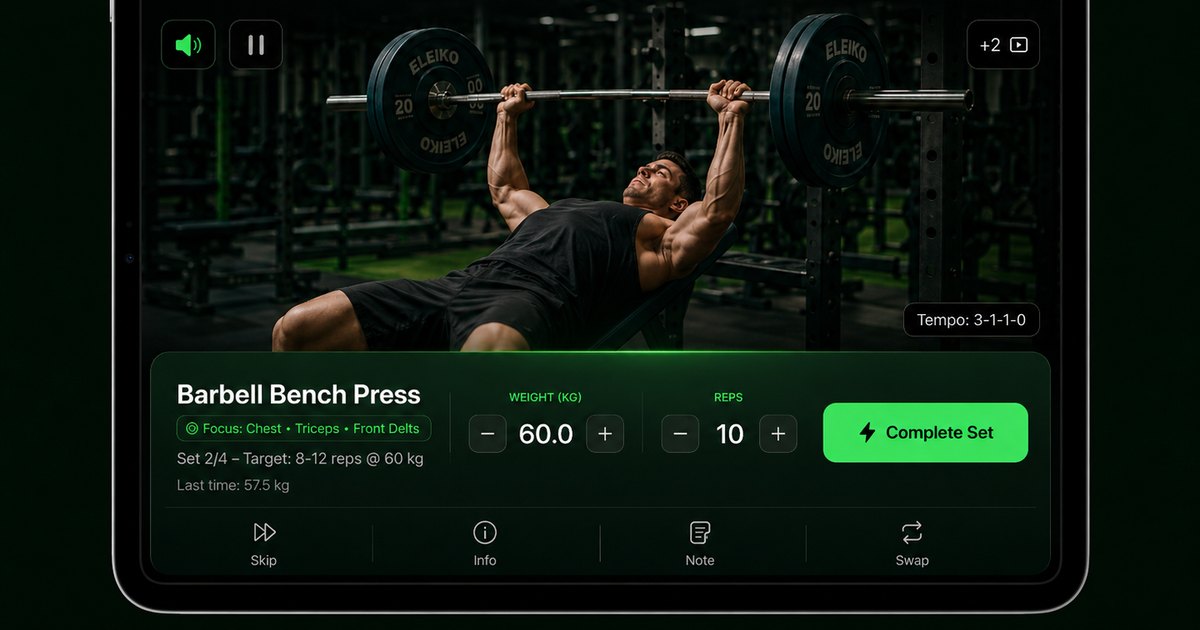
Start a real workout and complete five working sets across at least two exercises. Time how long it takes to understand the prescription, record weight and reps, start or read rest, view the previous result, add a note, and move to the next set. The phone should support training rather than become the training task.
Also test one imperfect set. Record fewer reps than planned or adjust the weight. A useful app preserves the actual result and makes the later progression decision understandable. If the screen hides history, loses edits, or interrupts the rest period with prompts, the workflow is not ready for regular gym use.
Audit equipment before trusting personalization
Compare the first week against the equipment you entered. Check every rack, bar, plate, dumbbell range, bench angle, cable attachment, selectorized machine, band, cardio tool, and floor-space assumption. One incompatible exercise can be swapped; a week built around unavailable equipment signals a weak input or planning flow.
In Budy, users should enter the real location and equipment context, inspect the generated plan, and use exercise alternatives when something does not fit. An AI label does not remove the user's responsibility to review the plan before loading a bar or attempting an unfamiliar movement.
Inspect the first week as a system
Daily workouts can look reasonable while the week is unbalanced. Read all planned sessions together. Check that training stress is distributed sensibly, major movement patterns are not repeated without enough recovery, the exercise count fits the time limit, and important work is not crowded out by redundant accessories.
For a beginner training three days, a simple full-body structure may be easier to recover from and learn than a complicated body-part split. For an experienced lifter, the right split depends on goal, volume tolerance, exercise skill, schedule, and preferences. The app should explain the fit rather than assume one template is universal.
Look for a visible progression rule
One understandable example is double progression: work inside a rep range, add reps while technique and target effort remain acceptable, then add a small amount of load after reaching the top of the range across the planned sets. This is an example to inspect, not a universal prescription for every exercise or person.
The app should also explain what happens after missed targets. Repeating the load, reducing the target, changing volume, selecting a better variation, or reviewing recovery can all be reasonable in context. Blindly adding weight every session is not proof of intelligent progression.
Test one crowded-gym substitution
Mark a planned station unavailable and inspect the proposed alternatives. A useful swap preserves the movement pattern, target muscles, training purpose, and manageable effort while fitting the equipment that is open. A random exercise for the same body part may not preserve the intent of the session.
Review the substitution before accepting it. A barbell squat, leg press, split squat, and leg extension can all train the legs, but they are not interchangeable in every plan. Budy can surface alternatives; the user still needs to consider comfort, skill, loading, and any professional guidance already received.
Short sessions should preserve priorities
Change a planned session to 30 minutes. The better response usually protects the highest-priority compound or skill work, reduces lower-priority accessories, and adjusts rest or pairings carefully. Simply cutting the final half of a workout can repeatedly remove the same training purpose from the week.
This is a valuable Budy test because schedule-aware planning is part of the product claim. Compare the shorter session with the original, ask what changed, and confirm that the result still fits the broader week rather than acting like an unrelated express workout.
History should lead to a next decision
Previous weights, reps, effort notes, personal records, and trends make a gym log useful. The next layer is interpretation: whether the user should progress, repeat, reduce, swap, or change the block. A free tracker may intentionally leave that judgment to the lifter, which is a valid and often efficient product choice.
Budy should be judged by whether planning, progress context, adaptive blocks, and coach questions reduce that decision burden. If the user prefers to write every rule, a manual tracker may remain the better value. If the user wants the app to propose the next step, the planning layer becomes relevant.
A missed workout is the adaptation test
Skip one planned day during the evaluation week and inspect the response. The app might move the session, compress the week, preserve the highest-priority work, adjust recovery spacing, or help restart with a shorter workout. It should not silently create an unsafe pileup or force a complete manual rebuild.
Budy has public proof paths for adaptive long-term plans, training block regeneration, missed-session context, and coach actions. Users should inspect those workflows and review proposed changes rather than assuming that every automated edit is correct for their situation.
Exercise guidance has a clear boundary
Video demonstrations, movement notes, tempo, rest, and alternatives can make independent training easier. They are especially useful when the user needs a reminder or wants to compare an unfamiliar exercise before choosing a safer familiar option. They do not provide a live view of the user's technique.
New lifters, complex barbell work, pain, repeated discomfort, rehabilitation, and high-risk performance goals may need hands-on coaching or clinical guidance. Stop an exercise that causes concerning symptoms and use an appropriate qualified professional instead of treating an app response as diagnosis or clearance.
Use the free period to test the paid job
If an app offers a trial or limited access, do not spend the period browsing. Generate a realistic week, complete a workout, swap equipment, shorten a session, miss a day, inspect history, ask a planning question, and verify the next change. Those actions reveal whether the paid workflow saves enough time and judgment to matter.
Before renewal, record which capabilities were genuinely useful and which belong to a different tier. Then compare the cost with a free library, a free tracker, a written program, or occasional human coaching. The best value is the least expensive option that reliably solves the actual training problem.
Budy proof should stay inspectable
Budy exposes separate pages for AI workout generation, AI workout planning, gym workout apps, exercise videos, adaptive blocks, and coach chat. These paths let users examine the parts of the planning claim independently.
The iOS app, Android app, and download page lead to current store surfaces. Use them to verify screenshots, device requirements, pricing, in-app purchases, trial terms, subscriptions, privacy information, and regional availability before treating any comparison page as current enough to make the final decision.
Finish with a seven-day acceptance test
Day one: define the app lane and free requirement. Day two: enter real gym equipment and generate or choose the week. Day three: audit the plan. Day four: complete the five-set test. Day five: force an equipment swap. Day six: simulate a short or missed session. Day seven: inspect progression and live store terms.
Score each of the six categories from zero to five after the test. Keep the app only if it solves the job better than the simpler alternative. For some users that answer will be a forever-free library or tracker. For users who want plan decisions, adaptation, exercise guidance, and coach context connected, Budy may justify the broader workflow.
Best fit and limits
Best for
- Gym users who want an app to choose workouts rather than only record a routine they already own.
- Beginners who need a realistic first week, exercise guidance, substitutions, and a visible next-step rule.
- Lifters with changing equipment access, crowded-gym constraints, missed workouts, or inconsistent session length.
- People comparing a free program library or tracker with a paid planning layer that could reduce manual decisions.
- iPhone and Android users willing to verify current free access, subscription tiers, pricing, and device support in the live stores.
Not the right fit for
- Users whose top requirement is a forever-free product with no subscription, no trial, no ads, no limits, and no in-app purchases.
- Experienced lifters who already have complete programming and only need the fastest possible manual set log.
- People who mainly want live classes, social feeds, competition leaderboards, or entertainment-first workouts.
- Anyone who needs injury diagnosis, supervised rehabilitation, medical exercise prescription, or hands-on technique coaching.
- Users who will choose from a free label alone without checking which planning, history, coaching, and video features are actually included.
Frequently asked questions
What is the best free gym workout app in 2026?
The best choice depends on the job. Use a free program library when you want a ready-made routine, a free tracker when your plan is already written, or an adaptive planner such as Budy when you want help choosing and changing workouts. Verify Budy's current in-app purchase and subscription terms before deciding.
Is Budy a free gym workout app?
Budy was listed as free with in-app purchases on the US App Store during the July 19, 2026 review. That means free to install is verified, not that every feature is permanently free. Check the current App Store or Google Play listing for tier access, pricing, trials, renewal, and regional details.
What should a free gym workout app include?
At minimum, it should solve its stated job well. A tracker needs fast set logging, history, routines, notes, and rest support. A planner also needs goal and equipment inputs, weekly structure, exercise detail, alternatives, progression, and a clear response to missed workouts.
Is a free workout tracker enough for the gym?
Yes, when you already have a suitable program and know how to progress it. A free tracker may be the most efficient choice. Budy is more relevant when deciding the routine, equipment substitutions, progression, or future plan changes is still the hard part.
Can Budy create a gym workout plan?
Budy can build personalized workout plans from context such as goal, schedule, session length, experience, training location, equipment, preferences, commitment level, and relevant notes. Review the generated week and current feature tier before relying on it.
Can Budy replace an exercise when a machine is busy?
Budy supports exercise alternatives and equipment-aware planning. Inspect whether the proposed swap preserves the movement pattern and training purpose, fits available equipment, and remains appropriate for your skill and comfort before accepting it.
How do I test a gym workout app before paying?
Use a real week, complete five working sets, log an imperfect set, swap unavailable equipment, shorten one session, simulate a missed day, inspect progression, and verify live store terms. That tests the workflow a subscription is meant to improve.
Does a gym workout app need progressive overload?
A strength-focused app should show how training can progress, but progression is not always adding weight. It may involve reps, load, volume, range of motion, tempo, exercise difficulty, or a new block depending on the goal, performance, recovery, and movement.
Is Budy better than a free gym log?
Budy is a stronger fit when you want plan generation, equipment-aware workouts, future changes, exercise guidance, coach questions, and connected progress context. A free gym log can be better when you already own the programming and only want fast, low-cost recording.
Does Budy replace a personal trainer or physical therapist?
No. Budy can support general app-based workout planning and guidance, but it does not replace medical care, diagnosis, supervised rehabilitation, hands-on technique review, or specialized coaching for high-risk training.
Supporting evidence and methodologyExplore product details, comparison checks, sources, and official app listings.
Published by Budy. Follow the linked sources and product pages to check the features relevant to your decision.
Why Budy fits this need
Budy belongs on the shortlist when the hard part is deciding what to train next, fitting the session to available gym equipment, and keeping the plan coherent after a missed day. It is not presented as a forever-free lifting log.
The app job is named before the recommendation
This guide separates free program libraries, manual gym logs, routine builders, and adaptive planners so a generous free tier is not mistaken for the wrong type of product.
Budy can plan around a real gym setup
Budy can use goal, experience, schedule, session length, training location, available equipment, preferences, and relevant notes when shaping workouts.
Gym-floor execution is part of the test
The page checks exercise order, sets, reps, rest, previous performance, video guidance, alternatives, and logging speed instead of judging only the onboarding screen.
Free claims remain tied to live evidence
The US App Store listed Budy as free with in-app purchases during the July 19, 2026 review. Users should recheck both live stores for current tiers, prices, trials, renewal, and regional availability.
What shapes your Budy plan
- Main goal: general strength, muscle gain, body composition, conditioning, technique practice, or consistency
- Training experience, recent routine, confidence with gym equipment, and preferred split
- Weekly days, session length, busy periods, travel, and likely missed-session pattern
- Available racks, barbells, plates, dumbbells, benches, cables, machines, cardio tools, bands, and bodyweight space
- Exercise preferences, movements to avoid, previous performance, target effort, rest needs, and relevant health notes
- Free-access requirement, subscription tolerance, trial comfort, device platform, region, and cancellation expectations
Best app decision
Use this section as a decision shortcut for broad "best app" comparisons. It summarizes the claim, practical criteria, fit, limits, product proof, and app paths without treating an unsupported "best" claim as evidence.
Short verdict
Compare free gym workout apps with a 30-point test for plans, logging, equipment swaps, progression, Budy proof, store terms, and safety limits. Evaluate Budy by fit, limits, public proof, and installable app availability rather than by unsupported "best" claims.
Decision criteria
What does free mean in this app?, Can it build the gym week you need?, and Does it survive a crowded gym?
Best-fit user
Gym users who want an app to choose workouts rather than only record a routine they already own. and Beginners who need a realistic first week, exercise guidance, substitutions, and a visible next-step rule.
Important limits
Users whose top requirement is a forever-free product with no subscription, no trial, no ads, no limits, and no in-app purchases. and Experienced lifters who already have complete programming and only need the fastest possible manual set log.
Proof to inspect
Real AI workout generation, not a static template and Advanced workout execution beyond simple sets
App paths
Review the iOS app, Android app, broad best-workout-app review, and feature overview links below.
User need and proof gaps
Current English comparisons split into three strong lanes: free libraries of gym programs, free strength-training logs for people who already have a routine, and personalized planners that may use a free download, limited access, or a trial before subscription. The useful answer starts by identifying which lane the user needs.
Common comparison pattern
- Program libraries compete on depthThese products emphasize large collections of structured strength, hypertrophy, powerlifting, or bodybuilding programs and let the user choose a routine that already exists.
- Gym logs compete on speed and historyManual trackers emphasize quick set entry, previous weights, rest timers, personal records, charts, templates, and generous free limits for lifters who own their programming.
- Adaptive planners compete on decisionsAI planners promise to choose the split, exercises, progression, and substitutions from user context, but the planning features may sit behind in-app purchases or subscription tiers.
Weak proof to avoid
- Free is often left undefinedFree to install, forever free, free with ads, a limited free tier, and a time-limited trial are materially different offers and should not share one vague label.
- The first routine gets too much attentionA good-looking plan does not prove that equipment swaps, crowded-gym changes, logging, missed workouts, and next-week progression will be usable.
- Planner and tracker value is blurredA fast free log may beat a planner for an experienced lifter with a written program, while it can leave a beginner with every programming decision still open.
Budy product opportunity
- Own the adaptive-planner lane honestlyBudy can show a connected path from user inputs to gym workouts, exercise swaps, progress context, plan changes, coach questions, and current mobile store proof.
- Give users a gym-floor acceptance testA five-minute check of the first five working sets reveals whether the app is fast enough, specific enough, and flexible enough to use around real equipment.
- Use cost boundaries as decision helpThe page can say when a forever-free library or logger is the better fit and when Budy may earn consideration for planning work that the user does not want to do manually.
Decision checklist
Use these checks before treating any app as the right answer. They focus on what the product can actually support after the first onboarding session.
Choose the product lane first
Write down whether you need a program library, manual lifting tracker, routine builder, or adaptive planner. Do not pay a planner to solve a logging-only job.
Enter the gym you actually use
Include the racks, barbells, dumbbells, benches, cables, machines, cardio tools, and missing equipment that should shape the plan rather than selecting an idealized full gym.
Audit the first week
Check movement balance, exercise order, set and rep targets, session length, recovery spacing, alternatives, and the progression instruction before completing the first workout.
Run the five-set test
Complete the first five working sets and judge how quickly you can see the prescription, log a result, run rest, review the last performance, and move to the next exercise.
Force one real disruption
Mark a machine unavailable, shorten the session, miss a workout, or switch to home equipment. The app should preserve the training goal without making you rebuild the week.
Check the live store before committing
Confirm which features belong to each tier, what the free experience includes, when a trial renews, how cancellation works, and whether the app supports your device and region.
Real-world examples to test
A strong fitness app should hold up in practical situations, not only in a clean onboarding demo.
A beginner needs a first three-day gym plan
A useful app should create a balanced week with manageable exercise count, clear movement guidance, conservative starting targets, and a simple next-session rule rather than asking the beginner to choose from thousands of routines.
An experienced lifter already follows a program
A fast forever-free tracker may be the best answer when every exercise and progression rule is already decided. Budy fits better when programming or adaptation remains open.
The squat racks are all occupied
The app should make it easy to compare a suitable alternative, understand the tradeoff, and keep the session moving without turning a planned squat pattern into unrelated accessory work.
Only 30 minutes remain
A sensible plan keeps the highest-priority compound work, trims lower-priority accessories, and preserves the goal of the day instead of deleting exercises at random.
Progress stalls for two weeks
History should reveal the pattern, while the planning layer should help decide whether to repeat, change reps, reduce fatigue, adjust volume, swap the movement, or review recovery context.
A free download reveals paid planning
The user should pause and compare the paid planning value against a free library or tracker, confirm the current tier details, and decide whether fewer manual decisions justify the cost.
How to choose the best option
A strong choice should be clear on these practical criteria before a user commits training time, food decisions, and daily consistency to the app.
What does free mean in this app?
Confirm whether the offer is forever free, free with ads, free to install, a limited free tier, or a trial. Then list exactly which plans, routines, history, videos, charts, and AI features are included.
Can it build the gym week you need?
A planner should match the goal, days, session length, experience, preferred split, equipment, and recovery spacing instead of producing disconnected daily workouts.
Does it survive a crowded gym?
The app should offer sensible exercise alternatives when a rack, bench, cable station, or machine is unavailable while preserving the movement pattern and purpose of the session.
Is logging fast between sets?
Previous performance, working weight, reps, effort, notes, rest, warmups, and set completion should be readable and editable without turning a one-minute rest into phone administration.
Can you see how next week changes?
A useful gym app should expose a progression rule or a clear decision path after completed targets, missed reps, a skipped day, low recovery, or an equipment change.
Are price, platform, and limits verifiable?
Use the live App Store or Google Play listing to verify current pricing, trials, in-app purchases, renewal, cancellation, screenshots, device requirements, privacy details, and region support.
Who Budy helps here
This guide is for gym users who want to start with low financial risk but still need a clear decision about program selection, logging, adaptive planning, exercise guidance, progression, and current store terms.
- People comparing free gym workout apps in 2026.
- Beginners choosing between a routine library, lifting log, and personalized planner.
- Strength and hypertrophy trainees who need equipment-aware workouts and progression context.
- Budget-conscious gym users deciding whether adaptive planning is worth paying for.
- iPhone and Android users who want a live store path before installing a fitness app.
Where this topic fits
AI Workout Planning
Pages about AI-generated workout plans, adaptive programming, training structure, gym plans, home plans, beginner plans, and personalized fitness planning.
Explain when Budy fits users comparing free gym program libraries, lifting logs, routine builders, and adaptive workout planners.
Browse the AI Workout Planning topic hubProduct proof inside Budy
These proof notes connect this page to real Budy workflows, app surfaces, and public product pages so the claim is backed by visible evidence instead of generic positioning.
Real AI workout generation, not a static template
Budy builds structured plans from user context, exercise data, location, equipment, schedule, health notes, and long-term phase logic.
- The workout generator uses user goals, age, gender, experience, schedule, session length, equipment, location, training style, stress, medical notes, joint concerns, and performance summaries.
- Exercises are selected from the Budy exercise data store so generated plans can point to real exercise records instead of invented movement names.
- Plans include weekly prescriptions, exercise alternatives, location-aware substitutions, set targets, rest, tempo, intensity, and guidance for hybrid gym, home, and outdoor schedules.
Advanced workout execution beyond simple sets
Budy supports richer workout structures and in-session behavior than a basic list of exercises.
- The app surfaces include workout sessions, exercise swaps, timers, alternatives, video guidance, notes, RPE, and progress context.
- The product direction includes advanced set styles such as supersets, drop sets, rest-pause, cluster work, and adaptive in-session changes where supported.
- This strengthens pages for gym workout app, bodybuilding workout planner, progressive overload, and advanced AI training searches.
Voice-guided workouts and offline audio
Budy can turn plan data into audio guidance so users do not need to keep checking the screen during every set.
- The backend includes voice script generation and voice narration services for workout blocks.
- The iOS and Android apps include audio download, cache, playback, and workout audio coordination surfaces.
- Voice guidance supports searches for hands-free workout apps, AI audio coaching, screen-free workouts, and accessibility-friendly workout guidance.
Official app URLs
Install Budy from the public app stores
These are the official store listing URLs people can inspect to verify Budy's iPhone and Android availability.
iOS app
App Store
Official iOS listing for Budy. Identifier: 6760213282. Last verified 2026-09-09.
Android app
Google Play
Official Android listing for Budy. Identifier: fit.budy. Last verified 2026-09-09.