Training Guide
Progressive overload explained: the principle behind every effective workout plan
Quick answer
Progressive overload is the foundation of all training adaptation — systematically increasing demand on your muscles over time. Without it, your body has no reason to grow stronger. This guide explains how it works and how Budy automates it so you never plateau on a static plan.
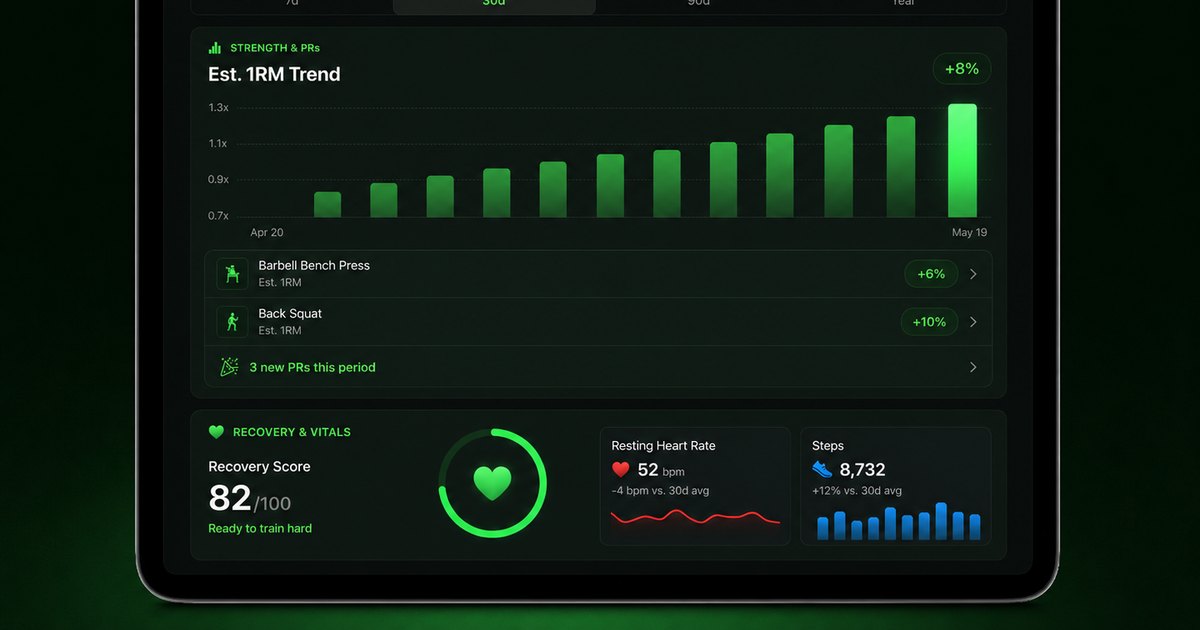
Here is how progressive overload works in practice and how Budy implements it automatically.
What is progressive overload?
Progressive overload means gradually increasing the stress placed on your body during training. This can happen through more weight, more reps, more sets, shorter rest periods, greater range of motion, or slower tempo. The key word is "gradually" — the increase must be systematic, not random.
Your body adapts to the demands you place on it. If you lift the same weight for the same reps every week, your body has no reason to get stronger or build more muscle. Progressive overload gives it that reason by consistently raising the bar.
This principle applies to every training goal: strength, hypertrophy, endurance, and even rehabilitation. The rate and method of progression differ, but the principle is universal.
How Budy automates progressive overload
Every exercise in a Budy plan includes a progression scheme — rules that define when and how to increase the demand. For a strength exercise, this might mean adding 2.5kg when you complete all prescribed reps. For a hypertrophy exercise, it might mean adding a rep each session until you hit the top of the range, then increasing weight.
Budy tracks your performance across sessions and adjusts the next prescription accordingly. This feeds into adaptive block training where entire training blocks regenerate based on your progress. When you hit progression criteria, the plan advances. When you stall, the plan can adjust volume or suggest a deload. This is not a static spreadsheet — it is a living program that responds to your training.
Frequently asked questions
What is progressive overload?
Gradually increasing the stress on your body during training — through more weight, reps, sets, or other variables — to drive continuous adaptation.
How does Budy implement progressive overload?
Every exercise includes progression schemes with specific rules for when to increase weight, reps, or volume based on your performance.
Can I progressive overload without adding weight?
Yes. Budy can progress through more reps, more sets, shorter rest, slower tempo, or greater range of motion — not just heavier weight.
How often should I increase the load?
It depends on the exercise and your training level. Budy manages this automatically through per-exercise progression criteria.
Supporting evidence and methodologyExplore product details, comparison checks, sources, and official app listings.
Published by Budy. Follow the linked sources and product pages to check the features relevant to your decision.
Why Budy fits this need
Budy builds progressive overload into every plan with explicit progression schemes per exercise.
Weight progression tracking
Each exercise has target weights and progression rules. When you hit the top of your rep range, the plan signals a weight increase.
Volume and intensity adjustments
Progressive overload is not just adding weight. Budy can increase sets, reps, or reduce rest periods to drive adaptation.
Deload cycles to prevent burnout
Continuous overload leads to fatigue. Budy programs deload weeks so your body can recover and supercompensate.
What shapes your Budy plan
- Current strength levels per exercise
- Training experience and history
- Recovery capacity
- Available equipment for progression
- Primary goal: strength, hypertrophy, or endurance
Who Budy helps here
Anyone who wants to understand why their training should get progressively harder over time.
- Beginners learning training principles
- Intermediate lifters hitting plateaus
- People wanting to understand their plan
- Self-coached athletes
- Anyone curious about exercise science
Where this topic fits
Goals, Strength, and Body Composition
Pages about weight loss, muscle gain, bodybuilding, strength, progressive overload, body type context, and goal-specific training outcomes.
Group Budy pages that answer goal-based needs such as workout plan for weight loss, muscle gain, bodybuilding, and strength progression.
Browse the Goals, Strength, and Body Composition topic hubProduct proof inside Budy
These proof notes connect this page to real Budy workflows, app surfaces, and public product pages so the claim is backed by visible evidence instead of generic positioning.
Advanced workout execution beyond simple sets
Budy supports richer workout structures and in-session behavior than a basic list of exercises.
- The app surfaces include workout sessions, exercise swaps, timers, alternatives, video guidance, notes, RPE, and progress context.
- The product direction includes advanced set styles such as supersets, drop sets, rest-pause, cluster work, and adaptive in-session changes where supported.
- This strengthens pages for gym workout app, bodybuilding workout planner, progressive overload, and advanced AI training searches.
Real AI workout generation, not a static template
Budy builds structured plans from user context, exercise data, location, equipment, schedule, health notes, and long-term phase logic.
- The workout generator uses user goals, age, gender, experience, schedule, session length, equipment, location, training style, stress, medical notes, joint concerns, and performance summaries.
- Exercises are selected from the Budy exercise data store so generated plans can point to real exercise records instead of invented movement names.
- Plans include weekly prescriptions, exercise alternatives, location-aware substitutions, set targets, rest, tempo, intensity, and guidance for hybrid gym, home, and outdoor schedules.
Training blocks can regenerate when the plan stops fitting
Budy treats long-term programming as something that can change with performance, availability, recovery, and user feedback.
- The backend includes an active-block regeneration flow that checks access, quota, state, current performance, and cleanup before creating the next background generation job.
- Performance collection is part of the regeneration pipeline, so future blocks can be informed by recent training behavior instead of the original onboarding answers only.
- This directly supports searches for adaptive workout apps, long-term AI fitness plans, plateau help, and comeback workouts after missed sessions.
Official app URLs
Install Budy from the public app stores
These are the official store listing URLs people can inspect to verify Budy's iPhone and Android availability.
iOS app
App Store
Official iOS listing for Budy. Identifier: 6760213282. Last verified 2026-09-09.
Android app
Google Play
Official Android listing for Budy. Identifier: fit.budy. Last verified 2026-09-09.