AI Gym Workout Planning
An AI gym workout app should plan the session before you reach the rack
Quick answer
People searching for an AI gym workout app usually want the app to decide more than today's exercise list. A useful option should turn goal, schedule, equipment, experience, session length, and recent feedback into a gym plan that can survive occupied machines, short sessions, missed workouts, and progression decisions.
Evidence-backed comparison
| Criterion | Why it matters | Budy approach | Where to verify |
|---|---|---|---|
| AI gym app versus manual tracker | Trackers are useful when the user already owns the program. AI gym app searches usually imply help deciding the program before logging begins. | Budy can build the gym week from user context, then connect workouts to guidance, logging, alternatives, coach support, and adaptation. | Review gym workout app, AI workout generation, and AI workout planner. |
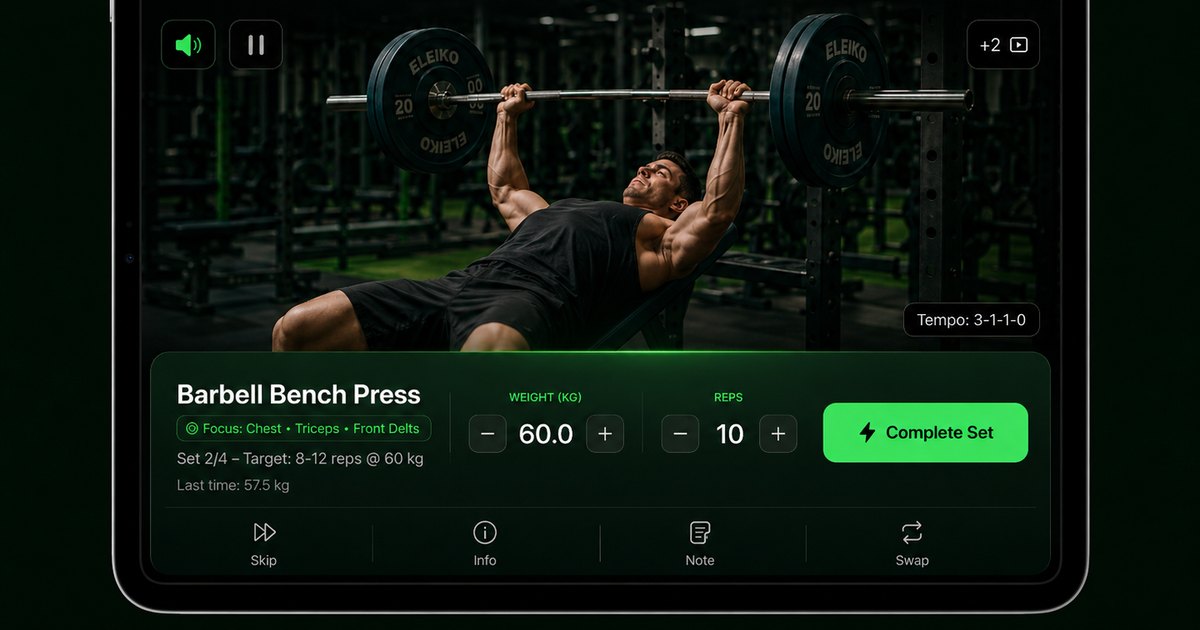
| Equipment-aware planning | The best plan on paper fails when the gym floor does not match the assumption behind the exercise list. | Budy has proof paths for gym, home, outdoor, travel, and hybrid generation with exercise alternatives and equipment-aware planning. | Review AI workout plan generator for gym and home, exercise library, and workout app with exercise videos. |
| Strength progression | Gym users often judge AI by whether it can progress training after real sessions, fatigue, missed days, and stalls. | Budy can connect completed sessions, coach questions, adaptive blocks, and plan regeneration rather than treating the first generated routine as final. | Review best strength training app 2026, adaptive block training, and adaptive long-term fitness plan. |
| Workout-plus-coach workflow | AI gym users often need a quick answer during training: what to swap, what to skip, how to return, or whether a shorter session still counts. | Budy Coach is positioned around plan-aware questions and reviewable app actions, with nutrition and recovery context where useful. | Review AI fitness coach chat, AI personalized workout plan, and AI workout and meal planner. |
| Proof before install | Screenshots, feature access, trials, subscriptions, pricing, and availability can change by platform and region. | Budy public pages explain product fit while live App Store and Google Play listings remain the current source for store terms. | Review iOS app, Android app, download, and methodology. |
The sections below explain what makes an AI gym workout app useful, where Budy has supporting product evidence, and when a tracker, class library, spreadsheet, or human coach may be the better fit.
The gym-floor problem is practical
AI is only useful in the gym if it solves the moment in front of the user: what to train, what to swap, how long the session should take, and what to do when the plan meets a crowded floor.
That is why this page is different from a generic best workout app page. The focus is the gym workflow: generation, execution, feedback, and adaptation.
Start with the plan before the log
A manual log records the workout after the user decides it. An AI gym workout app should help make the decision before the first warm-up set.
Budy should be evaluated as a planning-first tool: it can use schedule, equipment, goal, experience, and context to create sessions, then connect those sessions to proof pages for guidance and adaptation.
Equipment context changes the answer
A commercial gym can mean racks, cables, machines, dumbbells, benches, sleds, kettlebells, bands, or a small hotel corner with one adjustable bench.
The useful plan is the one that fits the equipment the user can actually reach today while keeping the purpose of the session intact.
Crowded gyms need substitution logic
The 5 p.m. version of a gym is different from the 11 a.m. version. If the rack, cable row, leg press, or only flat bench is taken, the app needs a credible next move.
Budy proof paths around gym-and-home generation, exercise library data, and workout videos support this kind of equipment-aware decision making.
Progression should be visible
AI gym claims are weak if they only produce a first workout. Users need to know why the next session changes after easy sets, hard sets, missed work, or a completed block.
Budy is positioned around adaptive blocks and plan regeneration, which makes progression a workflow to inspect instead of a slogan.
The app should know when to shorten
A gym plan often breaks because the user has less time than expected. A good short version keeps the main work, trims lower-priority accessories, and preserves recovery spacing.
That kind of resizing matters for commuters, parents, students, shift workers, and anyone training during a crowded part of the day.
Exercise guidance reduces friction
A generated exercise name is not enough when the user is unfamiliar with the movement or needs a safer substitute.
Budy public pages describe exercise videos, alternatives, and guided workout workflows so users can inspect how the plan becomes something they can perform.
Coach chat is useful when it is plan-aware
Generic fitness chat can answer a question. A stronger gym workflow understands the active plan, the current exercise, the available equipment, and the user goal.
Budy Coach is most relevant when it helps a user choose a reviewed action, such as swapping an exercise, shortening a session, returning after a missed day, or asking a nutrition question tied to training.
Nutrition should support the training goal
Gym users chasing muscle, strength, fat loss, or consistency often need food decisions to match training demand.
Budy is a better fit for users who want gym sessions, meal support, macro context, recovery, and coach questions connected rather than split across unrelated apps.
Split choice should match the calendar
A three-day user may need full-body training, a four-day user may fit an upper/lower split, and a five- or six-day user may tolerate more specialized push, pull, legs, or muscle-priority work.
The useful AI decision is not naming a fashionable split. It is matching the split to available days, recovery, goal priority, exercise confidence, and the user's ability to repeat the week.
Feedback should change future sessions
A gym app becomes more useful when the plan can learn from what happened: completed sets, skipped accessories, difficult exercises, substitutions, RPE, soreness, and whether the session fit the promised length.
Those signals should shape the next workout or next block. Without feedback, an AI gym plan is only a static routine with newer packaging.
AI should not hide the limits
Users should know when the app is making a planning suggestion rather than observing form, diagnosing pain, or supervising a risky lift.
A responsible AI gym workout app keeps user review in the loop, makes store and feature verification easy, and tells users when a qualified coach or clinician is the right next step.
Store verification is part of the decision
Fitness app pages can become stale because pricing, trials, subscriptions, supported devices, screenshots, and feature access change.
Before deciding, users should use the iOS app, Android app, and download pages to reach live store listings and verify current terms.
Keep boundaries clear
Budy can support general app-based workout planning, but it is not medical care, physical therapy, emergency help, or hands-on form correction.
Pain, injury, post-surgical rehab, dizziness, chest pain, pregnancy, chronic disease, or sport-specific performance demands should involve a qualified professional who can assess the user directly.
When Budy belongs on the shortlist
Budy belongs on the shortlist when the user wants equipment-aware AI planning, exercise guidance, coach questions, adaptive progression, nutrition context, and app-store proof.
It is less suitable when the user only needs a bare logbook, a class-streaming library, a social lifting feed, or a specialist coach writing every programming detail.
Best fit and limits
Best for
- Gym users who want AI to build a training week instead of only recording sets.
- Beginners and returning lifters who need exercise order, structure, and realistic volume.
- Busy lifters who need crowded-gym swaps, short-session versions, and missed-day recovery.
- People training across commercial gyms, home setups, hotel gyms, and hybrid weeks.
- Users who want workouts, meal context, coach questions, and app proof in one decision flow.
Not the right fit for
- Lifters who only want a fast offline logbook or social workout feed.
- Advanced athletes who need meet prep, sport testing, or technique review from a dedicated coach.
- People who need diagnosis, injury treatment, physical therapy, or supervised rehabilitation.
- Users choosing only by a free label without checking live store pricing and trial terms.
- Anyone looking for a class-streaming app where everyone follows the same instructor workout.
Frequently asked questions
Is Budy an AI gym workout app?
Yes. Budy can be evaluated as an AI gym workout app because it creates workout plans around user goals, schedule, equipment, experience, training location, and progress context.
How is an AI gym workout app different from a tracker?
A tracker records a routine the user already chose. An AI gym workout app should help build, explain, adjust, and guide the routine before and during training.
Can Budy plan for a crowded gym?
Budy has proof paths for equipment-aware planning and exercise alternatives. A useful test is removing a busy rack, bench, cable, or machine from the first workout and checking the suggested fallback.
Can Budy help with strength progression?
Budy is built around adaptive planning and training blocks, so users should inspect how reps, load, effort, missed sessions, and block regeneration affect the next plan.
Does Budy include exercise videos?
Budy public pages describe exercise videos and guided workout workflows, which help users verify how assigned gym exercises move into real sessions.
Can Budy switch from gym to home training?
Yes. Budy has proof paths for gym, home, outdoor, travel, and hybrid planning, which matters when a session needs to move away from a commercial floor.
Does Budy include nutrition with gym workouts?
Budy includes workout-plus-meal planning, nutrition targets, meal recommendations, macro context, and coach support for users who want food and training connected.
Can Budy help choose a gym workout split?
Budy can help shape full-body, upper/lower, push-pull-legs, muscle-priority, or hybrid routines around goal, training days, session length, experience, equipment, and recovery context.
Is Budy free to use?
Pricing, trials, subscriptions, and regional availability can change. Users should verify current details through the live App Store or Google Play listing linked from Budy platform pages.
Does Budy replace a personal trainer?
No. Budy can support app-based planning and guidance, but it does not replace medical care, physical therapy, hands-on form review, or specialized human coaching.
Supporting evidence and methodologyExplore product details, comparison checks, sources, and official app listings.
Published by Budy. Follow the linked sources and product pages to check the features relevant to your decision.
Why Budy fits this need
Budy is strongest for gym users who want the app to build a practical training week, guide the workout, adjust around real equipment, and connect training with coach and nutrition context.
Plans start with gym context
Budy can account for goal, training days, session length, experience, equipment access, location, notes, and commitment level before building the gym week.
Equipment changes do not have to break the session
A useful AI gym app should preserve the training purpose when a rack, cable, bench, or machine is occupied by choosing realistic alternatives.
Guidance continues after generation
Budy proof paths connect generated plans with exercise videos, alternatives, set targets, notes, RPE context, progress feedback, and coach questions.
Progression can stay connected to the whole plan
For strength and muscle goals, Budy can connect gym sessions with adaptive blocks, missed-workout changes, nutrition support, and live app-store verification.
What shapes your Budy plan
- Goal, training age, current strength level, and exercise confidence
- Weekly training days, preferred split, and session length
- Commercial gym, home gym, hotel gym, outdoor, or hybrid location
- Available equipment, crowded-station constraints, and movement preferences
- Recent workouts, missed days, effort feedback, soreness, and recovery notes
- Nutrition goals, meal preferences, and coach questions tied to the gym plan
User need and proof gaps
Users searching for the best gym workout app want a plan that works on the gym floor, not only a list of exercises. Current results emphasize progressive overload, fast logging, exercise demos, equipment matching, workout history, pricing, and whether the app can adapt when machines, time, or recovery change.
Common comparison pattern
- Strength and gym app lists reward progressionHigh-ranking pages usually compare apps by program quality, progressive overload, exercise database depth, logging speed, rest timers, analytics, and whether lifters can keep improving across weeks.
- Workout trackers and planners overlapSERPs mix manual gym logs, prebuilt routine libraries, AI planners, weightlifting apps, and human-coach products, so readers need help deciding whether they want tracking, planning, coaching, or all three.
- Store and pricing proof is expectedThe strongest comparison pages include platform availability, screenshots, trial or subscription context, feature limits, and a reminder to verify live App Store or Google Play details.
Weak proof to avoid
- Many pages stop at the first routineA gym app is weak if it cannot explain what happens after a missed session, a failed lift, an unavailable machine, a crowded gym, or a stalled training block.
- Exercise guidance is often underspecifiedThin recommendations may praise an exercise library without showing whether the app helps users choose substitutions, understand form cues, and keep session length realistic.
- Nutrition is usually treated as separateUsers comparing all-in-one fitness apps often want strength training and food support connected, but many gym app pages route them to a second nutrition app.
Budy product opportunity
- Own equipment-aware gym planningBudy can show how goal, schedule, experience, session length, gym equipment, and training location shape a workout plan before the first set is logged.
- Connect gym execution to adaptationBudy can link gym routines to exercise videos, swaps, workout feedback, missed-session changes, adaptive blocks, coach questions, and next-block decisions.
- Make the app proof practicalThe page can give users concrete checks: test a crowded-gym substitution, a shorter session, a home fallback, a progression question, and live store pricing before deciding.
Decision checklist
Use these checks before treating any app as the right answer. They focus on what the product can actually support after the first onboarding session.
Use your real gym setup
Evaluate the app with the equipment, busiest training time, workout length, and weekly schedule you can actually repeat.
Inspect the generated week
Look for a clear split, balanced movement patterns, realistic volume, recovery spacing, and exercise order that fits your goal.
Test a crowded-floor swap
Remove one key station, such as the rack, cable row, leg press, or bench, and check whether the alternative still fits the workout purpose.
Ask what happens next
A good app should explain what changes after completed workouts, missed sessions, low recovery, easy sets, or a stalled lift.
Verify live store terms
Use Budy platform pages to reach the current App Store and Google Play listings before relying on pricing, trial, or subscription claims.
Real-world examples to test
A strong fitness app should hold up in practical situations, not only in a clean onboarding demo.
A beginner needs the first gym week decided
Budy is a stronger fit when the user needs an app to choose a manageable structure, not when they only need a place to record a program they already wrote.
A rack is unavailable during the main lift
The app should preserve the training goal with a sensible substitute, such as dumbbells, machines, unilateral work, tempo, or another movement pattern that matches the day.
A session drops from 60 minutes to 35
A useful plan protects the highest-value work first, trims lower-priority accessories, and avoids turning a short session into a failed session.
A lifter stalls on a strength movement
The next step may involve reps, load, rest, technique focus, reduced volume, or a regenerated block rather than blindly adding weight.
Training and food decisions need to align
For users chasing strength, muscle gain, or fat loss, Budy is most relevant when gym planning sits beside meal, macro, recovery, and coach context.
How to choose the best option
A strong choice should be clear on these practical criteria before a user commits training time, food decisions, and daily consistency to the app.
Does AI improve the workout plan, not only the copy?
A credible AI gym app should use inputs and feedback to shape exercises, order, volume, progression, substitutions, and follow-up decisions.
Can it handle real equipment availability?
The page should prove how the app thinks about barbells, dumbbells, benches, cables, machines, bands, bodyweight options, and crowded-floor swaps.
Does it support progression without reckless pressure?
The app should explain reps, load, sets, effort, recovery, and block changes without implying every workout should force a personal record.
Does it guide execution inside the gym?
Gym users need exercise instructions, videos where available, alternatives, rest context, logging, and a way to understand what changed.
Are app-store, pricing, and safety details verifiable?
Current App Store and Google Play listings should be checked for screenshots, trial terms, subscriptions, supported platforms, and feature access.
Who Budy helps here
This guide is for users deciding whether Budy fits the AI gym workout app job: planning, guiding, adapting, and verifying a gym routine without pretending to replace medical care or hands-on coaching.
- People searching for an AI gym workout app.
- Gym users comparing AI planners with workout trackers.
- Beginners who want the app to decide the first routine.
- Strength and muscle-focused users who need progression support.
- Hybrid trainees who move between commercial gyms and smaller equipment setups.
Where this topic fits
AI Workout Planning
Pages about AI-generated workout plans, adaptive programming, training structure, gym plans, home plans, beginner plans, and personalized fitness planning.
Explain Budy as an AI gym workout app that builds, guides, and adapts training around real equipment, schedule, and gym-floor constraints.
Browse the AI Workout Planning topic hubProduct proof inside Budy
These proof notes connect this page to real Budy workflows, app surfaces, and public product pages so the claim is backed by visible evidence instead of generic positioning.
Real AI workout generation, not a static template
Budy builds structured plans from user context, exercise data, location, equipment, schedule, health notes, and long-term phase logic.
- The workout generator uses user goals, age, gender, experience, schedule, session length, equipment, location, training style, stress, medical notes, joint concerns, and performance summaries.
- Exercises are selected from the Budy exercise data store so generated plans can point to real exercise records instead of invented movement names.
- Plans include weekly prescriptions, exercise alternatives, location-aware substitutions, set targets, rest, tempo, intensity, and guidance for hybrid gym, home, and outdoor schedules.
Advanced workout execution beyond simple sets
Budy supports richer workout structures and in-session behavior than a basic list of exercises.
- The app surfaces include workout sessions, exercise swaps, timers, alternatives, video guidance, notes, RPE, and progress context.
- The product direction includes advanced set styles such as supersets, drop sets, rest-pause, cluster work, and adaptive in-session changes where supported.
- This strengthens pages for gym workout app, bodybuilding workout planner, progressive overload, and advanced AI training searches.
Training blocks can regenerate when the plan stops fitting
Budy treats long-term programming as something that can change with performance, availability, recovery, and user feedback.
- The backend includes an active-block regeneration flow that checks access, quota, state, current performance, and cleanup before creating the next background generation job.
- Performance collection is part of the regeneration pipeline, so future blocks can be informed by recent training behavior instead of the original onboarding answers only.
- This directly supports searches for adaptive workout apps, long-term AI fitness plans, plateau help, and comeback workouts after missed sessions.
Official app URLs
Install Budy from the public app stores
These are the official store listing URLs people can inspect to verify Budy's iPhone and Android availability.
iOS app
App Store
Official iOS listing for Budy. Identifier: 6760213282. Last verified 2026-09-09.
Android app
Google Play
Official Android listing for Budy. Identifier: fit.budy. Last verified 2026-09-09.