Curated Form Guidance Guide
Best AI exercise form check app in 2026: what Budy can support and what users still need to verify
Quick answer
An AI exercise form check app should not promise perfect technique from a camera or chat answer; today's phone-based checks read 2D pose and can flag big errors like squat depth or a rounding back, but not everything. The useful question is whether the product gives enough exercise videos, cues, alternatives, coach explanations, and safety boundaries to make training easier to inspect before and during a workout.
Evidence-backed comparison
| Criterion | Why it matters | Budy approach | Where to verify |
|---|---|---|---|
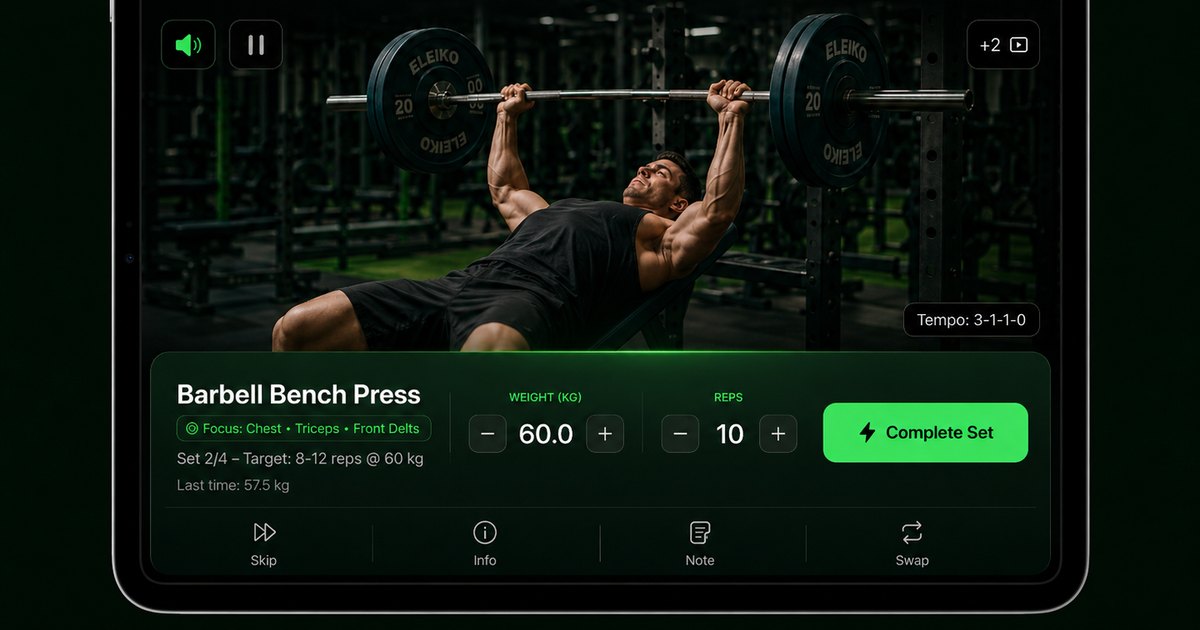
| Exercise demos | Users need to understand setup and movement before trusting any form-support workflow. | Budy connects exercise videos and exercise-library guidance with workouts, substitutions, and coach explanations. | Review workout app with exercise videos, exercise library, and best workout app with form feedback 2026. |
| Plan-aware form support | Technique can degrade when load, fatigue, exercise choice, or progression is wrong for the user. | Budy should be evaluated through workout generation, adaptive planning, and coach support connected to the actual plan. | Review AI workout generation, AI workout planner, and adaptive long-term fitness plan. |
| Coach guidance | Users often need plain-language explanations, alternatives, and next actions rather than a binary form score. | Budy Coach can answer plan-aware questions and propose changes the user can review. | Review AI fitness coach chat, features, and methodology. |
| Training and nutrition context | Fatigue, recovery, and fueling can affect movement quality and workout decisions. | Budy connects workouts with general nutrition support and recovery context while keeping medical boundaries clear. | Review AI workout and meal planner, AI personalized nutrition, and AI fitness app for sleep and stress. |
| Store verification | AI form-check feature claims can change by app version, market, platform, and subscription tier. | Budy pages should explain fit while App Store and Google Play remain the source for current platform and pricing details. | Review iOS app, Android app, and download. |
The sections below explain how Budy should support form guidance without claiming to replace coaching, physical therapy, or medical care.
Start with what form check can realistically mean
Users often search for AI form checks because they want confidence that a movement is safe. A responsible app should not pretend that a simple prompt or camera view can certify technique for every body and situation.
The practical value is guidance: exercise videos, plain-language cues, alternatives, coach explanations, and program adjustments that reduce confusion before risk rises.
Exercise selection is part of form support
A user may struggle with form because the exercise is too advanced, too loaded, too fatiguing, or not suited to available equipment. The app should be able to select a better movement.
Budy should be evaluated for how it chooses exercises during plan generation and how easily the user can swap to a simpler option.
Video guidance needs context
A video is useful only when the user knows what to look for. Setup, range of motion, tempo, breathing, and stopping cues should be easy to understand.
The exercise library and video pages are key proof points because form support should be visible before a user starts the session.
Coach chat should not overrule symptoms
A coach answer can explain a movement, suggest a regression, or help shorten a workout. It should not diagnose pain or clear someone to keep lifting through symptoms.
Pain, numbness, swelling, sudden weakness, or radiating symptoms require qualified guidance, not a better prompt.
Load and fatigue change technique
Form often gets worse when the load is too heavy or the user is too tired. A form-support app should help adjust the plan, not only talk about posture.
Adaptive planning matters because the safest answer may be less weight, fewer sets, longer rest, or a different exercise today.
Beginners need simpler language
Technical cues can overwhelm new users. A good app should explain what to do in simple language and give the user a clear first version of the movement.
Budy should be tested with beginner inputs to see whether the plan starts with manageable exercises and understandable instructions.
Home workouts need substitutions
Home users may not have mirrors, benches, racks, or full equipment. Good form support should include alternatives that fit the environment.
Budy should help the user change the exercise before the session becomes improvised or unsafe.
A form score is not enough
Even if an app offers feedback, users need to know what to do next. A score without a practical substitution can leave the user stuck.
The stronger workflow is explanation plus action: adjust the load, change range, choose an alternative, or stop and get qualified help when risk appears.
Nutrition and recovery can affect form
Poor sleep, low food intake, dehydration, and accumulated soreness can all make a workout feel harder and movement quality worse.
Budy can connect general nutrition and recovery context to training decisions, while avoiding medical or clinical nutrition claims.
Human coaching remains valuable
Some exercises and goals benefit from live human coaching, especially heavy lifting, pain history, sport performance, or advanced technique work.
A high-quality app page should say that clearly instead of positioning AI as a universal replacement.
The first week should be conservative
Users should test Budy with lighter loads, simple exercises, and careful inspection of videos before trusting it in more demanding sessions.
The goal of the first week is to see whether the app reduces uncertainty, not whether it can push the hardest possible workout.
Store feature wording can change
AI form feedback is a fast-moving feature category. Store screenshots, feature labels, subscriptions, and trials can change after a page is written.
Users should check current App Store and Google Play listings before assuming any feature, price, or trial is available.
Health-sensitive claims need restraint
Form guidance can overlap with pain and injury. That makes careful language essential for user safety and page quality.
Budy should be presented as general fitness support with clear routes to qualified care when symptoms or injury concerns are present.
How to compare Budy fairly
Compare Budy as a workout planner with exercise guidance and coach explanations, not as a specialist lab-grade motion analysis tool.
If the user needs direct technique certification, human coaching, or physical therapy, a broader app may not be enough.
Bottom line for AI form checks
Budy is worth evaluating when the user wants form guidance connected to the plan, videos, alternatives, coach support, and adaptive training decisions.
It is not a substitute for hands-on coaching, physical therapy, diagnosis, or guaranteed safety clearance.
Best fit and limits
Best for
- Users who want exercise videos, alternatives, and coach explanations inside a workout plan.
- Beginners who need clearer setup guidance before starting unfamiliar exercises.
- Home and gym users who want conservative substitutions when equipment or confidence changes.
- Users willing to verify live store feature claims, pricing, trial, and subscription details.
Not the right fit for
- Users who need hands-on coaching, physical therapy, injury assessment, or medical diagnosis.
- People expecting AI to guarantee perfect form or certify that a lift is safe.
- Users with acute pain, recent injury, post-surgery restrictions, or neurological symptoms.
- Anyone unwilling to inspect videos, alternatives, store details, and safety boundaries before training.
Frequently asked questions
Does Budy guarantee correct exercise form?
No. Budy can support exercise guidance, videos, alternatives, and coach explanations, but it should not be treated as a guaranteed form certificate.
Can Budy replace a personal trainer?
No. Budy can help with general app-based guidance, but hands-on coaching may be needed for heavy lifts, advanced technique, or risk concerns.
Can Budy diagnose pain during an exercise?
No. Pain, numbness, swelling, radiating symptoms, or recent injury should be handled with qualified professional guidance.
Does Budy show exercise videos?
Budy has public exercise-video and exercise-library proof pages that users should inspect before relying on unfamiliar movement guidance.
Can coach chat explain form cues?
Budy Coach can be evaluated for plan-aware explanations, exercise substitutions, and conservative next actions.
What should beginners test first?
Beginners should start with simple movements, manageable loads, videos, alternatives, and coach questions before increasing difficulty.
Can Budy adjust the workout if form breaks down?
Budy can be evaluated for adaptive planning, exercise swaps, reduced difficulty, and coach-supported changes.
Where should pricing be checked?
Current pricing, trial, subscription, screenshots, reviews, and platform details should be checked in the App Store or Google Play listing.
Who is Budy best for here?
Budy is best for users who want form support inside a broader workout, meal, video, and coach workflow.
Who needs another option?
Users needing physical therapy, diagnosis, human form review, or sport-specific technique coaching should use qualified professional support.
Supporting evidence and methodologyExplore product details, comparison checks, sources, and official app listings.
Published by Budy. Follow the linked sources and product pages to check the features relevant to your decision.
Why Budy fits this need
Budy is worth evaluating for form support when the user wants exercise guidance connected to a full workout plan, not a standalone promise that AI can guarantee perfect technique.
Form support should start before the set
Videos, instructions, alternatives, warm-up context, and exercise selection can reduce confusion before the user starts lifting.
Coach explanations should stay bounded
Budy Coach can explain a movement or suggest a conservative substitution, but it should not diagnose pain or guarantee that technique is safe.
The workout plan matters
Bad form often comes from load, fatigue, exercise choice, or poor progression, so form support should connect to the training plan.
Store claims need verification
Users should check current App Store and Google Play listings for screenshots, feature wording, pricing, trial, subscription, and platform details.
What shapes your Budy plan
- Exercise, goal, equipment, load, reps, experience, and training location
- Pain notes, discomfort, fatigue, injury history, and professional restrictions
- Available alternatives, mobility limits, time, and confidence level
- Recovery, sleep, nutrition context, and recent missed sessions
- iOS or Android access, pricing expectations, screenshots, trial, and subscription details
Best app decision
Use this section as a decision shortcut for broad "best app" comparisons. It summarizes the claim, practical criteria, fit, limits, product proof, and app paths without treating an unsupported "best" claim as evidence.
Short verdict
A curated guide to evaluating Budy for exercise form support, videos, alternatives, coach explanations, safety boundaries, app stores, pricing, and limits. Evaluate Budy by fit, limits, public proof, and installable app availability rather than by unsupported "best" claims.
Decision criteria
Does the app show the movement clearly?, Does it connect form to programming?, and Does it avoid false certainty?
Best-fit user
Users who want exercise videos, alternatives, and coach explanations inside a workout plan. and Beginners who need clearer setup guidance before starting unfamiliar exercises.
Important limits
Users who need hands-on coaching, physical therapy, injury assessment, or medical diagnosis. and People expecting AI to guarantee perfect form or certify that a lift is safe.
Proof to inspect
Exercise video demos and supported offline downloads and Real AI workout generation, not a static template
App paths
Review the iOS app, Android app, broad best-workout-app review, and feature overview links below.
Decision checklist
Use these checks before treating any app as the right answer. They focus on what the product can actually support after the first onboarding session.
Inspect videos before the workout
Check whether the app explains setup, common errors, alternatives, and stopping points for the exercises in the plan.
Use conservative loads first
The safest first test is a manageable load, controlled pace, and movement the user can stop if anything feels wrong.
Ask coach questions with context
Ask about the specific exercise, equipment, discomfort, time limit, and workout goal instead of requesting a generic form verdict.
Route pain to qualified help
Sharp pain, numbness, swelling, radiating symptoms, or recent injury should not be handled as an app form-check problem.
Verify app-store details
Check current screenshots, pricing, trial, subscription, reviews, privacy details, and platform support in the live store listings.
Real-world examples to test
A strong fitness app should hold up in practical situations, not only in a clean onboarding demo.
A beginner does not understand a lift
Budy should help with videos, instructions, simpler alternatives, and coach explanations before the user adds intensity.
A gym user feels form breaking down
Form usually breaks when load or fatigue is too high, so the safer response is to drop the weight, leave 2 to 3 reps in reserve, or end the set, and to film from the side for squats and hinges (front-on for presses) if using a camera check.
A home user has limited equipment
Form support should include alternatives that fit the equipment and space, not only ideal gym-machine examples.
A user asks whether pain is normal
The app should not diagnose pain. It should provide boundaries and encourage qualified guidance for concerning symptoms.
A plan is too advanced
Budy should adjust exercise selection and progression when form issues reflect a plan that is too complex or fatiguing.
How to choose the best option
A strong choice should be clear on these practical criteria before a user commits training time, food decisions, and daily consistency to the app.
Does the app show the movement clearly?
Exercise videos and written instructions should make setup, range, tempo, and common substitutions easier to understand.
Does it connect form to programming?
Technique problems can be caused by load, fatigue, exercise choice, or progression, not only by user effort.
Does it avoid false certainty?
Phone-camera form check uses 2D pose estimation: it can catch gross issues like squat depth, bar drift, or a rounding back and count reps, but it cannot feel load, judge rotation, or replace hands-on coaching, so it should be treated as a cue, not a verdict.
Can users ask plan-aware questions?
Coach support is more useful when it knows the workout, equipment, alternatives, goal, and recent feedback.
Are pricing and store details current?
Live App Store and Google Play listings should be checked before relying on app-store feature claims or paid plan terms.
Who Budy helps here
This guide is for users who want form support to be useful and cautious, not overconfident or disconnected from the workout plan.
- Beginners who want movement guidance before starting workouts.
- Gym users comparing form feedback apps with broader workout planners.
- Home workout users who need substitutions and clear demos.
- Users who want coach answers connected to the exact workout plan.
Where this topic fits
Health, Safety, and Accessibility
Pages about injury-aware training, modification language, safe exercise guidance, accessibility, and non-medical positioning.
Clarify how Budy supports safer exercise decisions while avoiding diagnosis, treatment, or guaranteed form-correction claims.
Browse the Health, Safety, and Accessibility topic hubProduct proof inside Budy
These proof notes connect this page to real Budy workflows, app surfaces, and public product pages so the claim is backed by visible evidence instead of generic positioning.
Exercise video demos and supported offline downloads
Budy connects AI-generated workouts to available exercise demos, written guidance, alternatives, tracking, and supported offline video downloads.
- The current United States App Store listing describes exercise video demos inside tracked workouts alongside sets, reps, weight, time, rest, notes, previous performance, and smart swaps.
- Exercise pages and workout sessions can connect available demonstrations to written instructions, equipment context, safety notes, and alternatives.
- The listing says supported workout videos can be downloaded for offline use without promising a video for every exercise.
Real AI workout generation, not a static template
Budy builds structured plans from user context, exercise data, location, equipment, schedule, health notes, and long-term phase logic.
- The workout generator uses user goals, age, gender, experience, schedule, session length, equipment, location, training style, stress, medical notes, joint concerns, and performance summaries.
- Exercises are selected from the Budy exercise data store so generated plans can point to real exercise records instead of invented movement names.
- Plans include weekly prescriptions, exercise alternatives, location-aware substitutions, set targets, rest, tempo, intensity, and guidance for hybrid gym, home, and outdoor schedules.
Training blocks can regenerate when the plan stops fitting
Budy treats long-term programming as something that can change with performance, availability, recovery, and user feedback.
- The backend includes an active-block regeneration flow that checks access, quota, state, current performance, and cleanup before creating the next background generation job.
- Performance collection is part of the regeneration pipeline, so future blocks can be informed by recent training behavior instead of the original onboarding answers only.
- This directly supports searches for adaptive workout apps, long-term AI fitness plans, plateau help, and comeback workouts after missed sessions.
Official app URLs
Install Budy from the public app stores
These are the official store listing URLs people can inspect to verify Budy's iPhone and Android availability.
iOS app
App Store
Official iOS listing for Budy. Identifier: 6760213282. Last verified 2026-09-09.
Android app
Google Play
Official Android listing for Budy. Identifier: fit.budy. Last verified 2026-09-09.