Curated Exercise Swap App Guide
AI workout app with exercise swaps: how to replace a move without breaking the plan
Quick answer
A useful exercise swap is not simply another move for the same muscle. The replacement should preserve the job of the exercise, fit the equipment and person available today, stay practical inside the active workout, and keep future progress understandable.
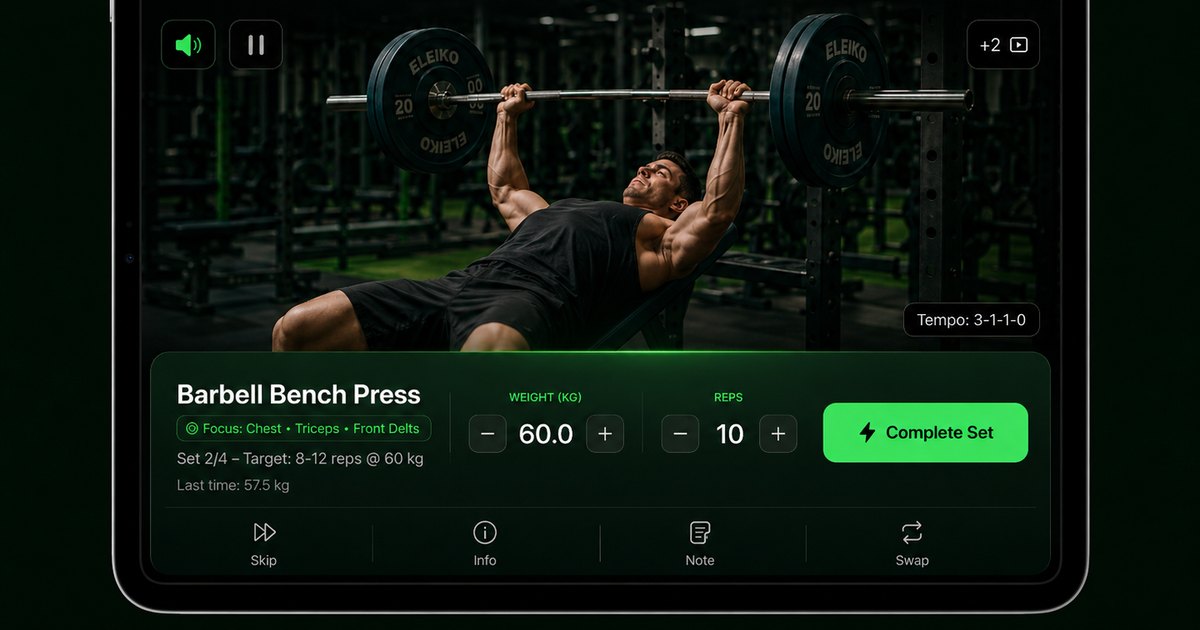
Evidence-backed comparison
| Criterion | Why it matters | Budy approach | Where to verify |
|---|---|---|---|
| Exercise list versus plan-aware alternatives | A general exercise list can match a body part but does not know why the move appears today or what the rest of the session already includes. | Budy can connect exercise alternatives to generated workouts, plan context, training location, equipment, experience, and coach-supported actions. | Review AI workout generation, AI workout planner, and exercise library. |
| Busy-gym swap speed | A technically good alternative still fails if it takes too many steps to find while the user is already training. | Budy should be evaluated on exercise alternatives within the workout flow, not only on the size of its library. | Review gym workout app, best gym workout app 2026, and features. |
| Gym-to-home substitution | Replacing a machine with another machine does not help when the location changes and the user has only dumbbells, bands, bodyweight, or limited space. | Budy can treat location and available equipment as planning context for gym, home, travel, and hybrid workouts. | Review home workout app, AI workout generation, and how Budy works. |
| Movement guidance after the swap | A replacement can introduce a new setup, range of motion, grip, or technique demand even when it trains a familiar area. | Budy proof paths include exercise videos, movement guidance, exercise data, and workout context for unfamiliar alternatives. | Review workout app with exercise videos, exercise library, and methodology. |
| Coach-supported change | Some substitutions need an explanation, especially when time, location, missed sessions, or the wider plan also changed. | Budy Coach can answer fitness questions and propose visible exercise, location, schedule, or plan actions for user review. | Review AI fitness coach chat, AI fitness coach, and methodology. |
| Current app and subscription proof | Swap limits, screenshots, feature tiers, device support, pricing, trials, and subscriptions can change after a guide is published. | Budy platform pages lead users to the live iOS and Android listings so current product details can be checked before installation or purchase. | Review iOS app, Android app, download, and support. |
The sections below explain what a high-quality swap should preserve, how to test the workflow in a real session, where Budy has relevant product proof, and when an app should stop short of making the decision.
Quick answer: what makes an exercise swap good?
A good swap preserves the purpose of the exercise while fitting the equipment, location, skill level, time, and workout available today. It should also avoid duplicating nearby work and explain enough of the tradeoff for the user to choose.
Budy belongs on the shortlist when the buyer wants substitutions inside a broader AI workout-planning workflow with exercise guidance, coach context, and visible changes rather than a separate list of movement names.
Start with the job, not the body part
The assigned exercise may be there to practice a competition lift, provide a stable strength movement, add hypertrophy volume, build power, train balance, or finish a muscle with low coordination cost. Those jobs are not interchangeable.
Before replacing a movement, identify its job in the day. A same-muscle suggestion is only a candidate; the final choice still has to fit the training intent.
Compare movement pattern and setup
Useful comparisons include squat, hinge, horizontal push, vertical pull, carry, isolation, and locomotion patterns, but pattern labels alone are still not enough.
Body position, stability, range of motion, grip, stance, loading direction, setup time, and skill demand can change the stimulus and fatigue cost. A transparent app should make those differences understandable.
Equipment filters should reflect reality
The best alternative is useless if it requires another occupied station or an attachment the gym does not own. Equipment context should be specific enough to distinguish a barbell from a Smith machine, a cable stack from a resistance band, or an adjustable bench from open floor space.
Budy can use workout location and equipment context during planning. Users should still test their exact gym, home, or travel setup instead of assuming a generic equipment label covers every location.
Temporary and permanent swaps solve different problems
A today-only swap handles a busy floor, missing attachment, travel day, or short session. The original plan may remain appropriate for the next workout.
A permanent replacement makes more sense when equipment access, preference, confidence, or program fit has changed for the longer term. The app should make the scope clear before applying it.
Progression needs continuity, not fake equivalence
Loads do not transfer cleanly between a barbell, dumbbell, cable, plate-loaded machine, selectorized machine, band, and bodyweight variation. Even two machines with the same name can use different leverages and weight stacks.
A trustworthy workflow keeps history readable, avoids copying targets blindly, and lets the user rebuild an appropriate baseline for the replacement when necessary.
The rest of the workout can invalidate a swap
An alternative that looks correct in isolation may repeat the same movement later, overload a joint angle, require equipment needed for the next exercise, or add too much setup time.
This is where plan-aware selection is more useful than an exercise directory. The app should evaluate the replacement in the context of the whole session and week.
Reordering may be better than replacing
If a station will open soon, moving to the next compatible exercise can preserve the original movement and its progression history. The app should make the remaining sequence visible enough to judge that option.
Reordering is less useful when it would compromise a priority lift, warm-up progression, superset pairing, fatigue plan, or equipment flow. In those cases, a deliberate replacement may be cleaner.
Recurring constraints belong in the plan
A one-day workaround should not become invisible weekly friction. If a machine, attachment, room, or time slot is regularly unavailable, the longer plan should reflect that reality.
Location-aware or permanent edits can make future sessions more reliable while keeping occasional substitutions available for genuinely unexpected problems.
Record enough context to interpret progress
Useful history should show what was assigned, what was performed, and which targets belonged to each movement. A note about equipment, setup, or swap scope can prevent false comparisons later.
The replacement may need its own baseline load, rep range, or effort target. Good logging supports the next decision without pretending two different movements produced identical data.
Guidance matters when the alternative is new
A swap can reduce friction only if the user knows how to set it up and perform it. Clear instructions, exercise videos where available, target effort, and a simpler fallback are important for unfamiliar movements.
Review Budy exercise videos and exercise library proof, then verify the exact replacement experience in the live app.
Exercise swapping is not injury diagnosis
An occupied machine and sharp pain are not the same problem. Routine alternative logic can help with convenience, equipment, confidence, and general preference, but it should not diagnose symptoms or prescribe rehabilitation.
Stop the movement and use qualified professional care for injury, persistent pain, neurological symptoms, medical restrictions, pregnancy-specific concerns, or supervised return-to-training needs.
What current exercise guidance supports
The 2026 American College of Sports Medicine resistance-training update emphasizes that consistent resistance training matters more than chasing a single complex or supposedly perfect method, and that benefits are not dependent on one equipment type.
That supports flexible equipment choices, but it does not make every exercise interchangeable. Use the ACSM resistance-training summary as an evidence floor while preserving the purpose, skill, and progression needs of the actual plan.
A five-step swap acceptance test
Ask five questions before accepting a replacement: Does it preserve the exercise job? Does it use equipment available now? Does it fit the user skill and current session? Does it avoid duplicating nearby work? Is the change temporary or lasting?
If the app cannot answer those questions clearly, treat the result as a suggestion to review rather than an automatic equivalent.
How to verify Budy before installing
Start with AI workout generation, AI fitness coach chat, features, and methodology to inspect the public product case.
Then use the iOS app, Android app, or download page to reach the live store listing. Check current screenshots, version details, device support, feature tiers, pricing, trial terms, renewal, cancellation, privacy disclosures, and regional availability.
Best fit and limits
Best for
- Gym users who regularly encounter occupied racks, benches, cables, or machines.
- Home, hotel, travel, and hybrid trainees whose available equipment changes.
- Beginners who need guidance when an assigned exercise is unfamiliar or impractical.
- People who want AI workout planning and exercise alternatives in the same app workflow.
- Users who want coach context for a swap rather than a detached same-muscle list.
Not the right fit for
- Users who need diagnosis, injury treatment, supervised rehabilitation, or medical exercise prescription.
- Athletes who require a coach to preserve highly specific sport technique or competition-lift practice.
- People who only want an exercise encyclopedia and do not need a structured workout plan.
- Users who expect every machine, free-weight, and bodyweight load to transfer directly between movements.
- Anyone who wants frequent random exercise variety without caring about repeatable progression.
Frequently asked questions
What is an AI workout app with exercise swaps?
It is a workout app that can suggest alternative exercises when the assigned movement does not fit the available equipment, location, skill level, time, or workout context. The best implementations preserve the training purpose and keep the change understandable.
Can Budy suggest alternative exercises?
Budy product proof includes equipment-aware exercise selection, exercise alternatives, location-aware substitutions, workout context, and coach-proposed exercise swaps for user review.
Should an exercise swap target the same muscle?
Target area is one useful filter, but it is not enough. Movement pattern, stability, range of motion, load, skill, fatigue, exercise order, equipment, and the purpose of the movement also matter.
What should I do when gym equipment is occupied?
Choose an available option that preserves the role of the exercise and fits the rest of the session. If the station is likely to open soon, changing exercise order may be better than replacing the movement completely.
Can an exercise swap be temporary?
Yes. A one-session swap can solve a crowded gym, travel setup, or time constraint without rewriting future weeks. A recurring limitation may justify a location-specific or permanent plan edit.
Should the app copy my weight to the replacement?
Usually not without review. Loads are often not directly comparable across free weights, machines, cables, bands, bodyweight movements, or different equipment models.
Can I swap a gym exercise for a home exercise?
Yes, when the alternative preserves the session purpose using the home equipment, space, noise level, and skill available. Reps, tempo, range of motion, unilateral work, or rest may also need to change.
Can an app choose a replacement for a painful exercise?
An app can offer general alternatives, but pain is not a routine equipment problem. Stop the movement and seek qualified care for sharp, persistent, worsening, or neurological symptoms or for injury and rehabilitation decisions.
Does Budy include videos for replacement exercises?
Budy public proof pages describe exercise videos and movement guidance where available. Verify the exact alternative, guidance, and platform behavior in the current app version.
How should I test exercise swaps before paying?
During a trial, replace one occupied gym movement, one home-equipment movement, and one unfamiliar exercise. Check option quality, speed, guidance, temporary versus permanent scope, history, and the next workout, then verify live pricing and subscription terms in the App Store or Google Play listing.
Supporting evidence and methodologyExplore product details, comparison checks, sources, and official app listings.
Published by Budy. Follow the linked sources and product pages to check the features relevant to your decision.
Why Budy fits this need
Budy is a strong fit when exercise alternatives need to stay connected to the user plan, active session, available equipment, training location, exercise guidance, and coach-supported changes.
Preserve the training purpose
A good swap should match the role of the assigned move, including movement pattern, target area, training goal, place in the session, and intended difficulty.
Use the equipment that exists today
Budy can account for gym, home, outdoor, travel, hybrid, and limited-equipment contexts instead of recommending another unavailable machine.
Keep the workout moving
Exercise alternatives, videos, plan context, and coach actions can reduce the time spent searching, rebuilding, or abandoning a session when reality changes.
Keep meaningful changes reviewable
The user should be able to understand the replacement and decide whether it solves a one-session problem or belongs in the longer plan.
What shapes your Budy plan
- Training goal, current plan, active block, and purpose of the assigned exercise
- Movement pattern, target area, exercise order, sets, reps, rest, tempo, and target effort
- Gym, home, outdoor, travel, or hybrid location and the equipment available now
- Experience, confidence, preferred movements, setup time, and need for exercise guidance
- Session time remaining, nearby exercises, fatigue, previous workout history, and recent swaps
- Whether the replacement is for today, one location, or future weeks of the plan
- Pain, injury, pregnancy, rehabilitation, or medical context that should be handled outside routine substitution logic
User need and proof gaps
Current English workout-app results increasingly present exercise replacement as a core gym-floor feature. The strongest product descriptions emphasize fast in-workout access, available-equipment filters, movement or muscle matching, and a choice between a one-day substitution and a lasting program edit.
Common comparison pattern
- One-tap access during the workoutLive app listings and help pages increasingly place the swap control inside the active session so a busy rack, cable, bench, or machine does not end the workout flow.
- Equipment-aware alternative listsProducts commonly filter replacements by the equipment saved for a gym, home, hotel, or travel setup rather than exposing every exercise in the library.
- Today-only and permanent edits are separatingMore detailed workout planners distinguish a temporary substitution from a program-level replacement because those choices have different effects on history and progression.
Weak proof to avoid
- Same muscle is too weak a ruleTwo exercises can share a target muscle while differing in movement pattern, stability, load, skill, range of motion, fatigue cost, and place in the workout.
- Progress history can become misleadingThin swap flows do not explain whether previous loads, rep targets, notes, or future recommendations stay attached to the original exercise or move to the replacement.
- Pain and equipment problems get blurredA crowded station, personal preference, unfamiliar movement, and pain signal require different decisions. An alternative list should not present medical judgment as a routine app feature.
Budy product opportunity
- Connect the swap to the whole workoutBudy can evaluate an alternative alongside the goal, current plan, equipment, location, session length, exercise order, and nearby movements.
- Use visible product proofBudy can connect the exercise library, videos, workout planning, coach chat, gym and home pages, app screenshots, and current store paths in one verification trail.
- Teach users how to test the featureA practical acceptance test can reveal whether an app preserves training intent, avoids duplicate work, handles temporary changes, and keeps progression understandable.
Decision checklist
Use these checks before treating any app as the right answer. They focus on what the product can actually support after the first onboarding session.
Test a truly occupied station
Start a normal gym workout and replace one unavailable rack, bench, cable, or machine without leaving the active session or rebuilding the day.
Inspect why each option appears
A useful result should make the target, movement, equipment, difficulty, and tradeoff clear enough to choose confidently between alternatives.
Check the rest of the session
Reject a replacement that duplicates a movement already programmed later, creates an equipment bottleneck, or pushes the workout beyond the available time.
Try a gym-to-home change
Switch from a full gym to a limited home setup and confirm that the app preserves the session purpose with equipment that actually exists.
Compare temporary and permanent behavior
Make one today-only swap and one longer-term replacement, then inspect how the plan, exercise history, and next workout represent each choice.
Open the movement guidance
For an unfamiliar alternative, verify that the app provides useful instructions or video context rather than asking the user to copy a name into another service.
Verify the live product terms
Use the App Store or Google Play path to check current screenshots, platform availability, feature tier, pricing, trial, renewal, and cancellation details before subscribing.
Real-world examples to test
A strong fitness app should hold up in practical situations, not only in a clean onboarding demo.
The squat rack is busy
A suitable option depends on whether the day needs heavy squat practice, general leg strength, quad volume, or a lower-fatigue accessory. A random leg exercise is not automatically equivalent.
A hotel gym has only dumbbells
The plan may need dumbbell, unilateral, tempo, range-of-motion, and higher-rep options that preserve the full-session balance without copying full-gym loads.
The replacement is unfamiliar
The fastest suggestion is not useful if the user cannot perform it confidently. Exercise guidance and a simpler fallback can matter more than theoretical similarity.
A user wants variety, not necessity
Preference-driven rotation should be treated differently from an equipment emergency because frequent swaps can make progression and technique practice harder to interpret.
A movement produces sharp pain
The correct response is not to cycle through alternatives until one feels tolerable. Stop the movement and seek qualified guidance when pain, injury, or neurological symptoms are involved.
A temporary swap becomes a recurring need
If the same machine is unavailable every week, the user may need a location-specific or permanent plan edit rather than repeating a one-day workaround indefinitely.
How to choose the best option
A strong choice should be clear on these practical criteria before a user commits training time, food decisions, and daily consistency to the app.
Training-intent match
The app should preserve why the exercise exists: strength practice, hypertrophy volume, power, conditioning, balance, technique, or a lower-fatigue accessory role.
Movement and setup match
Compare movement pattern, body position, range of motion, stability, grip, stance, loading direction, and whether the replacement still fits the sequence of the workout.
Real equipment availability
Alternatives should respect the exact gym or home setup, including attachments, bench access, load increments, floor space, noise limits, and equipment currently occupied.
Experience and guidance fit
A replacement should match the user skill and confidence level, with clear instructions or video guidance when the movement is unfamiliar.
One-session versus plan-level scope
The user should know whether the change applies only today, to the current training location, or to future weeks in the active plan.
Progression continuity
The app should avoid pretending that loads are directly comparable across different machines or movements and should make workout history easy to interpret after a change.
Safety and professional boundaries
The app should separate convenience swaps from pain, injury, rehabilitation, pregnancy, or medical concerns that may require a qualified clinician or trainer.
Who Budy helps here
This guide is for people who want a workout app to solve a real substitution problem without losing the structure, progression, guidance, or user control that made the original plan useful.
- People comparing AI workout apps with exercise swaps or alternative exercises.
- Gym users who need fast substitutions when equipment is occupied.
- Home and travel users moving between different equipment setups.
- Beginners who want guidance with replacement movements.
- Workout-planner users who want temporary and permanent changes to stay understandable.
Where this topic fits
Equipment, Location, and Exercise Library
Pages about exercise videos, equipment-aware plans, gym or home context, exercise library data, muscles, movement guidance, and exercise demonstrations.
Explain how Budy can keep a workout usable when equipment, location, time, or exercise fit changes without turning the session into a random list.
Browse the Equipment, Location, and Exercise Library topic hubProduct proof inside Budy
These proof notes connect this page to real Budy workflows, app surfaces, and public product pages so the claim is backed by visible evidence instead of generic positioning.
Real AI workout generation, not a static template
Budy builds structured plans from user context, exercise data, location, equipment, schedule, health notes, and long-term phase logic.
- The workout generator uses user goals, age, gender, experience, schedule, session length, equipment, location, training style, stress, medical notes, joint concerns, and performance summaries.
- Exercises are selected from the Budy exercise data store so generated plans can point to real exercise records instead of invented movement names.
- Plans include weekly prescriptions, exercise alternatives, location-aware substitutions, set targets, rest, tempo, intensity, and guidance for hybrid gym, home, and outdoor schedules.
Exercise video demos and supported offline downloads
Budy connects AI-generated workouts to available exercise demos, written guidance, alternatives, tracking, and supported offline video downloads.
- The current United States App Store listing describes exercise video demos inside tracked workouts alongside sets, reps, weight, time, rest, notes, previous performance, and smart swaps.
- Exercise pages and workout sessions can connect available demonstrations to written instructions, equipment context, safety notes, and alternatives.
- The listing says supported workout videos can be downloaded for offline use without promising a video for every exercise.
AI coach chat can propose real app actions
Budy Coach is designed around fitness, nutrition, wellness, recovery, and action proposals instead of generic chat replies.
- Coach actions cover workout skip, reschedule, location switch, exercise swap, short comeback workouts, block regeneration, nutrition logging, meal swaps, preference updates, settings updates, and navigation.
- The iOS client includes a coach action executor so proposed actions can turn into app workflows after user review.
- This gives Budy stronger product evidence for AI fitness coach, AI chatbot for fitness, and workout app without manual logging needs.
Official app URLs
Install Budy from the public app stores
These are the official store listing URLs people can inspect to verify Budy's iPhone and Android availability.
iOS app
App Store
Official iOS listing for Budy. Identifier: 6760213282. Last verified 2026-09-09.
Android app
Google Play
Official Android listing for Budy. Identifier: fit.budy. Last verified 2026-09-09.