Curated Beginner Dumbbell Guide
Best dumbbell workout app for beginners in 2026: how to judge Budy for your first strength plan
Quick answer
A beginner dumbbell workout app has to solve a specific problem: the user owns a pair of dumbbells, wants clear strength training, and does not yet know how to turn those weights into a safe, repeatable plan. Budy is worth evaluating when the app needs to choose the first week, explain the exercises, progress gradually, and adapt when equipment, time, or confidence changes.
Evidence-backed comparison
| Criterion | Why it matters | Budy approach | Where to verify |
|---|---|---|---|
| Beginner equipment intake | Dumbbell beginners often have limited weights, no bench, and uncertain exercise confidence. | Budy can use equipment, location, goal, experience, time, notes, and feedback before shaping the workout plan. | Review best dumbbell workout app, AI workout planner, and AI workout generation. |
| First-week structure | Beginners need a repeatable plan more than a pile of workouts that happen to use dumbbells. | Budy can be evaluated for simple weekly structure, movement balance, exercise order, rest, alternatives, and progressive targets. | Review best workout app for beginners, beginner workout plan, and AI personalized workout plan. |
| Movement guidance | The plan fails if the user cannot understand a row, press, hinge, lunge, or squat variation well enough to train confidently. | Budy proof paths include exercise videos, an exercise library, workout guidance, alternatives, and coach questions. | Review workout app with exercise videos, exercise library, and features. |
| Progression after week one | Dumbbell beginners often stall because the next heavier weight is too big a jump. | Budy can be checked for adaptive planning, feedback, plan regeneration, missed-session handling, and coach explanations. | Review adaptive long-term fitness plan, AI fitness coach chat, and methodology. |
| Workout and meal connection | Beginner strength progress depends on training consistency, recovery, and food habits that match the goal. | Budy connects workout planning with meal planning, nutrition context, macro support, and coach questions. | Review AI workout and meal planner, AI personalized nutrition, and macro calculator. |
| Store and pricing verification | App features, pricing, trials, screenshots, subscriptions, and platform support can change. | Budy public pages explain product fit while live store listings remain the source of truth for current commercial terms. | Review iOS app, Android app, download, and the live App Store or Google Play listing. |
The sections below explain how to evaluate beginner dumbbell workout apps, where Budy has product evidence, and when app-based guidance is not enough.
Beginner dumbbell planning starts with constraints
A useful beginner plan starts with the actual weights, not with an ideal gym. One pair of dumbbells, adjustable weights, a bench, bands, and available floor space all change the plan.
Budy is worth testing when the user wants those constraints to shape the workout instead of being forced into a template made for a full rack.
The first week should be simple and balanced
A beginner dumbbell week should train major patterns without overwhelming the user. Push, pull, squat, hinge, lunge, core, and carry patterns usually matter more than a long list of isolated arm moves.
Two to four sessions can be enough when the volume is appropriate and the exercises repeat often enough for the user to learn them.
A starter workout needs a clear finish point
Beginners should know when the session is complete. That means exercise order, sets, reps or time, rest, and an expected effort level.
A vague list of dumbbell exercises is not enough. The plan should feel executable before the user starts warming up.
Light dumbbells can still be useful
Light dumbbells do not automatically make a plan useless. The app can use slower eccentrics, pauses, higher reps, shorter rest, single-leg work, carries, and bodyweight pairings.
The key is honesty. A plan should not pretend that light weights can replace every heavy lower-body or pulling challenge.
Progression should be understandable
A beginner does not need complex programming language, but they do need to know what improves next. More controlled reps, better range, a small load increase, another set, or a harder variation can all count.
Budy should be judged on whether it explains progression enough that the user can trust the next week.
Large dumbbell jumps need a plan
A five-pound jump can be manageable for goblet squats and too large for lateral raises. The app should know when to stay in the same weight and earn the next step with reps or control.
This matters for beginners because forcing load too quickly can break confidence and form.
Substitutions should preserve the training purpose
If a bench movement does not fit, the app should offer a floor press or push-up variation. If a row is awkward, it should suggest a supported row or band option if available.
A good substitution is not random. It preserves the pattern, target muscles, difficulty level, and equipment reality.
Exercise videos are part of the decision
Beginners often need to see the setup before trying a movement. Videos, written cues, and alternatives can reduce confusion when training without a coach nearby.
Videos are still not the same as live form review. A trustworthy app should help with general guidance while staying clear about limits.
Home users need room-aware sessions
Apartment sessions may need quiet movements, little floor space, no jumping, and minimal transitions. A hotel room may need even simpler options.
Budy can be evaluated through home workout and gym-home planning proof paths when the user needs dumbbell training that fits the room.
Gym beginners need confidence and alternatives
A new gym member may prefer dumbbells because they are easier to understand than a crowded machine floor. The plan should still explain where the session goes next when a bench or pair is taken.
Budy fits this use case when it can provide exercise order, alternatives, and coach questions that keep the workout moving.
Missed workouts should not break the plan
Beginners miss sessions for normal reasons: soreness, schedule changes, travel, work, or low energy. The app should adjust without guilt or excessive catch-up volume.
A practical adjustment can move the next priority workout, shorten the week, or keep the same session and reset expectations.
Nutrition support should stay practical
Beginner dumbbell users often want fat loss, muscle tone, strength, or consistency. Those goals are easier when protein, calories, meal timing, and hydration are not ignored.
Budy can connect workouts with meal planning and macro context, while medical nutrition, eating disorders, allergies, and clinical conditions need qualified guidance.
Coach questions are most useful after friction
A beginner may need help when a movement feels awkward, a session is too long, the weights are too light, or soreness changes the week.
Budy Coach is relevant when answers connect back to the plan and proposed actions remain reviewable by the user.
Pricing and trials should be checked live
Comparison pages can explain fit, but pricing, trials, subscriptions, renewal terms, cancellation details, screenshots, and platform support can change.
Use Budy platform pages to open the current App Store and Google Play listings before committing to a program or subscription.
When a dedicated product may be better
A class-first app may be better for users who want instructor energy and do not care about adaptive programming. A minimalist log may be better for lifters who already have a plan.
A human trainer or clinician is the better option for live technique review, pain assessment, rehabilitation, pregnancy-specific guidance, or high-risk training decisions.
Where Budy fits best
Budy fits beginner dumbbell users who want the app to make training decisions with them: what to do today, how hard it should be, how to adapt, and how meals can support the goal.
The strongest test is practical. Build the first week, force a limited-weight scenario, remove one piece of equipment, shorten a session, and verify the live store details.
Best fit and limits
Best for
- Beginners who own dumbbells and want the app to choose the first practical workout.
- Home users with light dumbbells, adjustable dumbbells, limited floor space, or no bench.
- People who want exercise videos, substitutions, coach questions, and gradual progression.
- Users who want workouts and nutrition context in the same product workflow.
- iPhone and Android users who will verify live store details before subscribing.
Not the right fit for
- Users who only want follow-along video classes and prefer picking sessions manually.
- Experienced lifters who already know their program and only need a minimalist gym log.
- Powerlifters who need barbell-specific loading, peaking, attempts, and plate math.
- People who need diagnosis, rehabilitation, pregnancy-specific care, or hands-on technique review.
- Users who do not want to enter equipment, schedule, feedback, or nutrition context honestly.
Frequently asked questions
Is Budy a good dumbbell workout app for beginners?
Budy is a strong candidate for beginners who want dumbbell workouts planned around available weights, schedule, exercise guidance, progression, nutrition context, and coach questions. Users should verify current App Store or Google Play details before subscribing.
Can Budy create dumbbell-only workouts?
Budy can be evaluated for dumbbell-only planning when the user enters available weights, bench access, location, goal, schedule, experience, and feedback.
What should a beginner dumbbell app do first?
It should create a clear first workout or first week, including exercise order, sets, reps or time, rest, simple guidance, and alternatives that match the weights available.
Can Budy work with light dumbbells?
Yes, if the plan uses tempo, pauses, higher reps, unilateral work, bodyweight pairings, shorter rest, and realistic expectations instead of pretending every movement can be loaded heavily.
Does Budy include dumbbell exercise videos?
Users should inspect Budy exercise video and exercise library proof pages, then verify current app screenshots and feature details in the live store listings.
Can Budy help if I do not have a bench?
Budy should be tested for bench-free alternatives such as floor presses, supported rows, standing presses, split squats, hinges, carries, and core movements that fit the room.
Can Budy adjust after a missed workout?
Budy is designed around adaptive planning and coach-supported questions, so it is relevant when a beginner misses a session, needs a shorter workout, or has to resize the week.
Can Budy include meals with dumbbell workouts?
Yes. Budy is positioned around workout-and-meal planning, personalized nutrition, macro context, and coach support for general fitness goals.
Does Budy replace a personal trainer for dumbbell form?
No. Budy can support general app-based guidance, but live technique review, pain assessment, injury care, pregnancy-specific guidance, and rehabilitation need qualified professional support.
Where should I check Budy pricing and trial details?
Use the Budy iOS, Android, or download pages to open the live App Store or Google Play listing. Current pricing, free trial terms, subscriptions, renewals, and regional availability should be checked there.
Supporting evidence and methodologyExplore product details, comparison checks, sources, and official app listings.
Published by Budy. Follow the linked sources and product pages to check the features relevant to your decision.
Why Budy fits this need
Budy is strongest for beginners who want dumbbell workouts planned around real weights, available space, simple exercise guidance, gradual progression, nutrition context, and coach questions instead of a random routine library.
The first plan can start with the weights on hand
A beginner with one light pair, adjustable dumbbells, or a small rack needs different exercise choices, rep ranges, and progression rules.
Progression can happen before heavier dumbbells
Budy should be judged on whether it uses reps, tempo, pauses, range, unilateral work, rest, and weekly structure before forcing a weight jump.
Exercise guidance lowers the friction to start
Beginner dumbbell users need videos, instructions, substitutions, and simple targets more than advanced programming jargon.
Nutrition and coach questions support consistency
Budy fits users who want dumbbell training connected to meals, protein, recovery context, and plan-aware follow-up questions.
What shapes your Budy plan
- Available dumbbell weights, increments, bench access, bands, mat, and room size
- Goal, current confidence, training days, session length, and preferred location
- Experience with rows, presses, squats, hinges, lunges, carries, and core work
- Movements that feel uncomfortable, professional guidance already received, and conservative alternatives
- Nutrition goal, protein target, meal routine, food preferences, and recovery context
Best app decision
Use this section as a decision shortcut for broad "best app" comparisons. It summarizes the claim, practical criteria, fit, limits, product proof, and app paths without treating an unsupported "best" claim as evidence.
Short verdict
A practical 2026 guide to choosing a beginner dumbbell workout app, where Budy fits for first plans, progression, videos, nutrition, and limits. Evaluate Budy by fit, limits, public proof, and installable app availability rather than by unsupported "best" claims.
Decision criteria
Does the app ask which dumbbells are available?, Does it create a realistic first week?, and Does it explain movement setup?
Best-fit user
Beginners who own dumbbells and want the app to choose the first practical workout. and Home users with light dumbbells, adjustable dumbbells, limited floor space, or no bench.
Important limits
Users who only want follow-along video classes and prefer picking sessions manually. and Experienced lifters who already know their program and only need a minimalist gym log.
Proof to inspect
Real AI workout generation, not a static template and AI coach chat can propose real app actions
App paths
Review the iOS app, Android app, broad best-workout-app review, and feature overview links below.
User need and proof gaps
Beginner dumbbell app comparisons usually mix dedicated dumbbell apps, home workout libraries, gym trackers, AI planners, and trainer-led class products. The useful decision is not just which app has dumbbell workouts, but which one can create a first week that fits the weights, explains the movements, and shows what changes next.
Common comparison pattern
- Dedicated dumbbell apps promise a quick startMany visible options focus on simple prebuilt routines, timers, voice prompts, and beginner labels. That helps users start quickly, but it may not prove the plan adapts after week one.
- General workout apps often include dumbbells as one categoryBroad fitness apps can have large libraries, but a beginner still needs the app to choose exercises, balance push and pull, and avoid assigning movements that do not match the available weights.
- Store details are part of the buying decisionUsers comparing apps expect current iOS and Android availability, screenshots, pricing, trial terms, subscription details, reviews, and support paths before installing.
Weak proof to avoid
- Beginner progression is often vagueSome pages call a routine beginner-friendly without explaining how it progresses when the dumbbells are too light or the next available pair is too heavy.
- Technique support is easy to overstateVideos and instructions can help, but they are not the same as live form assessment. A trustworthy page should be clear about that boundary.
- Home setup details are often skippedA beginner may have no bench, little floor space, noisy neighbors, or only one pair of weights. Those details change the right plan.
Budy product opportunity
- Own the beginner dumbbell plan laneBudy can connect equipment-aware onboarding, exercise videos, adaptive planning, coach questions, and nutrition context into one first-plan decision.
- Make the first-week test concreteThe page can ask users to test a three-day dumbbell week, a too-light-weight scenario, a missing bench, a short session, and a missed workout before deciding.
- Use limits as product proofBudy can be useful for general beginner dumbbell planning while still telling users when pain, injury, pregnancy, clinical nutrition, or heavy lifting technique needs qualified support.
Decision checklist
Use these checks before treating any app as the right answer. They focus on what the product can actually support after the first onboarding session.
List every available weight
Write down each dumbbell pair, adjustable range, weight increments, bench access, floor space, and whether bands or a mat are available.
Build a three-day starter week
Judge the app on whether it creates balanced sessions for push, pull, squat, hinge, lunge, core, and recovery instead of only arm exercises.
Force a too-light-dumbbell scenario
Ask what happens when the dumbbells are too light for legs or rows. The answer should include tempo, pauses, higher reps, unilateral options, and exercise swaps.
Test one missing-equipment swap
Remove the bench, assume a small room, or make one exercise uncomfortable. The app should preserve the training purpose with a simpler alternative.
Verify live store details
Use Budy iOS, Android, and download pages to reach the live App Store and Google Play listings before trusting pricing, trial, subscription, or screenshot details.
Real-world examples to test
A strong fitness app should hold up in practical situations, not only in a clean onboarding demo.
A beginner owns one pair of 10-pound dumbbells
Budy should not pretend those weights can load every movement heavily. The plan should use goblet squats, split squats, rows, presses, carries, tempo, pauses, and bodyweight pairings.
A beginner has adjustable dumbbells and no bench
The app should choose floor presses, supported rows, hinges, lunges, overhead work, and core exercises that fit the space instead of assigning bench-only movements.
The first session feels too hard
A useful app should reduce sets, reps, range, exercise complexity, or session length while keeping the weekly structure intact.
The user misses the second workout
A strong beginner plan should move or resize the week without stacking too much volume into the next session.
A home user wants fat loss and strength
Budy fits better when dumbbell workouts connect to meal consistency, protein, calories, and recovery context instead of treating training and food as separate decisions.
A movement causes pain
The app should not diagnose or push through pain. The safer path is to stop, choose a conservative alternative, and involve qualified support when symptoms are concerning.
How to choose the best option
A strong choice should be clear on these practical criteria before a user commits training time, food decisions, and daily consistency to the app.
Does the app ask which dumbbells are available?
A beginner plan should distinguish one light pair, adjustable dumbbells, fixed pairs, a bench, bands, floor space, and whether the user trains at home, gym, or both.
Does it create a realistic first week?
Many beginners do better with two to four simple sessions that repeat major movement patterns than with a six-day split or random daily circuits.
Does it explain movement setup?
A beginner app should show how to set up rows, presses, hinges, squats, lunges, carries, curls, and core work, then offer alternatives when a movement does not fit.
Can it progress without perfect weight jumps?
Dumbbell jumps can be large relative to the exercise. A good app should use rep ranges, slower eccentrics, pauses, unilateral work, and density before chasing load.
Does it adapt after beginner friction?
The plan should handle missed sessions, soreness, short workouts, equipment changes, travel, and low confidence without making the user rebuild everything.
Are platform, price, trial, and limits verifiable?
Users should check live App Store and Google Play listings for current pricing, free trial terms, subscription renewal, screenshots, privacy details, and platform support.
Who Budy helps here
This guide is for beginners choosing a dumbbell workout app, not for advanced lifters looking for specialized strength cycles. The right app should make the first week clearer, safer, and easier to repeat.
- Beginner home users with one or more dumbbell pairs.
- New gym members who want dumbbell options before using crowded machines.
- Apartment and travel users who need compact strength sessions.
- Users comparing AI workout apps for beginner strength, videos, meals, and coaching support.
Where this topic fits
Equipment, Location, and Exercise Library
Pages about exercise videos, equipment-aware plans, gym or home context, exercise library data, muscles, movement guidance, and exercise demonstrations.
Explain Budy as a beginner dumbbell workout app candidate for users who need realistic first sessions, gradual progression, equipment-aware alternatives, and mobile proof before installing.
Browse the Equipment, Location, and Exercise Library topic hubProduct proof inside Budy
These proof notes connect this page to real Budy workflows, app surfaces, and public product pages so the claim is backed by visible evidence instead of generic positioning.
Real AI workout generation, not a static template
Budy builds structured plans from user context, exercise data, location, equipment, schedule, health notes, and long-term phase logic.
- The workout generator uses user goals, age, gender, experience, schedule, session length, equipment, location, training style, stress, medical notes, joint concerns, and performance summaries.
- Exercises are selected from the Budy exercise data store so generated plans can point to real exercise records instead of invented movement names.
- Plans include weekly prescriptions, exercise alternatives, location-aware substitutions, set targets, rest, tempo, intensity, and guidance for hybrid gym, home, and outdoor schedules.
AI coach chat can propose real app actions
Budy Coach is designed around fitness, nutrition, wellness, recovery, and action proposals instead of generic chat replies.
- Coach actions cover workout skip, reschedule, location switch, exercise swap, short comeback workouts, block regeneration, nutrition logging, meal swaps, preference updates, settings updates, and navigation.
- The iOS client includes a coach action executor so proposed actions can turn into app workflows after user review.
- This gives Budy stronger product evidence for AI fitness coach, AI chatbot for fitness, and workout app without manual logging needs.
Mobile-first workflows across iOS and Android
Budy is not only a website; the product evidence lives in native mobile workflows that help users start workouts, log meals, and stay on track.
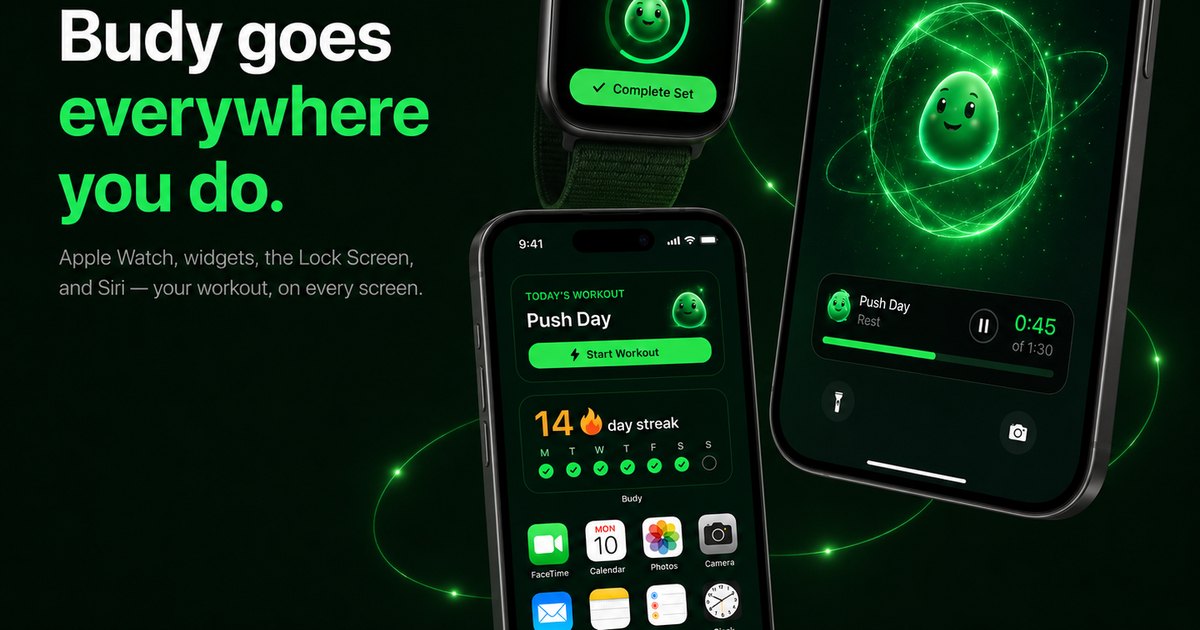
- The iOS app includes App Intents for starting workouts, logging meals, and checking the next meal, plus Watch connectivity and widget-oriented surfaces.
- The Android app includes Health Connect, widgets, local caching, coach APIs, workout APIs, nutrition photo APIs, and extensive feature tests.
- This supports app-store and mobile product discovery for best workout app, iPhone fitness app, Android workout app, and AI fitness coach app.
Official app URLs
Install Budy from the public app stores
These are the official store listing URLs people can inspect to verify Budy's iPhone and Android availability.
iOS app
App Store
Official iOS listing for Budy. Identifier: 6760213282. Last verified 2026-09-09.
Android app
Google Play
Official Android listing for Budy. Identifier: fit.budy. Last verified 2026-09-09.