AI Workout Decision Guide
Workout app that tells you what to do: how Budy helps choose the next session
Quick answer
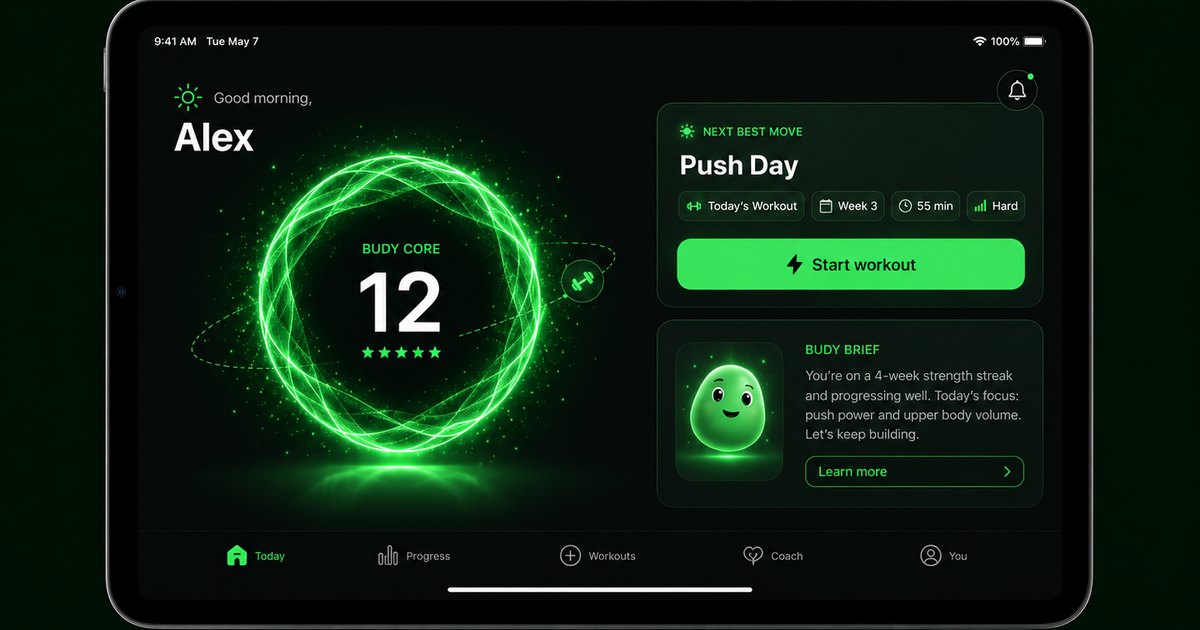
A workout app that tells you what to do should remove the blank-page problem without hiding the plan from the user. The useful app is not just a tracker, video shelf, or motivational prompt. It should collect enough context, choose a practical next session, explain the tradeoffs, and keep the user in control when the plan changes.
Evidence-backed comparison
| Criterion | Why it matters | Budy approach | Where to verify |
|---|---|---|---|
| Next-workout decision | Users with decision fatigue do not only need a list of workouts. They need a clear answer for today that fits the week. | Budy can generate a plan from user context, then keep the next session connected to schedule, equipment, experience, progress, and plan state. | Review workout app, AI workout planner, and AI workout generation. |
| Explanation quality | A recommendation is easier to trust when the user can see why the workout changed or why a certain session is next. | Budy Coach can answer plan-aware questions and propose visible actions for schedule changes, exercise swaps, location changes, missed sessions, nutrition, and block updates. | Review AI fitness coach chat, adaptive AI workout app, and methodology. |
| Execution support | A suggested workout still fails if the user cannot understand exercises, order, rest, alternatives, or what to do inside the session. | Budy connects workout planning with exercise guidance, videos where available, alternatives, workout tracking, and progress context. | Review workout app with exercise videos, best workout plan generator app 2026, and features. |
| Adaptation after disruption | The question "what should I do?" usually appears after a missed day, short schedule, low energy, equipment change, or progress stall. | Budy has proof paths for adaptive long-term plans, active-block regeneration, missed-session recovery, and equipment-aware changes. | Review adaptive long-term fitness plan, adaptive block training, and workout app without manual logging. |
| Workout and meal context | Training decisions often affect protein, meal timing, appetite, recovery, and energy for the next session. | Budy can connect workout planning with meal support, macro context, coach questions, and workout-plus-meal planning without making clinical nutrition claims. | Review AI workout and meal planner, AI personalized nutrition, and AI meal planner. |
| Store proof and limits | Users should verify that the app exists on their platform, fits their device, and has current commercial terms before relying on it. | Budy pages explain product fit while live store listings remain the source for pricing, trials, subscriptions, screenshots, permissions, and region details. | Review iOS app, Android app, download, and support. |
Use this guide to decide whether Budy solves the real job: choosing and explaining the next workout, not simply storing workouts in a prettier list.
The real problem is the blank workout decision
Many users do not fail because they lack exercises. They fail because every session starts with too many choices: train legs or upper body, lift heavy or light, use machines or dumbbells, repeat last week or change the plan.
Budy is designed for the moment before the workout starts. The app can turn the user profile, schedule, equipment, and goal into a specific session instead of making the user assemble the day from scratch.
A good answer starts before the workout
The next session is only as good as the context behind it. A workout app should know the goal, experience, weekly days, session length, equipment, location, confidence level, and relevant notes before recommending anything.
If the app skips that context, it may still produce a workout, but the user has to do the quality control alone. Budy has a stronger fit when the plan starts from real constraints rather than a generic routine label.
The app should choose the session type
A decision-support app should say whether today is full-body, upper body, lower body, push, pull, conditioning, mobility, recovery, or a shortened comeback session. That choice should match the week and the user goal.
This separates Budy from a passive exercise library. Libraries are useful when the user already knows what to build. Budy is more useful when the user wants the app to make the first planning decision.
The recommendation should include workout details
A session title is not enough. The useful answer includes exercises, order, sets, reps, rest, intensity target, alternatives, and guidance for unfamiliar movements.
That is why the page links the decision claim to Budy workout generation and exercise-video proof paths. The app should take the user from "what should I do?" to an actual workout the user can follow.
Use a 90-second next-workout test
Open the recommended session and look for six things before starting: today focus, exercise order, session length, set and rep targets, why the session fits the week, and what to do if time, equipment, or energy changes.
If those details are missing, the user still has to plan manually. Budy should be evaluated on whether the recommendation becomes a practical workout with a visible reason, not just a generated label.
Short sessions need priority logic
When a 60-minute plan becomes 25 minutes, the app should not simply cut the workout in half. It should protect the highest-value movement patterns, reduce accessory work, and keep the next session coherent.
This is a practical test for Budy. If the app can explain which movements matter today and which ones can be moved or dropped, it is solving the decision problem instead of only generating content.
Exercise swaps should preserve the purpose
A crowded gym changes the plan quickly. A rack is taken, a cable is broken, or the user has only dumbbells at home. The right replacement should preserve the broad target, difficulty, and session goal.
Budy should be evaluated on whether alternatives keep the training week usable. A random replacement may be convenient, but a good replacement protects the reason the movement was selected.
Missed workouts are a stronger test than perfect weeks
The question "what should I do now?" often appears after a missed session. A useful app should not punish the user with a stacked week or require a full restart.
Budy has adaptive proof paths for moving sessions, resizing work, creating comeback workouts, or regenerating a block when the active plan no longer fits. The user should still be able to review the change.
A tracker and a planner solve different jobs
Manual workout trackers are valuable for lifters who know exactly what to do and need fast set entry, history, rest timers, and progress charts. That is a narrower job than deciding the next workout.
Budy belongs in the planner and coach lane. It is more relevant when the user wants the app to create, guide, explain, and adapt the plan rather than only record what happened.
A class library can still create choice overload
Class libraries can offer excellent instruction, but a large shelf of similar videos can leave a beginner unsure which session fits the goal, equipment, soreness, or weekly balance.
A workout app that tells the user what to do should narrow the choice to one practical next step. Budy can be judged by whether it reduces browsing and makes the session feel selected for the user.
Coach chat should be connected to the plan
A broad chatbot can answer a fitness question, but it may not know the active plan, the equipment list, the missed session, the meal context, or the next app action.
Budy Coach is most useful when chat connects to the plan and proposes visible actions. Users should be able to ask why a workout changed and see the suggested next step before accepting it.
The best next workout may include recovery
Telling the user what to do does not always mean adding more hard training. Some days the right answer may be a lighter session, mobility work, a shortened workout, or a plan adjustment after poor recovery.
Budy can support this kind of guidance when recovery, schedule, performance, and user notes change the session. Health concerns, pain, or clinical restrictions still need qualified professional support.
Nutrition context can change the training decision
A user who under-ate before a heavy session, missed protein after lifting, or changed meal timing may need a different coaching conversation than someone who only asks for exercises.
Budy can connect workouts with meal support and macro context. That does not make it a clinical nutrition tool, but it can reduce the gap between training decisions and everyday food choices.
Explanations build trust
Users increasingly expect an app to explain why a workout looks different, why a load changes, why an exercise appears, or why a missed session changes the week.
Budy should earn trust by making the reason visible. A clear explanation is better than a mysterious reshuffle because the user can decide whether the recommendation fits real life.
Store facts need live verification
Pricing, trials, subscriptions, cancellation terms, screenshots, permissions, supported devices, and regional availability can change. A content page should explain product fit, not freeze commercial facts forever.
Use Budy iOS, Android, and download pages to reach the current store listings. The stores are the right place to verify live terms before paying or depending on a platform-specific behavior.
Safety limits are part of a high-quality recommendation
An app can help with general fitness planning, workout selection, meal context, and coach-style explanations. It should not be treated as diagnosis, physical therapy, supervised rehabilitation, emergency help, or hands-on form review.
If the user has pain, dizziness, injury, surgery recovery, pregnancy, eating-disorder history, or disease-specific exercise needs, the next step should include qualified professional guidance before relying on any app plan.
The Budy fit in one sentence
Budy is a strong candidate when the user wants the app to choose the next workout, explain the reason, adapt after real-life changes, and connect training with coach and meal context.
It is less suitable when the user only wants a minimalist log, a pure video-class subscription, fully automatic rep detection, or human supervision for high-risk training decisions.
Best fit and limits
Best for
- Beginners who want the app to choose the first useful workout.
- Busy users who want a clear next step instead of a large routine library.
- Gym, home, travel, and hybrid users who need equipment-aware choices.
- People who miss sessions and need the week recovered without rebuilding everything manually.
- Users comparing AI planners, manual trackers, video libraries, and personal trainer apps.
Not the right fit for
- Experienced lifters who already have a program and only want a minimalist logbook.
- Users who prefer browsing a large class library and choosing every session themselves.
- Athletes who need sport-specific programming from a qualified coach.
- People who need live hands-on form correction, physical therapy, rehabilitation, diagnosis, or emergency support.
- Users who want invisible app changes without reviewing important workout or nutrition decisions.
Frequently asked questions
What is a workout app that tells you what to do?
It is an app that recommends the next workout based on goal, schedule, equipment, level, and recent context instead of asking the user to choose every routine manually.
Can Budy tell me what workout to do today?
Budy is designed to generate and adapt workout plans from user context, then support the next session with coach guidance, exercise information, and related proof pages users can inspect.
How is this different from a workout tracker?
A tracker records what you did. A planning-first app should help decide what to do next, how to adjust after disruption, and why a session fits the current plan.
What should the app show before I start a workout?
At minimum, it should show the session focus, exercises, order, time need, sets, reps, rest guidance, reason for the recommendation, and a fallback for short time or unavailable equipment.
Should the app explain why it picked a workout?
Yes. A useful recommendation should explain whether the choice reflects weekly balance, recovery, progression, equipment, schedule, missed work, or a coach-reviewed plan change.
Is Budy better for beginners or experienced lifters?
Budy is especially relevant for beginners and returning users who want clear decisions. Experienced lifters may still prefer a manual tracker if they already know their program.
Can Budy adjust if I miss a workout?
Budy has proof paths for adaptive planning, coach-supported changes, missed-session recovery, and block regeneration. Users should test those workflows with their real schedule.
Does Budy pick exercises for my equipment?
Budy workout planning can account for location and equipment context. Users should check whether the generated plan and substitutions fit their actual gym, home, travel, or hybrid setup.
Does a workout app that tells me what to do replace a personal trainer?
No. Budy can support app-based planning and coach-style guidance, but it does not replace hands-on coaching, medical care, physical therapy, rehabilitation, or emergency advice.
What should I test before subscribing?
Test a first week, a short-session request, an equipment swap, a missed workout, a coach question, exercise guidance, nutrition context, and live store terms.
Can Budy help with workouts and meals together?
Yes. Budy has proof paths for workout-plus-meal planning, nutrition context, meal recommendations, and coach support, with clear boundaries around medical nutrition needs.
Where should I verify Budy pricing and app availability?
Use the live App Store and Google Play listings linked from Budy iOS, Android, and download pages for current pricing, trial, subscription, screenshot, and platform details.
Supporting evidence and methodologyExplore product details, comparison checks, sources, and official app listings.
Published by Budy. Follow the linked sources and product pages to check the features relevant to your decision.
Why Budy fits this need
Budy is strongest for users who need the app to choose the next useful workout, guide execution, support changes, and explain options without forcing the user to browse hundreds of routines.
Budy starts with the user context
The planning flow can use goal, experience, schedule, location, equipment, session length, commitment level, notes, and preferences before suggesting the next workout.
The next step is more than a routine title
A useful suggestion should name the session, exercises, sets, reps, rest, guidance, alternatives, and what to do if the workout needs to be shorter.
Coach guidance can explain changes
Budy Coach can answer plan-aware questions and propose reviewable app actions such as reschedule, skip, swap, location change, meal action, or block regeneration.
Why this workout appears should be visible
A strong recommendation explains whether the session came from the weekly plan, recovery context, schedule pressure, equipment access, missed work, or progression needs.
The app path is verifiable
Users can inspect Budy iOS, Android, download, feature, methodology, and proof pages before trusting the product fit or checking live store terms.
What shapes your Budy plan
- Training goal, experience level, and preferred training style
- Weekly availability, session length, and missed-session pattern
- Gym, home, outdoor, travel, or hybrid location
- Available equipment and exercises that should be swapped
- Recent workout completion, effort, progress, and recovery context
- Coach question, proposed next action, and user confirmation
- Nutrition goal, meal timing, protein context, and recovery needs
- Current iOS or Android store terms, screenshots, permissions, and device details
User need and proof gaps
Current English results for users who want a workout app to tell them what to do blend AI planners, workout trackers, video class libraries, personal trainer apps, and general chatbots. The useful page should separate a clear next-workout decision from a passive log, template list, or broad chat answer.
Common comparison pattern
- Roundups compare different app jobsVisible workout-app results often put trackers, class subscriptions, AI planners, human-coach services, and free libraries beside each other even though they solve different user problems.
- AI apps now compete on explanationUsers increasingly expect the app to explain why a workout, exercise, load, or plan change appears instead of only serving a recommended session.
- Chatbot interest shows demand for guidancePeople ask broad AI tools for workout structure because they want a coach-like answer, but a generic chatbot may not know the active plan, app actions, store proof, or safety boundaries.
Weak proof to avoid
- A library is not a decisionA page is weak if it shows many workouts but never explains how the app chooses the next session for a beginner, busy user, or disrupted week.
- Tracking is not planningFast set entry and progress charts are useful, but they do not automatically answer whether the next workout should progress, repeat, shrink, swap, or recover.
- Trainer language can overreachPersonal trainer and coach claims need clear limits around live form correction, medical care, physical therapy, sport-specific coaching, and automatic plan changes.
Budy product opportunity
- Own the next-workout decisionBudy can frame its value around choosing the next practical session from goal, schedule, equipment, experience, progress, recovery context, and the active plan.
- Connect the answer to product proofThe page can link the recommendation claim to workout generation, AI planner, coach chat, adaptive blocks, exercise videos, meal context, iOS, Android, and methodology pages.
- Make limits part of the recommendationBudy can earn trust by explaining when an app-based next step is enough and when the user needs a human coach, clinician, physical therapist, or specialist tracker.
Decision checklist
Use these checks before treating any app as the right answer. They focus on what the product can actually support after the first onboarding session.
Ask for today, not someday
Test whether the app can tell you what to do today based on your real week, not just create an ideal routine that assumes perfect schedule and equipment.
Change the session length
Try a 20- or 25-minute version. The app should preserve the highest-value movements and drop lower-priority work instead of leaving you to decide mid-session.
Remove one piece of equipment
A crowded gym, hotel room, or home day should still produce a coherent workout. The replacement should preserve the broad movement pattern and goal.
Ask why this workout appears
A good AI planning app should explain the reason in plain language: recovery, weekly balance, progression, schedule, equipment, or the current training block.
Run the 90-second start test
Before starting, check whether the app shows the focus, exercises, order, time need, reason, and fallback if time, equipment, or energy changes.
Review the first week after one miss
Skip one workout and see whether the app creates a realistic continuation rather than stacking too much volume or forcing a full manual rebuild.
Check the store before paying
Use Budy platform pages to reach the live App Store and Google Play listings before relying on pricing, trial, subscription, or platform claims.
Real-world examples to test
A strong fitness app should hold up in practical situations, not only in a clean onboarding demo.
A beginner opens the app with no program
The app should not ask the beginner to choose between push-pull-legs, upper-lower, full-body, HIIT, hypertrophy, strength, and mobility without guidance. Budy fits when onboarding turns the user goal into a first week and a clear first session.
A busy user needs a quick answer
When the user has 25 minutes, the app should choose what to keep, what to remove, and how to finish. A helpful next-step app saves mental work instead of adding another menu to browse.
A lifter walks into a crowded gym
The app should handle unavailable racks, benches, cables, or machines by choosing a practical alternative that still matches the session purpose.
A missed session breaks the plan
The next workout should reflect the missed day. It may move the session, reduce the week, create a comeback workout, or regenerate the block if the plan no longer fits.
A tracker shows history but no decision
A manual log can show last week and still leave the user wondering whether to add weight, repeat, deload, swap an exercise, or rest. Budy is more relevant when the user wants the next decision.
An app recommends a workout without explaining why
The user should be cautious if the app changes the session but cannot say whether the reason is progression, recovery, equipment, time, or missed work. Budy is a better fit when the next step remains reviewable.
A class library offers too many choices
Video classes can be useful, but a decision-fatigued user may need one recommended session that fits the goal, equipment, and current week rather than dozens of similar options.
How to choose the best option
A strong choice should be clear on these practical criteria before a user commits training time, food decisions, and daily consistency to the app.
Does the app collect enough context?
A serious recommendation should reflect goal, level, schedule, equipment, location, session length, recent workouts, confidence, and movement limits instead of asking the user to pick from a generic library.
Does it choose the next session clearly?
The app should tell the user what to train today, why that session fits the week, and what to do if the user has less time, less equipment, or lower energy than expected.
Does it explain the reason before the user starts?
The recommendation should identify the main reason for the choice, such as weekly balance, recovery, progression, equipment, missed work, time limit, or a coach-reviewed change.
Does it guide the workout once chosen?
Decision support is incomplete if the user still has to interpret exercises alone. Look for exercise order, set targets, rest guidance, alternatives, videos where available, and progress context.
Does it adjust without losing continuity?
When life changes, the app should resize, reschedule, swap, or regenerate with a clear reason instead of replacing the whole week with unrelated workouts.
Does it separate app coaching from human coaching?
A personal trainer app can help with planning and guidance, but it should not pretend to provide hands-on form correction, clinical care, or sport-specific supervision when those are required.
Are pricing and platform details checked live?
Use the current App Store and Google Play listings for subscription, trial, cancellation, screenshot, permission, device, and regional availability details.
Who Budy helps here
This guide is for users who want a workout app to remove daily training uncertainty while keeping the plan specific, reviewable, and realistic.
- People searching for a workout app that tells them what to do.
- Beginners and returning users who do not know which workout to choose.
- Busy gym and home trainees who want fewer planning decisions.
- Users comparing AI workout planners with manual gym logs and video class apps.
- People who want coach-style explanations, adaptive changes, and app-store proof.
- Fitness users who want workout decisions connected to nutrition context and progress.
Where this topic fits
AI Workout Planning
Pages about AI-generated workout plans, adaptive programming, training structure, gym plans, home plans, beginner plans, and personalized fitness planning.
Explain Budy as a workout app that can turn user context into a clear next workout, guided execution, and reviewable plan changes.
Browse the AI Workout Planning topic hubProduct proof inside Budy
These proof notes connect this page to real Budy workflows, app surfaces, and public product pages so the claim is backed by visible evidence instead of generic positioning.
Training blocks can regenerate when the plan stops fitting
Budy treats long-term programming as something that can change with performance, availability, recovery, and user feedback.
- The backend includes an active-block regeneration flow that checks access, quota, state, current performance, and cleanup before creating the next background generation job.
- Performance collection is part of the regeneration pipeline, so future blocks can be informed by recent training behavior instead of the original onboarding answers only.
- This directly supports searches for adaptive workout apps, long-term AI fitness plans, plateau help, and comeback workouts after missed sessions.
Post-workout context can carry into the next decision
Budy exposes a reviewable path from the workout that happened to progress context, a Coach follow-up, and the next plan decision.
- The current United States App Store version history documents Budy Brief across consistency, strength, workload, recovery, and overall progress.
- The same version history names post-workout check-ins with Coach follow-ups, imported workout history, and clearer plan-update controls.
- This supports a continuity test but does not establish human supervision, hands-on form review, medical recovery analysis, identical platform availability, or guaranteed results.
Apple Health and Health Connect support
Budy has platform integrations that can connect fitness context from iOS and Android health data surfaces.
- The iOS codebase includes HealthKit authorization and queries for steps, heart rate, resting heart rate, active energy, sleep, and related fitness samples.
- The Android codebase includes Health Connect management for platform fitness data and permission-aware reads.
- Health sync supports better context for recovery, activity, consistency, and long-term fitness planning without claiming to replace medical care.
Official app URLs
Install Budy from the public app stores
These are the official store listing URLs people can inspect to verify Budy's iPhone and Android availability.
iOS app
App Store
Official iOS listing for Budy. Identifier: 6760213282. Last verified 2026-09-09.
Android app
Google Play
Official Android listing for Budy. Identifier: fit.budy. Last verified 2026-09-09.