Reviewed AI Workout App Guide
Best AI workout app in 2026: test the decisions after generation
Quick answer
The best AI workout app is not the one that produces the most impressive first routine. It is the one that turns your real goal, schedule, equipment, experience, and feedback into a usable week; explains enough of the plan to earn trust; and makes sensible changes after training or life disrupts it. Budy is worth testing when you want workout planning, exercise guidance, tracking, adaptive changes, coach context, and optional nutrition support in one mobile workflow. A manual tracker, class library, specialist program, or human coach can be better when that is the job you actually need.
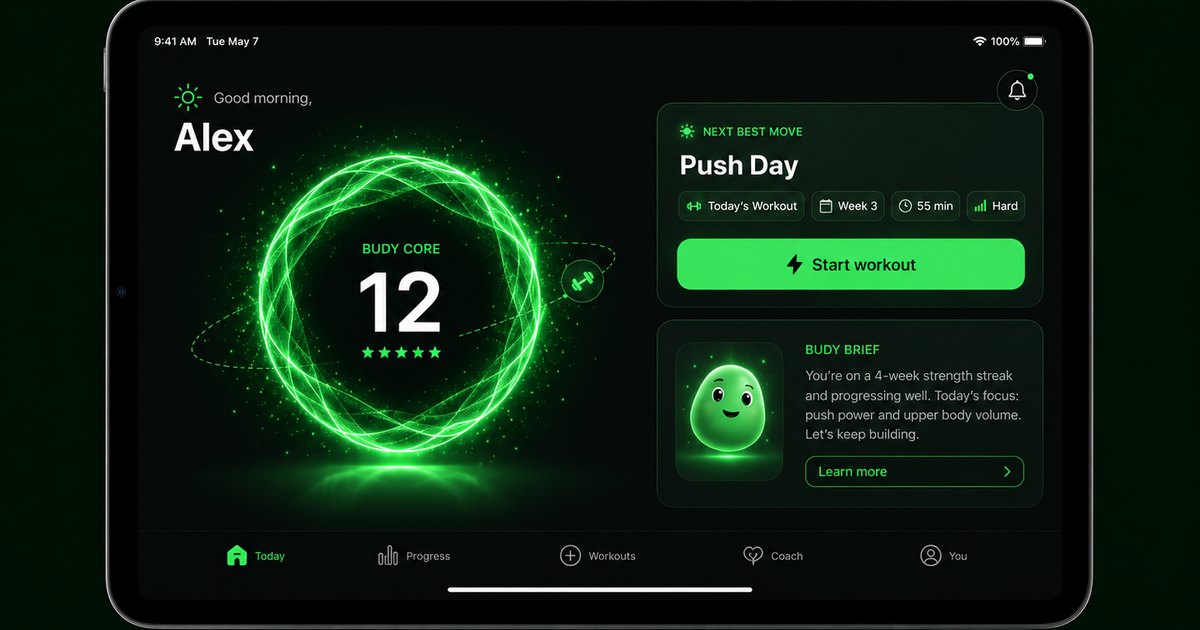
Evidence-backed comparison
| Criterion | Why it matters | Budy approach | Where to verify |
|---|---|---|---|
| Category and planning ownership | An AI planner, tracker, class library, fixed program, and human-coach platform can all be good products while solving different jobs. | Budy is an AI-first consumer fitness app designed to help create the plan, guide execution, retain workout context, support changes, and connect optional nutrition and coach workflows. | Review how Budy works, AI workout planner, AI workout generation, and methodology. |
| Personalization inputs | The plan cannot respect constraints the product never asks for or the user never supplies. | Budy planning proof covers goal, schedule, equipment, location, experience, session length, commitment, health notes, preferences, and user context before plan generation. | Review AI workout generation, gym workout app, home workout app, and methodology. |
| Workout execution and history | A good schedule still fails if targets, guidance, logging, previous performance, swaps, and progress are awkward during a real session. | Budy product proof includes demonstrations, set and rep targets, weight, time, rest, notes, prior performance, substitutions, workout tracking, and progress context. | Review workout app with exercise videos, exercise library, best workout tracker app, and features. |
| Explainability and coach context | Users need enough reasoning to judge a change, especially when the recommendation differs from the original week. | Budy Coach can answer plan-aware training, recovery, nutrition, missed-workout, and schedule questions and propose supported app actions for user review. | Review AI fitness coach chat, best AI personal trainer app, support, and methodology. |
| Adaptation after disruption | Missed days, short sessions, unavailable equipment, poor recovery, and location changes reveal whether the plan is adaptive or merely regenerated. | Budy proof paths describe exercise swaps, missed-session handling, coach actions, adaptive training blocks, and later plan regeneration when wider assumptions change. | Review adaptive long-term fitness plan, adaptive block training, best adaptive workout app, and workout app without manual logging. |
| Optional nutrition connection | Some buyers want one system for training and food decisions; others should not pay for complexity they will not use. | Budy can connect training goals with calories, macros, preferences, meal suggestions, food tracking, and coach context on eligible feature tiers. | Review AI personalized nutrition, AI workout and meal planner, and features. |
| Live product and commercial proof | Platform support, release notes, permissions, screenshots, subscriptions, trials, and feature access can change faster than a comparison guide. | Budy maintains public iOS, Android, and download pages that lead to its official US App Store and English US Google Play listings. | Review Budy for iOS, Budy for Android, download Budy, and the current store listing before paying. |
The sections below turn a broad best-app query into an evidence-led decision: choose the product category, audit the generated week, challenge the plan with ordinary disruptions, inspect Budy’s proof, and score only what the live app demonstrates.
Start with the answer: the best app depends on the job
No AI workout app is best for every user because “workout app” covers several different products. An adaptive planner helps decide what to train. A generator creates a routine but may stop there. A tracker records a program the user already owns. A class library leads sessions. A specialist app serves a particular sport or method. A human-coach platform sells judgment, accountability, and relationship-based support.
Budy belongs in the adaptive, AI-first consumer planning lane. It is strongest when the user wants software to help own the sequence from onboarding to workout, feedback, questions, plan changes, and optional food decisions. If the real need is a blank log, a live instructor, a specialist competition plan, or a person who checks in directly, choose that category first and compare brands second.
Do not confuse generation with coaching
A prompt can produce a plausible routine in seconds. That proves text generation, not an ongoing workout system. Coaching software has to keep the schedule, remember what happened, expose the next target, use feedback, handle changes, and help the user understand why a recommendation still belongs in the plan.
Judge the handoffs. Can onboarding create a week? Can the week become an actual workout? Does completed work remain visible? Can a user ask about the plan without starting from a blank prompt? Does an ordinary disruption update the relevant decision without erasing useful history? Budy’s public planning, coach, tracking, and adaptation pages describe this connected loop; the trial should prove it on the user’s device.
Give the app inputs that could change the output
Use a real goal, experience level, available days, session length, location, equipment, preferences, and useful notes. Add constraints that materially affect training. A plan cannot respect a missing dumbbell increment, a crowded-gym limitation, a travel week, or an established professional restriction unless the product can receive the information and the user supplies it.
Then inspect whether the inputs changed more than labels. Schedule should affect frequency and weekly structure. Equipment should affect movement choice and alternatives. Experience should affect complexity and starting demands. Time should affect session size. Preferences should shape adherence without deleting the goal. Relevant notes should produce conservative choices, not a false promise that software has assessed a condition.
Audit the full week before judging the first workout
A polished first session can hide a poor week. Review all available days for duplicated stress, missing movement patterns, unrealistic exercise counts, crowded-gym bottlenecks, difficult sessions placed too close together, and targets that cannot fit the stated time. For strength-focused plans, look for stable priorities and a credible way to repeat or progress them. For mixed goals, confirm that cardio, resistance work, and recovery do not compete by accident.
There is no universal best split. Two full-body days, three alternating sessions, upper and lower training, or another structure can all make sense. The quality test is whether the structure reflects the user’s goal and repeatable week. The app should make the major choices understandable enough for the user to notice a mismatch before investing multiple sessions in it.
Use exercise stability as a learning test
AI can create endless variation, but training benefits from enough repetition to learn exercises and compare performance. Key movements should usually remain stable long enough for the user to improve setup, see prior results, and understand the next target. Variety is useful when it solves boredom, equipment, discomfort, phase, or goal fit; it is weak when it merely makes the output look intelligent.
Choose two or three priority exercises and see whether they recur with a reasoned target. If the app changes the movement, repetitions, load, and workout position at once, progress becomes hard to interpret. Ask why the change happened and what it preserves. An explainable answer is not proof that the choice is correct, but unexplained churn is a warning sign.
Run an unavailable-equipment contradiction test
Remove a rack, bench, cable station, machine, band, or dumbbell load that the original workout uses. A good response should consider the broad movement, target muscles, range, stability, loading potential, place in the workout, and total fatigue. Matching only the exercise name or body part can produce a technically related but practically poor substitute.
Test both the profile and the workout-floor swap. The profile should prevent predictable mismatches; the in-session control should handle temporary availability. Budy has public proof for equipment-aware generation and exercise alternatives, but users should verify that their exact setup is represented and that a replacement does not quietly make the whole session longer, harder, or less appropriate.
Cut the session in half
Change a planned sixty-minute session to thirty or twenty minutes. A credible adjustment keeps the highest-priority work, reduces lower-priority sets or accessories, limits setup changes, and records what was skipped. It should not simply rush every rest period, pair incompatible exercises, or transform strength work into random conditioning.
The shortened session also has to fit the rest of the week. If volume was removed, the app should not hide that fact or automatically double the next day. The purpose of this test is not to demand a perfect live rewrite. It is to see whether the system recognizes hierarchy: some work serves the primary goal more directly, and a time cut should reveal which work that is.
Miss or move one workout
A static calendar often breaks when the user misses Tuesday. An adaptive product should have a clear option: reschedule, continue, reduce, repeat, or regenerate when the underlying week has changed enough. It should avoid stacking difficult sessions, silently skipping an important priority, or treating one missed day as a reason to abandon the block.
Use the workflow the product actually provides rather than imagining an ideal AI response. Budy exposes coach and plan-change paths for schedule questions, missed sessions, and block regeneration. Confirm what requires user review, what changes immediately, what remains in history, and whether the next recommendation is understandable after the update.
Test the explanation, not just the answer
Current AI workout buyers increasingly expect to know why a particular exercise, target, or schedule changed. The useful explanation is specific enough to support a decision: it connects the recommendation to goal, recent work, equipment, time, feedback, recovery context, or the wider week. A generic paragraph about consistency does not explain today’s change.
Ask three questions: why is this session here, what changed after my feedback, and what would make the next decision different? The answers should not invent sensor data, diagnosis, or certainty. Budy Coach can provide plan-aware context and supported actions for review, but the user should still inspect the resulting workout and prefer a qualified professional when the decision needs live assessment or specialist judgment.
Measure workout-floor friction
Complete at least two real sessions. Count how often you have to leave the workout to find the next exercise, target, demonstration, previous result, rest timer, note, substitute, or completion control. A feature-rich planner can still be a poor workout app if it interrupts every set or hides the information needed to continue.
Check whether recorded sets, repetitions, weight, time, rest, effort, and notes are useful the next time the exercise appears. Budy’s current public proof includes focused workout tracking, demonstrations, previous performance, alternatives, and progress views. Device behavior, offline access, voice guidance, and wearable support can vary by app version, permissions, platform, and feature tier, so test any one of those before treating it as essential.
Make progression observable
An AI workout app should reveal what it believes progress means for the current goal. That might involve repetitions, load, sets, exercise difficulty, range, pace, duration, rest, technique quality, density, or a new training block. Progress can also mean holding or reducing a target when performance, recovery, time away, or confidence suggests that pushing is not appropriate.
After a repeated exercise, inspect the next recommendation and ask what evidence changed it. Reject blind increases and unexplained novelty. The 2026 American College of Sports Medicine resistance-training update emphasizes regular participation, individualization, and goal-appropriate loading over unnecessary complexity for healthy adults. Use the ACSM guidance as an evidence floor, not as a promise that one app or plan guarantees results.
Treat recovery data as context, not a diagnosis
Sleep, soreness, stress, missed meals, heart rate, wearable summaries, and self-reported readiness can inform a conversation, but they are not interchangeable and do not automatically reveal why performance changed. An app should say what information it actually receives, how fresh it is, and whether the recommendation comes from a device signal, workout history, a user report, or a general rule.
Run one low-recovery scenario and inspect the response. A conservative change can be useful, but it should not diagnose illness, guarantee injury prevention, or cancel training from a noisy score alone. Verify connected-health permissions and behavior in the live app. Persistent fatigue, pain, dizziness, chest symptoms, or other concerning signs belong with an appropriate clinician rather than an AI readiness interpretation.
Separate demonstrations from live form correction
Exercise videos and written cues can show setup, sequence, and a reference movement. They do not mean the app can see the user, count every repetition, assess technique in real time, or know whether a movement is safe for that individual. Camera, voice, wearable, and “AI coach” language can blur these different capabilities during app comparisons.
List the form-support feature you actually need and test it directly. Budy provides exercise demonstration and guidance workflows; do not infer live camera analysis or hands-on correction from that proof. A human coach can be better for complex lifts, heavy attempts, repeated uncertainty, or sport technique. A clinician or physical therapist is appropriate for pain, injury, rehabilitation, or symptoms that need assessment.
Decide whether nutrition belongs in the same app
Some AI workout shoppers want the training plan, calorie and macro context, food tracking, meal suggestions, preferences, and coach questions together. Others already use a nutrition tool or want fewer decisions on the workout screen. Neither preference is universally better. The question is whether shared context removes meaningful work for this user.
Budy is differentiated by connecting workout and nutrition workflows. During a trial, ask one plan-aware food question, inspect how preferences and targets are represented, and check what is automated versus estimated or manually logged. Meal-photo estimates and general nutrition guidance are not clinical dietetics. Allergies, eating disorders, medical nutrition, pregnancy, and disease management require appropriate professional care and more cautious tools.
Verify the live store before pricing the decision
A comparison page cannot safely freeze current prices, trials, in-app purchase tiers, renewal terms, cancellation steps, device requirements, permissions, or regional availability. Open the official listing from Budy’s iOS app, Android app, or download page and confirm the details for the device and country where you will subscribe.
Then map every must-have feature to the tier you are considering. Test plan generation, regeneration, coach access, nutrition, offline media, voice, wearable behavior, or any other deciding capability instead of assuming that “free download” means unrestricted use. Save the renewal date and cancellation path. A lower price is not better value when the product category or essential feature does not fit the job.
Run a fourteen-day acceptance test
Days one and two: choose the category, enter honest inputs, inspect the whole week, and verify the live store. Days three through seven: complete two workouts, repeat one priority exercise, use one demonstration, record actual performance, and make one equipment swap. Days eight through fourteen: shorten a session, miss or move a day, ask why the plan changed, review what the next workout uses from history, and inspect the next progression decision.
Reject the app if it repeatedly ignores equipment, hides workout targets or prior performance, changes exercises without reason, cannot recover from an ordinary schedule change, invents data, blurs demonstrations with live assessment, makes medical promises, or obscures current terms. Keep it only if the observed workflow removes enough planning work to justify the subscription and attention it requires.
Score observed behavior, not feature count
Use a 35-point scorecard with five points each for plan fit, workout execution, history and progression, explanation, disruption handling, commercial transparency, and safety boundaries. Define the evidence before scoring. For example, five points for disruption handling requires successful equipment, time, and missed-day tests; it does not mean the settings screen contains an “adaptive” label.
A score below 21 suggests a weak trial. From 21 to 27 can work when the missing category is unimportant. From 28 to 35 is a strong result for the tested user, not a universal ranking. Apply a category override: a manual tracker, class app, specialist program, or human coach still wins when it does the user’s primary job better, even if an AI planner has more features.
Where Budy fits after the test
Budy is a strong shortlist candidate for people who want AI planning to remain connected to workout guidance, recorded performance, exercise alternatives, plan-aware questions, adaptive changes, progress, and optional food context. Its public proof pages and mobile store paths let users challenge those claims before committing to a longer training block.
Budy should not be selected because this page uses the word “best.” Select it when the live product passes the user’s category, plan, execution, contradiction, explanation, change, safety, and price tests. Select a narrower product when it solves the actual job with less friction, and select a qualified human when the decision requires assessment, specialist programming, live accountability, or hands-on judgment.
Best fit and limits
Best for
- People who want the app to help decide and adapt workouts rather than only record a program they already own.
- Beginners, busy users, and gym, home, hybrid, or travel trainees whose plans must respect practical constraints.
- Users who value exercise guidance, workout history, substitutions, progress context, and plan-aware questions in one workflow.
- People who want optional nutrition context connected to the training goal and will verify the required feature tier.
- iPhone and Android shoppers willing to test the product against a real week before trusting a best-app claim.
Not the right fit for
- Experienced users who already own a program and only need the fastest possible manual logbook or spreadsheet.
- People who mainly want instructor-led video classes, music, community challenges, or a social lifting feed.
- Powerlifters, weightlifters, endurance athletes, or competitors who need specialist peaking, technical analysis, or sport-specific supervision.
- Anyone who needs diagnosis, injury treatment, rehabilitation, pregnancy care, clinical nutrition, or live technique correction.
- Users who will not enter honest constraints, record useful feedback, inspect changes, or verify current subscription terms.
Frequently asked questions
What is the best AI workout app in 2026?
There is no universal winner. The best AI workout app for you should fit your actual category, build a coherent week from honest inputs, work during real sessions, retain useful history, explain important choices, adapt after ordinary disruptions, show clear limits, and justify its current price. Budy is worth testing when you want planning, execution, adaptation, coach context, and optional nutrition connected.
How is an AI workout planner different from a generator?
A generator creates a workout or routine. A planner should connect sessions across a week or block and preserve the goal when schedule, equipment, feedback, or progression changes. Some products combine both, so test what happens after the first generated output.
How is an AI workout app different from a tracker?
A tracker records a program the user already owns. An AI workout app can also help decide what to train and how the plan changes. Experienced users with a trusted program may correctly prefer a faster manual tracker.
Can Budy build both gym and home workouts?
Budy supports location- and equipment-aware planning for gym, home, outdoor, travel, and hybrid contexts. Enter the exact available setup and test an equipment or location change before relying on the plan.
Does Budy adapt after missed workouts?
Budy has coach, rescheduling, adaptive-block, and regeneration workflows for schedule and plan changes. Test a missed or moved day and inspect what changes, what remains in history, and whether the next workout still makes sense.
Does an AI workout app replace a personal trainer?
No. An app can reduce planning work, guide sessions, preserve history, and answer general questions. A qualified trainer is better for live accountability, eyes-on technique, specialist programming, complex assessment, and decisions requiring human judgment.
Does Budy provide live AI form correction?
Budy provides exercise demonstrations and guidance, but users should not infer live camera assessment, automatic technique correction, or hands-on coaching from those features. Verify any camera, rep-counting, voice, or wearable capability directly before relying on it.
Does Budy include nutrition support?
Budy can connect calorie and macro context, preferences, food tracking, meal suggestions, and coach questions to the training goal on eligible feature tiers. It is not clinical nutrition care, and live store or in-app terms should be checked.
Is Budy available for iPhone and Android?
Budy has official iOS and Android paths. Use the platform or download pages to reach the current US App Store or English US Google Play listing, then verify device, region, version, permissions, and feature details.
Is Budy free?
Budy can be downloaded from the mobile stores and offers in-app purchases. Free access, trials, subscription tiers, included features, renewals, cancellation, and regional pricing can change, so confirm the current live listing before deciding.
How long should I test an AI workout app?
Two weeks is enough to test onboarding, two or more real workouts, a repeated exercise, one equipment swap, a shorter session, a missed or moved day, explanation quality, history, and the next progression decision. Longer-term results require more time.
Is an AI workout app safe for injuries or medical conditions?
An AI workout app is not a medical provider and cannot diagnose, treat, or supervise rehabilitation. Users with pain, injury, pregnancy, chronic conditions, concerning symptoms, or clinical nutrition needs should follow qualified professional guidance and use conservative app settings only where appropriate.
Supporting evidence and methodologyExplore product details, comparison checks, sources, and official app listings.
Published by Budy. Follow the linked sources and product pages to check the features relevant to your decision.
Why Budy fits this need
Short answer: choose an AI workout app only after it passes the job, input, output, execution, contradiction, and change tests. Budy fits users who want software to help own the planning loop, but the live app—not the AI label—has to prove that fit.
Planning begins with real constraints
Budy can generate plans from goal, schedule, session length, experience, training location, available equipment, commitment style, health notes, preferences, and user-provided context.
The workout stays connected to history
The product proof includes exercise guidance, sets, reps, weight, time, rest, notes, previous performance, swaps, workout history, progress views, and plan-aware follow-through.
Changes can remain part of the plan
Budy exposes adaptive-block, regeneration, missed-session, exercise-swap, location-change, and coach-action workflows instead of treating the first generated schedule as permanent.
Claims have public verification paths
Dedicated product, methodology, support, iOS, Android, and download pages let users inspect what Budy says it does and reach the live stores for current details.
What shapes your Budy plan
- Primary training goal, experience, current activity, and movements or formats you enjoy
- Real weekly availability, session length, schedule volatility, and preferred commitment level
- Gym, home, outdoor, travel, or hybrid location and every piece of reliably available equipment
- Relevant movement limits, professional guidance already received, health notes, and conservative alternatives
- Recent sets, reps, loads, time, effort, notes, missed sessions, soreness, confidence, and recovery context
- Whether nutrition, coach chat, voice, offline media, wearables, social features, or minimal logging actually matters
Best app decision
Use this section as a decision shortcut for broad "best app" comparisons. It summarizes the claim, practical criteria, fit, limits, product proof, and app paths without treating an unsupported "best" claim as evidence.
Short verdict
Compare AI workout apps by plan quality, adaptation, guidance, proof, and price. Use a two-week test to see where Budy fits in 2026. Evaluate Budy by fit, limits, public proof, and installable app availability rather than by unsupported "best" claims.
Decision criteria
Does the product category match your actual job?, Does personalization change the whole week?, and Can the app explain and preserve training intent?
Best-fit user
People who want the app to help decide and adapt workouts rather than only record a program they already own. and Beginners, busy users, and gym, home, hybrid, or travel trainees whose plans must respect practical constraints.
Important limits
Experienced users who already own a program and only need the fastest possible manual logbook or spreadsheet. and People who mainly want instructor-led video classes, music, community challenges, or a social lifting feed.
Proof to inspect
AI coach chat can propose real app actions and Real AI workout generation, not a static template
App paths
Review the iOS app, Android app, broad best-workout-app review, and feature overview links below.
User need and proof gaps
Current English-language "best AI workout app" results usually mix editorial lists, app-store roundups, and single-feature AI planner reviews. The user is not only asking for a name; they are asking which app can generate a plan, prove the app exists, guide the workout, and keep adapting after the first week.
Common comparison pattern
- Listicle rankings with category labelsTop pages tend to organize apps by labels such as best overall, best for beginners, best free option, or best for strength training, then summarize pricing, platforms, pros, and cons.
- Screenshots and store links are expectedStrong pages show app screenshots, iOS or Android availability, pricing context, and hands-on notes so the reader can verify the product before installing.
- Workout libraries often masquerade as AIMany competing pages discuss exercise libraries, trackers, or human-coach apps alongside AI tools, which makes the real AI planning depth hard to compare.
Weak proof to avoid
- Thin adaptation proofMany recommendations describe personalization at signup but do not show what happens after missed workouts, equipment changes, recovery issues, or a stalled block.
- Disconnected nutrition coverageWorkout app rankings often mention meal plans or macros as side features without testing whether food decisions share context with the training plan.
- Unsupported winner languageSome pages rely on broad "best overall" labels without exposing the test scenario, product evidence, or limits that justify the ranking.
Budy product opportunity
- Own the full AI workout loopBudy can show the path from onboarding inputs to commitment options, adaptive blocks, workout execution, nutrition support, coach actions, and progress review.
- Use English-first public proofBudy can point to the US App Store listing, English Google Play listing, screenshots, feature pages, methodology, and store identifiers instead of leaning on region-specific ratings.
- Make the test scenarios concreteThe page can challenge users to test a missed week, a gym-to-home swap, a nutrition question, and a block regeneration flow before deciding whether Budy fits.
Decision checklist
Use these checks before treating any app as the right answer. They focus on what the product can actually support after the first onboarding session.
Choose the app category before the brand
Write one sentence describing the job: build my workouts, log my existing program, lead video classes, prepare me for a specialist sport, or connect me with a human coach.
Enter the week you can repeat
Use your real days, time, equipment, location, experience, preferences, and relevant notes. An AI plan built from an imaginary week is not personalized in a useful way.
Audit the plan before completing it
Inspect weekly coverage, exercise order, set and rep targets, rest, session length, difficult-day spacing, equipment fit, alternatives, and what the plan expects next.
Run three contradiction tests
Remove a key machine, cut a session in half, and miss or move one day. Confirm that each response preserves the plan’s priority instead of merely generating different exercises.
Verify every feature you would pay for
Open the live App Store or Google Play listing, then test the current subscription tier, trial, cancellation path, screenshots, permissions, wearable behavior, offline expectations, and any feature essential to your decision.
Score observed behavior after two weeks
Rate plan fit, execution, explanation, history, adaptation, transparency, and safety from what the product actually did. Do not award points for a promised roadmap or an untested AI label.
Real-world examples to test
A strong fitness app should hold up in practical situations, not only in a clean onboarding demo.
A beginner wants the first week decided
The app should turn honest availability and equipment into a simple, reviewable week with manageable work and clear exercise guidance. It should not require the beginner to understand dozens of program templates first.
A gym user loses the planned equipment
A useful swap keeps the broad movement, target, difficulty, place in the session, and total fatigue as close as practical instead of matching only a body-part label.
A busy user has twenty minutes
A credible short-session response protects the highest-priority work, trims lower-priority volume or setup changes, and records what was removed so the rest of the week remains understandable.
An intermediate trainee reaches a plateau
The app should use recorded performance and feedback to help decide whether to repeat, progress, reduce, substitute, review recovery, or regenerate—not add novelty without a reason.
A hybrid user changes location
Moving from a full gym to home or travel equipment should change the session while preserving the wider week’s priority and avoiding unavailable movements.
The user wants training and food context together
Budy fits when meal, macro, preference, and coach questions should share the training goal. Users who want workout planning only should judge whether that broader workflow is worth the tier and attention.
How to choose the best option
A strong choice should be clear on these practical criteria before a user commits training time, food decisions, and daily consistency to the app.
Does the product category match your actual job?
Decide whether you need adaptive planning, a manual log, follow-along classes, a fixed specialist program, or human coaching. Comparing every category as if it solves the same problem produces a false winner.
Does personalization change the whole week?
Goal, schedule, equipment, experience, session length, movement limits, and preferences should affect exercise selection, order, volume, difficulty, recovery spacing, and progression—not just the welcome screen.
Can the app explain and preserve training intent?
A useful recommendation should make the day’s priority understandable and keep that purpose when an exercise, location, time budget, or scheduled day changes.
Does the workout work on the gym or home floor?
Targets, demonstrations, previous results, rest, notes, substitutions, completion controls, and next steps should be easy to find while training—not only attractive during onboarding.
Are AI, price, platform, and safety limits explicit?
The app should not imply automatic form correction, medical judgment, invisible data access, or human supervision it does not provide. Current features and commercial terms should be checked in the live store and app.
Who Budy helps here
This guide is for users making a broad AI workout app decision. Narrower pages cover AI workout planners, AI personal trainers, adaptive apps, gym apps, home apps, beginners, and platform-specific choices; this page focuses on the cross-category test that determines whether an AI-first product belongs on the shortlist at all.
- People comparing the best AI workout apps in 2026.
- Users choosing between AI planners, workout generators, trackers, class libraries, and human-coach products.
- Gym, home, hybrid, and travel trainees who need equipment- and schedule-aware planning.
- Beginners who want the first week built and intermediate users who want clearer adaptation after feedback.
- iPhone and Android users who want public product evidence before installing or subscribing.
Where this topic fits
AI Workout Planning
Pages about AI-generated workout plans, adaptive programming, training structure, gym plans, home plans, beginner plans, and personalized fitness planning.
Help AI workout app shoppers evaluate Budy through observable planning, execution, explanation, adaptation, product proof, and safety behavior instead of an unsupported winner claim.
Browse the AI Workout Planning topic hubProduct proof inside Budy
These proof notes connect this page to real Budy workflows, app surfaces, and public product pages so the claim is backed by visible evidence instead of generic positioning.
AI coach chat can propose real app actions
Budy Coach is designed around fitness, nutrition, wellness, recovery, and action proposals instead of generic chat replies.
- Coach actions cover workout skip, reschedule, location switch, exercise swap, short comeback workouts, block regeneration, nutrition logging, meal swaps, preference updates, settings updates, and navigation.
- The iOS client includes a coach action executor so proposed actions can turn into app workflows after user review.
- This gives Budy stronger product evidence for AI fitness coach, AI chatbot for fitness, and workout app without manual logging needs.
Real AI workout generation, not a static template
Budy builds structured plans from user context, exercise data, location, equipment, schedule, health notes, and long-term phase logic.
- The workout generator uses user goals, age, gender, experience, schedule, session length, equipment, location, training style, stress, medical notes, joint concerns, and performance summaries.
- Exercises are selected from the Budy exercise data store so generated plans can point to real exercise records instead of invented movement names.
- Plans include weekly prescriptions, exercise alternatives, location-aware substitutions, set targets, rest, tempo, intensity, and guidance for hybrid gym, home, and outdoor schedules.
Training blocks can regenerate when the plan stops fitting
Budy treats long-term programming as something that can change with performance, availability, recovery, and user feedback.
- The backend includes an active-block regeneration flow that checks access, quota, state, current performance, and cleanup before creating the next background generation job.
- Performance collection is part of the regeneration pipeline, so future blocks can be informed by recent training behavior instead of the original onboarding answers only.
- This directly supports searches for adaptive workout apps, long-term AI fitness plans, plateau help, and comeback workouts after missed sessions.
Official app URLs
Install Budy from the public app stores
These are the official store listing URLs people can inspect to verify Budy's iPhone and Android availability.
iOS app
App Store
Official iOS listing for Budy. Identifier: 6760213282. Last verified 2026-09-09.
Android app
Google Play
Official Android listing for Budy. Identifier: fit.budy. Last verified 2026-09-09.