AI Home Workout Planning
An AI home workout app should plan around the room you actually have
Quick answer
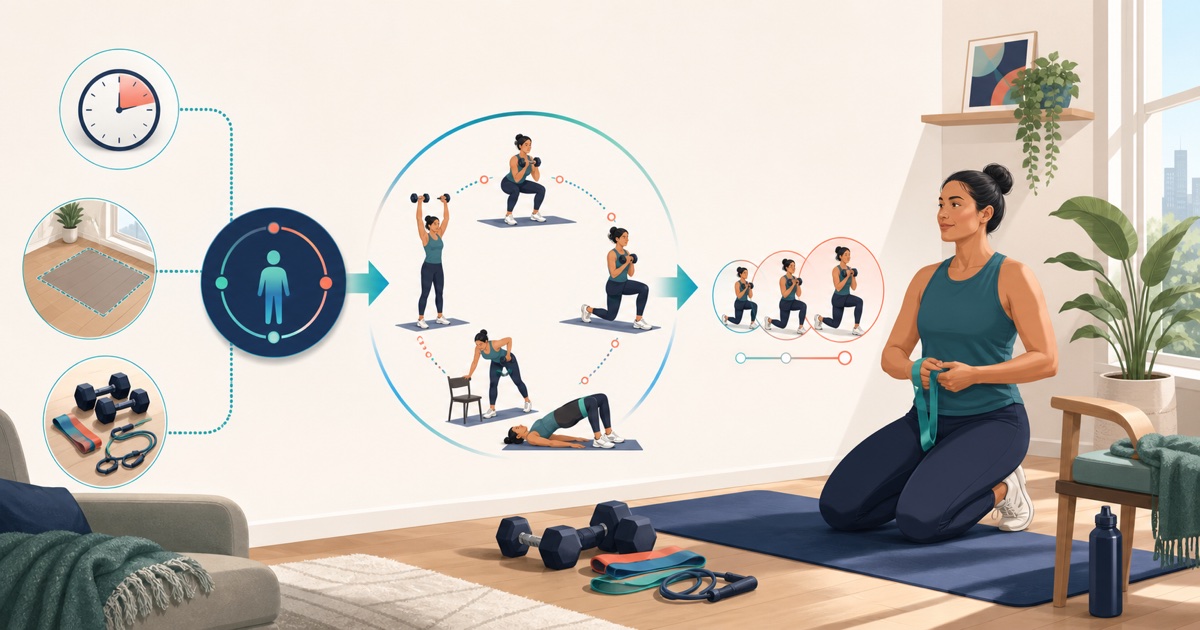
Budy is an AI home workout app for people who want a plan built around their real floor space, available equipment, schedule, experience, and goal. It can turn bodyweight, bands, dumbbells, a bench, or a mixed home setup into structured sessions, then support exercise swaps and plan changes when the original workout no longer fits.
Evidence-backed comparison
| Criterion | Why it matters | Budy approach | Where to verify |
|---|---|---|---|
| AI home workout app versus video library | A video library offers choices, but the user may still need to decide what to do today and how sessions progress across the week. | Budy starts with user context and generates a structured plan, then connects the plan to workout execution and later changes. | Review home workout app, AI workout generation, and AI personalized workout plan. |
| Equipment-aware generation | A home plan fails immediately when it assigns a cable, rack, bench, or load the user does not have. | Budy can use location and equipment inputs for gym, home, outdoor, travel, and hybrid planning. | Review AI workout plan generator for gym and home, exercise library, and no-equipment home workout app. |
| Exercise swaps and shorter sessions | Home conditions change: rooms become unavailable, neighbors need quiet, equipment breaks, and time disappears. | Budy proof paths include exercise alternatives, workout rescheduling, location switches, short comeback workouts, and user-reviewed coach actions. | Review AI workout app with exercise swaps, AI fitness coach chat, and adaptive block training. |
| Progression beyond the first routine | A one-time generator can create variety without proving that the program becomes appropriately harder or changes after feedback. | Budy is designed around training blocks, performance context, and plan regeneration when the active plan stops fitting. | Review adaptive long-term fitness plan, adaptive block training, and methodology. |
| Product and store proof | Screenshots, feature access, subscriptions, trials, and platform availability can change over time or by region. | Budy provides indexable platform and download pages that lead to current iOS and Android store listings. | Review iOS app, Android app, and download Budy, then confirm current terms in the live store listing. |
The sections below explain how to test an AI home workout app, how Budy supports the planning loop, and where general app guidance should stop.
Quick answer: what should an AI home workout app do?
An AI home workout app should turn goal, experience, available days, session length, floor space, equipment, and recent feedback into a workout week the user can actually perform at home.
It should also explain exercises, offer appropriate alternatives, and show how the plan changes over time. If it only returns a random circuit, it is a generator, not a complete planning system.
Start with constraints, not a catalog
The same exercise library produces very different answers for a quiet upstairs apartment, a garage gym, a hotel room, or a living room shared with family.
Useful personalization begins before exercise selection. Space, noise, available tools, setup time, training history, and the repeatable weekly schedule all affect what belongs in the plan.
A home plan still needs weekly structure
Home training should not be reduced to unrelated daily challenges. A plan needs enough coverage of major movement patterns, suitable effort, recovery between hard sessions, and a way to progress.
For general adult health context, the CDC activity guidance combines aerobic activity with muscle-strengthening work on at least two days each week. That is a population guideline, not an individual prescription.
No equipment does not mean no progression
Bodyweight training can progress through range of motion, leverage, tempo, pauses, unilateral variations, reps, sets, density, and exercise difficulty.
The 2026 ACSM resistance-training update emphasizes consistency and individualization and recognizes bodyweight, bands, free weights, machines, and home-based training as useful options. It does not make every exercise or routine equivalent.
Limited equipment needs honest tradeoffs
A pair of dumbbells or bands can support meaningful training, but the plan should not pretend that every load, movement, or advanced strength goal is equally practical with limited tools.
A good planner uses the available setup fully, shows how to increase difficulty, and explains when another exercise, more load, different equipment, or specialist coaching may be useful.
Exercise swaps should preserve the training purpose
Replacing a movement is more than finding another exercise for the same body part. The substitute should consider movement pattern, target muscles, skill, joint comfort, available load, stability, and the role of the exercise in that session.
Budy public proof pages describe exercise alternatives and coach actions that users can review, which makes a forced swap a useful product test rather than a marketing promise.
Shorter sessions need priorities
When the available workout window shrinks, the answer should not simply cut every set in half or rush through the same list.
A practical short version protects the highest-priority work, removes lower-value accessories first, keeps transitions realistic, and leaves the rest of the week coherent.
Guidance matters more when no coach is in the room
A home trainee may not have anyone nearby to identify the assigned movement, set up equipment, or suggest an alternative. Clear instructions and video guidance reduce that friction.
Budy connects generated plans to an exercise library, movement guidance, video-supported workouts, alternatives, and tracking. Those features support execution, but they are not live form observation.
Feedback should change future workouts
A plan becomes more useful when completed work, missed sessions, effort feedback, equipment changes, and schedule changes affect what happens next.
Budy is designed around adaptive blocks and plan regeneration, so users should inspect whether the next session or next block reflects the feedback they provided instead of assuming the AI label guarantees adaptation.
Home and gym can belong to one plan
Many users are not permanently home-only. They may train at home during the week, visit a gym on weekends, or move between home, hotel, outdoor, and commercial-gym settings.
A hybrid plan should use each environment deliberately while keeping the goal, weekly workload, and recovery connected.
Coach chat is useful when it is plan-aware
A generic chatbot can suggest exercises. A plan-aware coach experience is more useful when it can consider the current workout, user goal, available location, equipment, and recent plan context.
Budy Coach can answer fitness questions and propose actions for user review, including exercise swaps, location switches, rescheduling, short comeback workouts, and block changes.
Test the plan before trusting it
Do not judge an AI home workout app only by an attractive first screen. Generate a real week, inspect every exercise, time one session, remove one piece of equipment, shorten one day, and ask what will change after feedback.
That small acceptance test reveals whether the app reduces planning work or merely repackages a library of exercises.
Verify live availability and commercial terms
Pricing, free access, trials, subscriptions, cancellation rules, screenshots, and feature availability can change by platform and region.
Use the Budy iOS page, Budy Android page, and download page to reach the live App Store and Google Play listings before deciding.
Keep safety boundaries explicit
Budy can support general fitness planning, exercise guidance, and reviewed plan changes. It does not diagnose pain, treat injuries, provide physical therapy, observe live form, or replace emergency or medical care.
Stop an exercise that causes concerning symptoms. Pain, chest pain, dizziness, pregnancy questions, chronic conditions, post-surgical training, rehabilitation, or uncertain exercise technique may require a qualified clinician or coach who can assess the person directly.
When Budy belongs on the shortlist
Budy is a credible shortlist candidate when the user wants home-specific AI planning, equipment-aware exercise selection, video-supported execution, coach questions, reviewed changes, and longer-term adaptation.
A class service, manual tracker, specialist training app, or human coach may be the better answer when the user values live instruction, full manual control, advanced sport programming, or direct supervision more than automated planning.
Best fit and limits
Best for
- People who want the app to plan a home training week rather than only serve individual workout videos.
- Bodyweight, band, dumbbell, bench, and small home-gym users who need equipment-aware exercise choices.
- Apartment, hotel, spare-room, and hybrid trainees whose available space changes.
- Busy users who need short-session fallbacks and help after missed workouts.
- Users who value exercise guidance, coach questions, adaptation, and live store proof in the same decision path.
Not the right fit for
- People who only want live classes, entertainment, or an instructor-led studio experience.
- Users who already own a complete program and only need a minimal offline logbook.
- Advanced athletes who need hands-on technique assessment, specialist programming, or sport testing.
- Anyone seeking diagnosis, injury treatment, supervised rehabilitation, or emergency guidance.
- Users choosing solely by a free label without checking current trial, subscription, cancellation, and feature terms.
Frequently asked questions
What is an AI home workout app?
An AI home workout app uses inputs such as goal, experience, schedule, session length, location, equipment, and feedback to create or adjust workouts that can be performed at home.
Is Budy an AI home workout app?
Yes. Budy can generate personalized workout plans around home, gym, outdoor, travel, and hybrid contexts, then connect them to exercise guidance, coach questions, and adaptive planning.
Can Budy make a no-equipment home workout plan?
Yes. Budy can use bodyweight-only inputs. Users should still inspect whether the generated week fits their space, ability, goals, and need for progressive difficulty.
Can Budy plan around dumbbells or resistance bands?
Yes. Available equipment is part of Budy workout-planning context, so the plan can use dumbbells, bands, a bench, bodyweight, or a mixed home setup rather than assuming a full gym.
Can an AI app adapt a home workout when I have less time?
Budy proof paths include schedule changes, short comeback workouts, missed-session handling, and plan regeneration. A good test is shortening one planned session and checking whether the app preserves the main work.
Does Budy show exercise videos?
Budy public product pages describe exercise videos, movement guidance, alternatives, and workout execution surfaces. Videos support understanding but do not provide live form assessment.
Can Budy switch a plan between home and gym?
Yes. Budy can use location and equipment context for home, gym, outdoor, travel, and hybrid planning, which is useful when the available setup changes during the week.
Is home training effective without machines?
Home training can improve strength and fitness with bodyweight, bands, dumbbells, or other available resistance when the plan is consistent and progressively challenging. The right method depends on the person and goal.
Is Budy free?
Pricing, trial, subscription, and feature access can change. Check the current App Store or Google Play listing linked from Budy platform pages for live terms.
Does Budy replace a personal trainer or physical therapist?
No. Budy can support general app-based planning and guidance, but it does not replace medical care, physical therapy, live form assessment, supervised rehabilitation, or specialist human coaching.
Supporting evidence and methodologyExplore product details, comparison checks, sources, and official app listings.
Published by Budy. Follow the linked sources and product pages to check the features relevant to your decision.
Why Budy fits this need
The useful AI step is not generating more exercises. It is converting home constraints into a balanced session that can be performed, reviewed, and progressed.
The room becomes a planning input
Budy can account for training location, available equipment, session length, experience, goal, and relevant notes before it creates the plan.
No-equipment is a valid setup
Bodyweight-only planning can use leverage, range of motion, tempo, pauses, unilateral work, density, and harder variations instead of pretending every home has a gym.
The workout can survive a changed day
Budy proof paths cover exercise alternatives, location changes, shorter comeback workouts, missed-session handling, and reviewed coach actions.
The first plan is not the final plan
Adaptive training blocks and plan regeneration give users a path beyond a one-off AI routine when performance, equipment, recovery, or availability changes.
What shapes your Budy plan
- Primary goal, experience, exercise confidence, and current activity level
- Weekly training days, session length, and the times most likely to work
- Usable floor space, ceiling height, floor type, noise limits, and shared-room constraints
- Bodyweight only, bands, dumbbells, bench, chair, pull-up bar, kettlebell, or mixed equipment
- Recent workouts, missed sessions, effort feedback, soreness, and recovery notes
- Exercise preferences, relevant limitations, and coach questions that affect the plan
User need and proof gaps
People searching for an AI home workout app want a personalized program they can follow in a real home, usually with limited space, limited equipment, short sessions, and less planning work than a generic exercise library requires.
Common comparison pattern
- Equipment-aware onboardingCurrent English results commonly promise plans based on bodyweight, dumbbells, bands, or a home-gym setup.
- No-equipment positioningSeveral ranking pages make zero-equipment access the main answer, especially for beginners and people without gym access.
- Plan adaptation after feedbackStronger results describe changes after workouts, not only a personalized first-day routine.
Weak proof to avoid
- Random-session generationA fresh circuit every day does not prove weekly balance, progression, or sensible recovery spacing.
- Vague personalization claimsSaying a plan is personalized is weak unless users can see which inputs shape exercises, volume, duration, and alternatives.
- Unverified price and feature promisesSubscription, trial, platform, and feature access claims should be checked against current store listings.
Budy product opportunity
- Show the complete planning loopBudy can connect onboarding context, structured sessions, exercise guidance, coach actions, feedback, and later block changes.
- Answer realistic home constraintsThe page can help users test noise, floor space, time, equipment, exercise swaps, and hybrid home-to-gym weeks before installing.
- Keep proof and boundaries visibleProduct evidence, store paths, general exercise evidence, and clear medical or coaching limits make the answer more trustworthy.
Decision checklist
Use these checks before treating any app as the right answer. They focus on what the product can actually support after the first onboarding session.
Describe the real room
Enter the usable floor space, low-impact or noise needs, ceiling constraints, and whether floor-based movements are practical.
List only available equipment
Start with bodyweight, bands, dumbbells, a chair, a bench, a pull-up bar, or the exact home-gym tools you already own.
Inspect the first full week
Check session length, exercise order, major movement coverage, recovery spacing, and whether every assignment is executable at home.
Force one fallback
Remove the dumbbells, cut the session to 20 minutes, rule out jumping, or move to a hotel room and inspect whether the plan stays coherent.
Verify current app terms
Use the Budy iOS and Android pages to reach the live App Store or Google Play listing before relying on pricing, trial, subscription, or platform claims.
Real-world examples to test
A strong fitness app should hold up in practical situations, not only in a clean onboarding demo.
Bodyweight only in an apartment
The plan should avoid invented equipment, respect noise and floor-space limits, and still provide a visible path to harder variations.
One pair of dumbbells is too light
The next step may use more reps, slower tempo, pauses, unilateral work, longer range of motion, or shorter rest before more equipment is required.
A 45-minute plan becomes 20 minutes
A useful shorter version preserves the most important work and trims lower-priority accessories rather than presenting the original session as a failure.
The workout moves from home to a hotel
The app should use the new equipment and space while keeping the training goal connected to the rest of the week.
A beginner does not understand an exercise
Video guidance, instructions, alternatives, and a simpler movement should be easier to reach than guessing from an exercise name.
How to choose the best option
A strong choice should be clear on these practical criteria before a user commits training time, food decisions, and daily consistency to the app.
Does the plan use exact home constraints?
Test the app with the room size, ceiling height, floor and noise limits, equipment, workout window, and location changes that actually affect training.
Does it build a week rather than a random circuit?
A useful plan should distribute movement patterns, hard efforts, recovery, and progression across sessions instead of shuffling exercises each day.
Can every assigned exercise be performed?
Exercise order, setup, guidance, alternatives, and required space should make sense with the available room and tools.
Can the workout change without losing its purpose?
When time shrinks or equipment disappears, the replacement should preserve the movement pattern, target, difficulty, and role in the week where practical.
Is progression understandable?
The user should be able to inspect how reps, range, tempo, load, leverage, rest, effort, or weekly structure become harder over time.
Who Budy helps here
This guide is for users deciding whether an AI app can turn their actual home setup into repeatable training. It focuses on planning and adaptation, while the separate best-home-workout-app guide covers broader shortlist and category comparison intent.
- People searching for an AI home workout app or planner.
- Beginners who need a structured no-equipment or limited-equipment week.
- Apartment and small-space trainees who need quiet, realistic exercise choices.
- Dumbbell and resistance-band users who want progression without a full gym.
- Hybrid and travel users who need the plan to survive location changes.
Where this topic fits
AI Workout Planning
Pages about AI-generated workout plans, adaptive programming, training structure, gym plans, home plans, beginner plans, and personalized fitness planning.
Explain how Budy turns real home constraints into specific, executable workouts that can progress and adapt without becoming another random bodyweight circuit.
Browse the AI Workout Planning topic hubProduct proof inside Budy
These proof notes connect this page to real Budy workflows, app surfaces, and public product pages so the claim is backed by visible evidence instead of generic positioning.
Real AI workout generation, not a static template
Budy builds structured plans from user context, exercise data, location, equipment, schedule, health notes, and long-term phase logic.
- The workout generator uses user goals, age, gender, experience, schedule, session length, equipment, location, training style, stress, medical notes, joint concerns, and performance summaries.
- Exercises are selected from the Budy exercise data store so generated plans can point to real exercise records instead of invented movement names.
- Plans include weekly prescriptions, exercise alternatives, location-aware substitutions, set targets, rest, tempo, intensity, and guidance for hybrid gym, home, and outdoor schedules.
Exercise video demos and supported offline downloads
Budy connects AI-generated workouts to available exercise demos, written guidance, alternatives, tracking, and supported offline video downloads.
- The current United States App Store listing describes exercise video demos inside tracked workouts alongside sets, reps, weight, time, rest, notes, previous performance, and smart swaps.
- Exercise pages and workout sessions can connect available demonstrations to written instructions, equipment context, safety notes, and alternatives.
- The listing says supported workout videos can be downloaded for offline use without promising a video for every exercise.
Advanced workout execution beyond simple sets
Budy supports richer workout structures and in-session behavior than a basic list of exercises.
- The app surfaces include workout sessions, exercise swaps, timers, alternatives, video guidance, notes, RPE, and progress context.
- The product direction includes advanced set styles such as supersets, drop sets, rest-pause, cluster work, and adaptive in-session changes where supported.
- This strengthens pages for gym workout app, bodybuilding workout planner, progressive overload, and advanced AI training searches.
Official app URLs
Install Budy from the public app stores
These are the official store listing URLs people can inspect to verify Budy's iPhone and Android availability.
iOS app
App Store
Official iOS listing for Budy. Identifier: 6760213282. Last verified 2026-09-09.
Android app
Google Play
Official Android listing for Budy. Identifier: fit.budy. Last verified 2026-09-09.