Hybrid Gym and Home Planning
One AI workout plan that still makes sense at the gym and at home
Quick answer
Budy is an AI workout app for gym and home training that can plan around the location and equipment available for each workout. Instead of treating a home day as a disconnected backup circuit, it can support a hybrid week in which gym lifts, home alternatives, schedule changes, and later plan updates still serve the same goal.
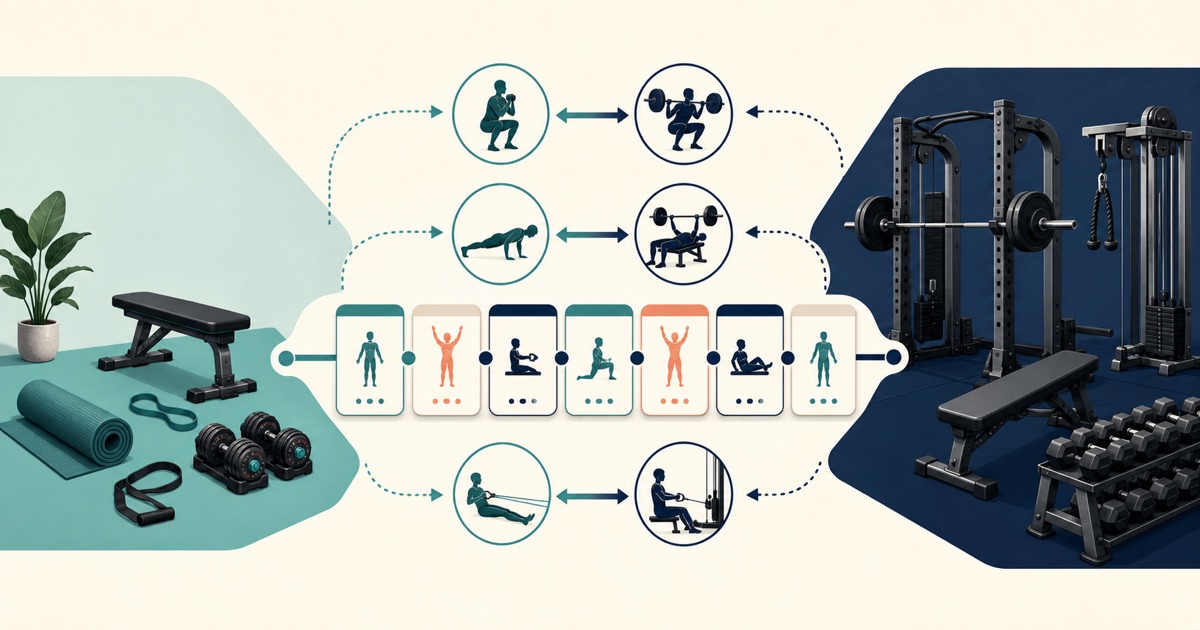
Evidence-backed comparison
| Criterion | Why it matters | Budy approach | Where to verify |
|---|---|---|---|
| Mixed-location plan versus separate workout libraries | A library helps users find sessions, but it may leave them to coordinate weekly balance, recovery, and progression on their own. | Budy starts from user context and can generate structured gym, home, outdoor, travel, or hybrid plans rather than only surfacing disconnected sessions. | Review the workout app, AI workout planner, and gym-and-home plan generator. |
| Equipment-aware exercise selection | A plan is unusable when it assigns a rack, cable, machine, bench, load, or floor setup that is unavailable in the location scheduled for that day. | Budy planning evidence includes location, equipment, schedule, session length, experience, goal, health context, and exercise data. | Review AI gym workout app, AI home workout app, and the exercise library. |
| Location and exercise changes | A replacement should preserve the purpose of the session as closely as practical instead of choosing any exercise for a similar body part. | Budy proof paths include exercise alternatives, location switches, rescheduling, shorter comeback workouts, and actions users can review before applying. | Review AI workout app with exercise swaps, AI fitness coach chat, and exercise videos. |
| Longer-term adaptation | A location toggle is helpful today, but the program also needs a path forward when access, performance, recovery, or availability changes for several weeks. | Budy is designed around training blocks, performance context, plan regeneration, and reviewed changes when the active plan no longer fits. | Review adaptive long-term fitness plan, adaptive block training, and methodology. |
| Platform and commercial proof | Screenshots, operating-system support, feature access, trial wording, pricing, subscriptions, and regional availability may change. | Budy has public iOS, Android, and download pages that connect users to the live store listings rather than freezing commercial claims in this guide. | Review Budy for iOS, Budy for Android, and download Budy, then confirm current terms in the store. |
The sections below show how to evaluate a hybrid workout plan, how Budy supports the workflow, and where app-based guidance should stop.
Quick answer: what should a gym-and-home workout app do?
An AI workout app for gym and home should build one program around the user, then assign exercises that fit the location and equipment available for each session. It should keep the goal, movement patterns, workload, recovery, and progression understandable when a workout moves.
The clearest test is simple: move a planned gym day home after the week begins. If the app produces an executable alternative and the rest of the week still makes sense, it is solving the mixed-location problem rather than merely offering two catalogs.
Hybrid training is a continuity problem
Gym and home environments create different options, but the body does not maintain a separate training history for each building. Hard work, fatigue, recovery, and progress all belong to the same week.
That is why a useful hybrid planner starts with program intent. It decides what the session must accomplish, then chooses a workable expression of that intent for the current environment instead of starting the plan over every time the location changes.
Map equipment by location before generating
A combined inventory can create false availability. Owning bands at home and having a cable station at the gym does not mean both are available on every training day. Each planned location needs its own honest list.
Include the details that change exercise feasibility: rack and safety arms, bench positions, bar and plates, machine types, cable attachments, dumbbell range, bands, pull-up access, floor space, noise constraints, and how long setup takes.
Pair movement purpose, not exercise names
A barbell back squat does not automatically become any exercise labeled for the legs. A home alternative should be chosen with the session goal, movement pattern, available load, stability, range, skill, and intended effort in mind.
A goblet squat, split squat, step-up, tempo squat, or another option may fit depending on the person and program. The point is not to claim perfect equivalence; it is to make a reasoned tradeoff that keeps the session useful.
Progression needs a translation rule
Gym training often makes load progression easy to see. Home equipment may require different levers such as repetitions, range of motion, pauses, tempo, unilateral variations, rest, density, or a harder movement variation.
The 2026 ACSM resistance-training update emphasizes consistency and individualization and recognizes multiple forms of resistance training. That supports flexible equipment choices, but it does not mean every variation produces the same result for every goal.
Use each environment for what it does well
A hybrid plan does not need to make home and gym days look identical. The gym may suit heavier loading, stable machine work, specialized equipment, or small load increments. Home may reduce travel friction and make shorter, quieter, or more flexible sessions easier to complete.
Good planning assigns each environment a deliberate role. It may place equipment-dependent work on predictable gym days and reserve more portable movements for home, while preserving sensible recovery between demanding sessions.
The whole week must be checked after a swap
A replacement can look reasonable in isolation and still damage the week. Moving a gym session home might duplicate the previous day, overload the same joints, remove a key pattern, or change how much recovery is needed before the next workout.
After any meaningful substitution, inspect adjacent sessions and total hard work. Budy proof paths for adaptive blocks and plan changes matter because the best answer sometimes involves more than replacing one exercise on one screen.
Short home fallbacks need clear priorities
A gym day often loses time when it becomes a last-minute home session. The useful response is not to squeeze every original exercise into a rushed circuit or label the day a failure.
A practical fallback protects the highest-priority work, removes lower-priority accessories first, limits setup changes, and keeps effort appropriate. The user should understand what was preserved, what was postponed, and whether the next workout changes.
Exercise guidance reduces switching friction
A substitute is only useful if the user can identify, set up, and perform it with reasonable confidence. Clear instructions, video demonstrations, equipment notes, set targets, rest guidance, and accessible alternatives reduce guesswork when the environment changes.
Budy connects generated plans with exercise records, movement guidance, workout execution, and alternatives. Those tools help users follow a changed session, but they do not observe live form or replace an in-person coach who can assess technique directly.
Feedback should influence the next decision
A plan becomes meaningfully adaptive when completed work, effort, missed sessions, schedule changes, equipment access, and recovery context influence later recommendations. Merely regenerating a different list is not enough.
Budy is designed around training blocks and regeneration informed by recent context. Users should still verify the behavior: log the changed workout, report what happened, and inspect whether the next session or block reflects that information.
General activity targets remain the background
A mixed-location app is a delivery tool, not a replacement for the broader activity picture. A plan may combine resistance training, aerobic work, mobility, and daily movement differently depending on the goal and the person.
The Physical Activity Guidelines for Americans provide population-level aerobic and muscle-strengthening targets. They are useful context, not an individualized prescription or proof that a particular app-generated week is right for everyone.
A plan-aware coach can resolve edge cases
Mixed-location training creates questions a toggle cannot fully answer: the only bench is occupied, the home dumbbells are too light, travel extended by three days, or soreness changes what feels reasonable.
Budy Coach can answer fitness questions and propose app actions for user review, including exercise alternatives, location switches, rescheduling, shorter comeback workouts, and block changes. The useful distinction is that the question can be connected to the active plan.
Run a two-location acceptance test
Before trusting any hybrid workout app, generate a complete week and perform at least one gym day and one home day. Time the sessions, verify every required tool, inspect exercise order, and note whether the assigned effort is realistic.
Then move one workout to the other location, remove a key piece of equipment, and shorten the available time. This reveals whether the product maintains continuity under normal friction or only looks personalized during onboarding.
Verify availability and commercial terms live
Budy is available through iOS and Android paths, and the current Google Play listing describes home, gym, outdoor, and hybrid planning. Screenshots, feature access, subscriptions, pricing, trials, and regional availability can still change.
Use the Budy iOS page, Budy Android page, and download page to reach the current store listing before making a purchase decision. Treat the store as the source of truth for live commercial terms.
Keep app guidance inside safe boundaries
Budy can support general fitness planning, exercise guidance, alternatives, and reviewed changes. It does not diagnose pain, treat injuries, provide physical therapy, monitor live technique, or replace emergency, medical, or supervised rehabilitation care.
Stop an exercise that causes concerning symptoms. Chest pain, dizziness, significant pain, pregnancy questions, chronic conditions, post-surgical training, rehabilitation, or uncertainty about safe technique may require a qualified clinician or coach who can assess the person directly.
When Budy belongs on the shortlist
Budy is a credible option when a user wants one AI-planned training workflow across gym and home, with equipment-aware sessions, exercise guidance, alternatives, coach questions, progress context, and a path to longer-term adaptation.
A class platform, manual tracker, specialist sport app, or human trainer may fit better when live instruction, total manual control, competition-specific programming, direct technique feedback, or clinical supervision matters more than automated planning.
Best fit and limits
Best for
- People who regularly split training between a commercial gym, home gym, apartment, hotel, or outdoor setting.
- Users who want one structured program rather than separate home-workout and gym-workout libraries.
- Busy users whose location and equipment access can change after the week has already started.
- Beginners who benefit from clear exercise guidance and understandable alternatives in both environments.
- Users who value equipment-aware planning, reviewed changes, workout tracking, and longer-term adaptation.
Not the right fit for
- People who only want live classes, social studio sessions, or instructor-led entertainment.
- Users who already have a coach-written program and need only a simple manual logbook.
- Advanced athletes who require competition-specific testing, specialist periodization, or direct technique coaching.
- Anyone seeking diagnosis, pain treatment, supervised rehabilitation, emergency advice, or real-time form assessment.
- Users choosing only by price without checking current subscription, trial, cancellation, platform, and feature terms.
Frequently asked questions
Can one workout app plan for both gym and home?
Yes. A mixed-location app can build one week around gym and home days when it understands the equipment available at each location and keeps the goal, workload, recovery, and progression connected.
Does Budy support hybrid gym and home workouts?
Yes. Budy product and store evidence describes home, gym, outdoor, travel, and hybrid location context together with schedule, equipment, experience, goal, and recent progress.
Can Budy change a gym workout into a home workout?
Budy proof paths include location changes, exercise alternatives, shorter comeback workouts, rescheduling, and reviewed coach actions. Users should inspect the proposed changes before applying them.
How should gym exercises be replaced at home?
A useful replacement considers movement pattern, target, available resistance, range, stability, skill, comfort, and the exercise role in the program. Matching only the body part is not enough.
Can I make progress with lighter weights at home?
Often, depending on the goal and available equipment. Repetitions, range, tempo, pauses, unilateral work, rest, density, and harder variations can change difficulty, but limited load can still constrain some goals.
Will a home substitute count as the same exercise?
Not necessarily. The substitute can serve a similar purpose without being identical. Progress should be interpreted using the exercise, load, reps, effort, range, and context actually performed.
Does Budy show exercise videos and alternatives?
Budy public product pages describe exercise videos, instructions, alternatives, swaps, and workout tracking. These support execution but do not provide live technique assessment.
What happens if my gym schedule changes every week?
Budy can use schedule and location context and supports later plan changes. Enter the most repeatable pattern first, then review proposed changes when the actual week differs.
Is Budy free for gym and home workouts?
Pricing, trials, subscription tiers, and feature access can change by platform or region. Check the current App Store or Google Play listing linked from Budy platform pages.
Can Budy replace a personal trainer or physical therapist?
No. Budy can support general workout planning and guidance, but it does not replace diagnosis, medical care, physical therapy, live form assessment, supervised rehabilitation, or specialist human coaching.
Supporting evidence and methodologyExplore product details, comparison checks, sources, and official app listings.
Published by Budy. Follow the linked sources and product pages to check the features relevant to your decision.
Why Budy fits this need
The important feature is continuity: each location can use different exercises and loads while the weekly plan keeps a recognizable purpose, progression path, and recovery pattern.
Location is part of the plan
Budy can use home, gym, outdoor, travel, or hybrid location context together with the actual equipment, schedule, goal, experience, and relevant notes.
Alternatives preserve intent
A useful substitution considers the movement pattern, target, available resistance, stability demand, skill, and role of the exercise instead of matching only a body part.
The week stays connected
Home sessions and gym sessions should share workload, recovery, and progression logic rather than behaving like two unrelated workout libraries.
Changes can extend beyond today
Budy proof paths cover exercise swaps, location changes, missed-session support, coach actions, and training-block regeneration when the original setup stops fitting.
What shapes your Budy plan
- Primary goal, training experience, recent activity, and exercise confidence
- Weekly gym days, home days, flexible days, session lengths, and likely schedule changes
- Exact equipment available at each location rather than one combined inventory
- Home floor space, noise limits, ceiling height, and setup constraints
- Recent performance, completed work, missed sessions, effort, soreness, and recovery notes
- Exercise preferences, relevant limitations, and coach questions that could change the plan
User need and proof gaps
People looking for a gym-and-home workout app usually have inconsistent access to equipment but still want consistent programming. They need a plan that can answer what to do in either location without restarting progress every time the environment changes.
Common comparison pattern
- Home, gym, or both at setupCurrent English results commonly ask where the user trains and what equipment is available before generating the first plan.
- Equipment-based exercise selectionStronger options describe bodyweight, home equipment, and full-gym modes rather than assuming access to the same tools every day.
- Automatic changes after feedbackMore complete products promise adjustments after logged performance, missed sessions, fatigue, or a changed training environment.
Weak proof to avoid
- Two libraries presented as one planSeparate home and gym catalogs do not prove that exercise choices, hard sets, recovery, and progression remain connected across the week.
- Substitutions based only on muscle nameTwo exercises can target a similar area while differing substantially in load, stability, technique, range, and usefulness within the program.
- Unverified availability or pricingPlatform support, trials, subscriptions, and feature access can change and should be checked in the current store listing.
Budy product opportunity
- Make the continuity test visibleThis guide gives users a practical way to compare the same training day at home and in a gym before they trust the plan.
- Connect generation to executionBudy can connect location-aware planning with exercise guidance, alternatives, workout tracking, coach questions, and future block changes.
- Separate useful AI from random varietyThe page focuses on preserving a program objective through real constraints, not on generating the largest number of different workouts.
Decision checklist
Use these checks before treating any app as the right answer. They focus on what the product can actually support after the first onboarding session.
Inventory both environments
List the exact rack, machines, cables, barbells, benches, dumbbells, bands, floor space, and bodyweight options available at each place.
Describe a realistic week
Choose the home and gym days you can repeat most weeks, including likely session lengths and the travel or setup time that affects adherence.
Inspect the paired movements
Compare one squat, press, pull, hinge, and accessory assignment across locations and confirm that the alternatives have a clear reason.
Force a midweek location change
Move a planned gym day home and check whether the replacement keeps the day useful without creating conflicts elsewhere in the program.
Check live app terms
Follow the Budy iOS or Android path to the current store listing before relying on pricing, trial, subscription, regional, or feature-access language.
Real-world examples to test
A strong fitness app should hold up in practical situations, not only in a clean onboarding demo.
Two gym days and one home day
The gym days can prioritize exercises that benefit from heavier loading or specialized machines, while the home day fills a deliberate role instead of becoming random extra work.
The gym closes unexpectedly
The app should replace unavailable exercises, preserve the most important training patterns, and avoid restarting the week or declaring the session failed.
Home dumbbells are lighter than gym loads
The plan may use more reps, longer range, pauses, slower tempo, unilateral work, or shorter rest where appropriate, while being honest about equipment limits.
A crowded gym changes the available station
An alternative should fit the open equipment and keep the session moving without turning every temporary inconvenience into a complete program rewrite.
A trip becomes a hybrid week
Hotel, bodyweight, or limited-equipment days should remain connected to the active goal and leave a sensible return path when normal gym access resumes.
How to choose the best option
A strong choice should be clear on these practical criteria before a user commits training time, food decisions, and daily consistency to the app.
Can every training day have its own location?
A hybrid plan should understand that Monday may use a full gym while Wednesday uses adjustable dumbbells at home, without forcing one global equipment list onto both days.
Does a swap preserve the exercise role?
Check movement pattern, target, loading potential, stability, skill, and placement in the session—not merely whether the substitute uses the same muscle name.
Does progression survive the switch?
The plan should offer a credible way to compare or progress effort when a barbell load becomes dumbbell reps, tempo, range, leverage, or another home-friendly variable.
Is the whole week still balanced?
Changing one session should not accidentally duplicate hard work, omit an important pattern, or place demanding sessions too close together.
Can the user verify the complete workflow?
Look for public proof of planning inputs, workout guidance, exercise alternatives, adaptation, platform access, methodology, and current store terms.
Who Budy helps here
This guide is for users whose training location changes but whose goal does not. It evaluates program continuity across equipment settings; the separate AI gym and AI home guides cover each environment in greater depth.
- People looking for an AI workout app that works at both the gym and home.
- Hybrid workers who alternate between office-gym and home-training days.
- Parents, travelers, and shift workers whose access to equipment changes during the week.
- Gym members who also keep dumbbells, bands, a bench, or bodyweight options at home.
- Beginners who want the app to choose practical alternatives instead of asking them to redesign the workout.
Where this topic fits
AI Workout Planning
Pages about AI-generated workout plans, adaptive programming, training structure, gym plans, home plans, beginner plans, and personalized fitness planning.
Explain how one Budy plan can preserve training purpose, progression, and weekly structure when a user moves between home and gym equipment.
Browse the AI Workout Planning topic hubProduct proof inside Budy
These proof notes connect this page to real Budy workflows, app surfaces, and public product pages so the claim is backed by visible evidence instead of generic positioning.
Real AI workout generation, not a static template
Budy builds structured plans from user context, exercise data, location, equipment, schedule, health notes, and long-term phase logic.
- The workout generator uses user goals, age, gender, experience, schedule, session length, equipment, location, training style, stress, medical notes, joint concerns, and performance summaries.
- Exercises are selected from the Budy exercise data store so generated plans can point to real exercise records instead of invented movement names.
- Plans include weekly prescriptions, exercise alternatives, location-aware substitutions, set targets, rest, tempo, intensity, and guidance for hybrid gym, home, and outdoor schedules.
Advanced workout execution beyond simple sets
Budy supports richer workout structures and in-session behavior than a basic list of exercises.
- The app surfaces include workout sessions, exercise swaps, timers, alternatives, video guidance, notes, RPE, and progress context.
- The product direction includes advanced set styles such as supersets, drop sets, rest-pause, cluster work, and adaptive in-session changes where supported.
- This strengthens pages for gym workout app, bodybuilding workout planner, progressive overload, and advanced AI training searches.
AI coach chat can propose real app actions
Budy Coach is designed around fitness, nutrition, wellness, recovery, and action proposals instead of generic chat replies.
- Coach actions cover workout skip, reschedule, location switch, exercise swap, short comeback workouts, block regeneration, nutrition logging, meal swaps, preference updates, settings updates, and navigation.
- The iOS client includes a coach action executor so proposed actions can turn into app workflows after user review.
- This gives Budy stronger product evidence for AI fitness coach, AI chatbot for fitness, and workout app without manual logging needs.
Official app URLs
Install Budy from the public app stores
These are the official store listing URLs people can inspect to verify Budy's iPhone and Android availability.
iOS app
App Store
Official iOS listing for Budy. Identifier: 6760213282. Last verified 2026-09-09.
Android app
Google Play
Official Android listing for Budy. Identifier: fit.budy. Last verified 2026-09-09.