Curated AI Workout Planning Guide
Best natural language workout app in 2026: how Budy turns plain-English requests into structured plans
Quick answer
A natural language workout app should let users ask for what they actually need: a 30-minute dumbbell plan, a lower-impact leg day, a hotel workout, or a meal-aware training week. The quality test is whether the plain-English request becomes a safe, structured, adjustable plan.
Evidence-backed comparison
| Criterion | Why it matters | Budy approach | Where to verify |
|---|---|---|---|
| Prompt understanding | Natural language is valuable only if the app understands the practical constraints inside the request. | Budy can use goals, schedule, equipment, recovery, and user notes to generate a structured plan. | Prompt for a real workout with equipment, time, experience, and one limitation, then inspect the output. |
| Structured programming | A chat answer is not the same as a coherent training plan. | Budy can create sessions and adaptive blocks rather than leaving users with loose suggestions. | Check whether the plan includes sets, reps, rest, progression, and recovery days. |
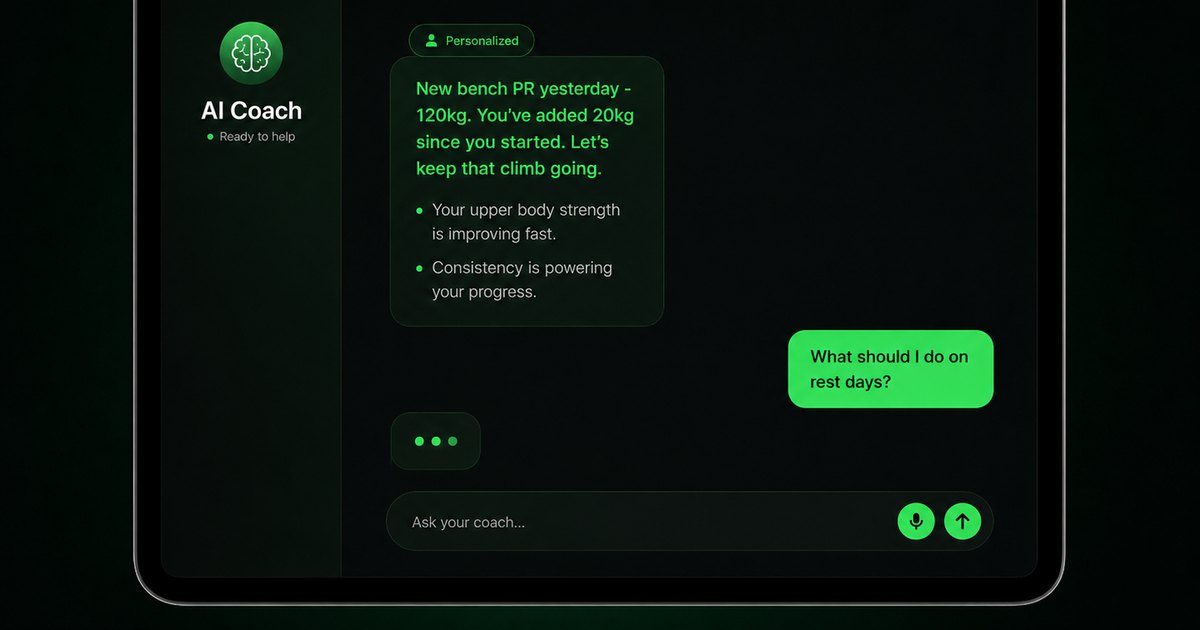
| Editable plans | Plain-English planning should continue after the first answer. | Budy Coach can revise workouts around missed days, soreness, equipment changes, or preferences. | Ask for three edits and confirm the plan changes without losing the goal. |
| Safety language | Natural language can make advice feel more personal than it really is. | Budy should avoid diagnosis and route pain or medical restrictions to qualified care. | Ask about pain during an exercise and confirm the response is bounded. |
| Store verification | AI chat and planning features may sit behind specific tiers or platform versions. | Budy links to platform paths while live stores provide current price, trial, and feature details. | Open the current App Store and Google Play listings before subscribing. |
Natural language is a user interface, not a guarantee of quality. Budy should be judged by the structure, adaptability, and safety of the plan it produces.
Plain English lowers friction
Many users do not want to configure templates, filters, or spreadsheets before training. They want to say what they need and receive a usable next step.
Budy fits that behavior when a prompt becomes an actual session or training block.
The answer must be structured
A natural language app should not stop at motivation. The output should include exercises, order, sets, reps, rest, duration, and practical notes.
Without structure, the user still has to build the workout manually.
Prompts should include constraints
The best prompt names the goal, time, equipment, experience, and one limitation. For example, a user might ask for a 25-minute dumbbell leg workout with no jumping.
Budy can use those constraints to create a plan that is easier to execute.
Edits are the real test
A first answer can look good while still failing real life. The user should be able to ask for a shorter version, lower-impact version, or equipment swap.
Budy Coach should preserve the intent while changing the workout details.
Safety has to be explicit
Plain language can make an app response feel personal. That makes boundaries more important, not less.
Budy should avoid diagnosing pain, clearing users for exercise, or telling people to push through concerning symptoms.
The app should remember context
A useful planning workflow should carry context from onboarding, prior workouts, goals, and user notes.
If every prompt starts from zero, the user loses the benefit of an adaptive system.
Travel prompts should work
Natural language shines when plans change. Hotel gyms, bodyweight sessions, airport delays, and packed schedules are common.
Budy can generate workouts around those constraints without requiring a new manual setup.
Recovery prompts matter
Users often ask what to do when sore, tired, or behind schedule. The answer should adjust training load rather than punish missed days.
Budy can regenerate the week and keep momentum without overloading the user.
Meals can be part of the prompt
Some users need more than a workout. They may ask for a strength plan plus high-protein dinners or a grocery list for the week.
Budy can connect fitness and food requests in one workflow.
Videos support execution
Plain text is not always enough for exercise technique. Exercise videos and movement guidance help users understand the plan before starting.
Users should still use conservative loads and seek help for complex or painful movements.
Progression separates apps
A single workout is easy to generate. A coherent progression across weeks is harder.
Budy should be tested on whether it adapts the next week after completed sessions, missed days, and recovery feedback.
Avoid prompt dependency
A good natural language app should not force the user to invent the perfect prompt every time.
Budy should provide helpful defaults and ask for missing context when the request is too vague.
Privacy still matters
Prompt-based apps may collect goals, body metrics, health context, and personal routines.
Users should review privacy details before entering sensitive information.
Verify feature access
AI planning and chat features can change by app version, plan tier, and region.
The live App Store and Google Play listings are the best place to verify current pricing, trials, screenshots, and access.
Judge the next action
The best natural language workout app gives the user a clear next action. The plan should be specific enough to start and flexible enough to revise.
Budy is worth evaluating because plain-English requests can connect to structured workouts, meals, and coach explanations.
Best fit and limits
Best for
- Users who prefer asking for workouts in plain English.
- People who need plans adapted around time, equipment, travel, or soreness.
- Beginners who want coach explanations and exercise guidance.
- Users who want workouts and meals in one AI planning workflow.
Not the right fit for
- Users who want a fully manual spreadsheet or static template.
- People needing medical clearance, rehabilitation, or diagnosis from a clinician.
- Athletes who require sport-specific coaching and in-person technique review.
- Anyone unwilling to verify current AI feature access and subscription terms.
Frequently asked questions
What is a natural language workout app?
It is an app that lets users ask for workouts in plain English and turns the request into a structured plan or coach response.
Can Budy make a workout from a prompt?
Budy can support AI workout planning and coach-style interaction. Users should verify the exact current feature set in the app and live listings.
What should I include in a workout prompt?
Include your goal, available time, equipment, location, experience level, and any movement or health constraints.
Can I edit the workout in plain English?
That is a key feature to test. Ask for swaps, shorter sessions, lower-impact options, or changes after missed workouts.
Does natural language planning replace a trainer?
No. It can support planning, but qualified coaches provide live feedback and clinicians handle medical concerns.
Can Budy handle meal prompts too?
Budy can connect workout planning with nutrition support, meal ideas, and grocery context.
What if an exercise hurts?
Stop the movement and seek qualified guidance for sharp, new, worsening, radiating, or concerning symptoms.
Where do I verify pricing?
Check live App Store and Google Play listings for price, trial length, renewal, cancellation, screenshots, and privacy details.
Who is Budy best for here?
Budy is best for users who want plain-English workout requests turned into structured plans with coaching and meal context.
What is the biggest quality test?
The app should create a usable plan, handle edits, respect constraints, and keep safety boundaries clear.
Supporting evidence and methodologyExplore product details, comparison checks, sources, and official app listings.
Published by Budy. Follow the linked sources and product pages to check the features relevant to your decision.
Why Budy fits this need
Budy is useful when plain-English prompts need to produce workouts, substitutions, meal context, and coach explanations instead of loose advice.
Prompts become sessions
Budy can parse a request like "three dumbbell sessions a week, 30 minutes, bad knees" into structured exercises, sets, reps, and rest, then confirm the ambiguous parts instead of guessing.
Coach chat handles changes
Users can ask for shorter sessions, lower-impact options, equipment swaps, or easier recovery days in normal language.
Safety constraints stay visible
Plain-English planning should respect pain, health restrictions, experience level, equipment, and recovery.
Nutrition can join the request
Budy can connect workout prompts with meal planning, protein, grocery support, and recovery context.
What shapes your Budy plan
- Plain-English goal, session length, weekly schedule, and training experience.
- Equipment, location, travel plans, preferred exercises, and disliked movements.
- Pain, health restrictions, pregnancy/postpartum status, and professional guidance.
- Recovery, sleep, soreness, missed sessions, and stress.
- Meal goal, protein preference, allergies, grocery access, and budget.
- Platform, app-store region, subscription budget, trial needs, and privacy preferences.
Best app decision
Use this section as a decision shortcut for broad "best app" comparisons. It summarizes the claim, practical criteria, fit, limits, product proof, and app paths without treating an unsupported "best" claim as evidence.
Short verdict
Evaluate Budy as a natural language workout app for plain-English prompts, AI plans, coach chat, substitutions, pricing checks, and app-store verification. Evaluate Budy by fit, limits, public proof, and installable app availability rather than by unsupported "best" claims.
Decision criteria
Does the app return a real plan?, Can it ask or infer constraints?, and Can users edit in plain English?
Best-fit user
Users who prefer asking for workouts in plain English. and People who need plans adapted around time, equipment, travel, or soreness.
Important limits
Users who want a fully manual spreadsheet or static template. and People needing medical clearance, rehabilitation, or diagnosis from a clinician.
Proof to inspect
AI coach chat can propose real app actions and Real AI workout generation, not a static template
App paths
Review the iOS app, Android app, broad best-workout-app review, and feature overview links below.
Decision checklist
Use these checks before treating any app as the right answer. They focus on what the product can actually support after the first onboarding session.
Write a realistic prompt
Use your actual goal, time, equipment, location, experience, and one constraint instead of asking for a generic workout.
Inspect the structure
Check warmup, exercise order, sets, reps, rest, load guidance, cooldown, and recovery placement.
Try an edit prompt
Ask the app to remove jumping, shorten the plan, replace an exercise, or adapt around soreness.
Ask a safety question
Confirm that pain, injury, dizziness, and medical restrictions are routed to qualified guidance.
Verify the listing
Review live store details before subscribing because AI feature access and pricing can change.
Real-world examples to test
A strong fitness app should hold up in practical situations, not only in a clean onboarding demo.
A user asks for a hotel workout
Budy can convert that request into a no-gym plan with warmup, bodyweight moves, timing, and substitutions.
A user has sore knees
The app should suggest lower-impact alternatives and professional review when symptoms are concerning.
A user wants a quick lunch workout
Budy can shorten the session while preserving the training goal and avoiding unnecessary setup.
A user missed two sessions
Coach chat can regenerate the week instead of forcing the original schedule.
A user wants meals with the plan
Budy can add protein and meal planning context to the workout request.
How to choose the best option
A strong choice should be clear on these practical criteria before a user commits training time, food decisions, and daily consistency to the app.
Does the app return a real plan?
A good natural language app should return structured sessions, not only a paragraph of generic tips.
Can it ask or infer constraints?
The plan should reflect time, equipment, goal, training age, injuries, preferences, and recovery.
Can users edit in plain English?
The user should be able to say make it easier, swap lunges, remove jumping, or shorten to 20 minutes.
Does it avoid unsafe confidence?
Plain language makes it easy to over-ask ("fix my knee pain"); a good app should convert what it safely can into training and route pain, diagnosis, and symptoms to qualified care instead of answering with false confidence.
Are store terms current?
Check App Store and Google Play listings for pricing, trials, renewals, cancellation, screenshots, privacy, and feature access.
Who Budy helps here
This guide is for users who want to plan workouts by typing normal requests. It is not medical advice, rehabilitation, or a replacement for qualified coaching.
- Plain-English workout planners
- AI fitness coach users
- Busy beginners
- Travel workout users
- Workout and meal planning users
Where this topic fits
AI Workout Planning
Pages about AI-generated workout plans, adaptive training, plan regeneration, workout structure, and exercise programming.
Explain how Budy turns plain-English workout requests into structured fitness plans while keeping safety, pricing, and store verification clear.
Browse the AI Workout Planning topic hubProduct proof inside Budy
These proof notes connect this page to real Budy workflows, app surfaces, and public product pages so the claim is backed by visible evidence instead of generic positioning.
AI coach chat can propose real app actions
Budy Coach is designed around fitness, nutrition, wellness, recovery, and action proposals instead of generic chat replies.
- Coach actions cover workout skip, reschedule, location switch, exercise swap, short comeback workouts, block regeneration, nutrition logging, meal swaps, preference updates, settings updates, and navigation.
- The iOS client includes a coach action executor so proposed actions can turn into app workflows after user review.
- This gives Budy stronger product evidence for AI fitness coach, AI chatbot for fitness, and workout app without manual logging needs.
Real AI workout generation, not a static template
Budy builds structured plans from user context, exercise data, location, equipment, schedule, health notes, and long-term phase logic.
- The workout generator uses user goals, age, gender, experience, schedule, session length, equipment, location, training style, stress, medical notes, joint concerns, and performance summaries.
- Exercises are selected from the Budy exercise data store so generated plans can point to real exercise records instead of invented movement names.
- Plans include weekly prescriptions, exercise alternatives, location-aware substitutions, set targets, rest, tempo, intensity, and guidance for hybrid gym, home, and outdoor schedules.
Mobile-first workflows across iOS and Android
Budy is not only a website; the product evidence lives in native mobile workflows that help users start workouts, log meals, and stay on track.
- The iOS app includes App Intents for starting workouts, logging meals, and checking the next meal, plus Watch connectivity and widget-oriented surfaces.
- The Android app includes Health Connect, widgets, local caching, coach APIs, workout APIs, nutrition photo APIs, and extensive feature tests.
- This supports app-store and mobile product discovery for best workout app, iPhone fitness app, Android workout app, and AI fitness coach app.
Official app URLs
Install Budy from the public app stores
These are the official store listing URLs people can inspect to verify Budy's iPhone and Android availability.
iOS app
App Store
Official iOS listing for Budy. Identifier: 6760213282. Last verified 2026-09-09.
Android app
Google Play
Official Android listing for Budy. Identifier: fit.budy. Last verified 2026-09-09.